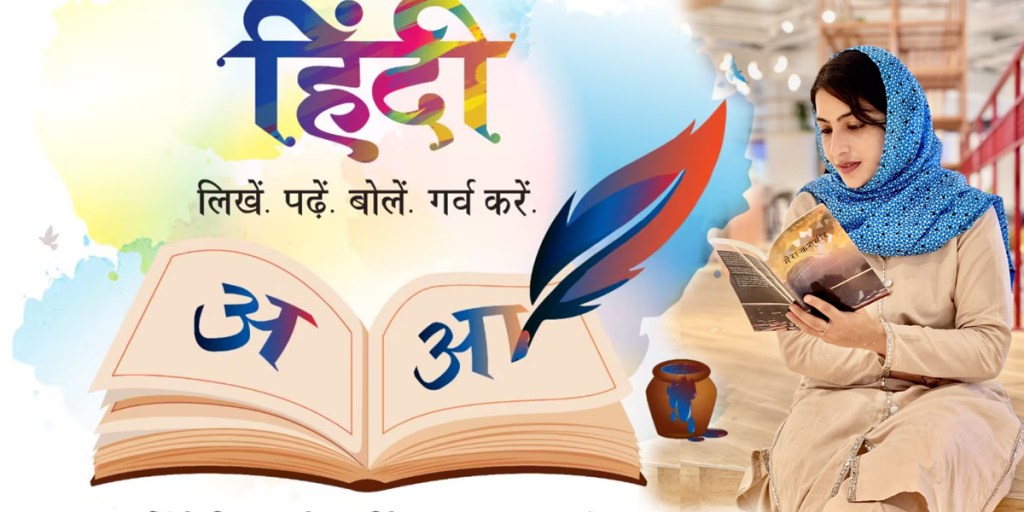
Every year, India celebrates Hindi Diwas on 14th September, marking the day in 1949 when Hindi was adopted as one of the official languages of the country. Across India, schools, colleges and institutions use this day to honor the language, its literature and its role in uniting a diverse nation. While Hindi is spoken more prominently in the Hindi heartland, its influence extends far beyond, reaching regions like Kashmir, where it plays a significant role in education, communication and national integration.
Kashmir, with its breathtaking valleys, rich culture and linguistic diversity, might not be the first place that comes to mind when thinking of Hindi. Yet, Hindi Diwas is celebrated here with enthusiasm, especially in schools and colleges. Students recite poems, participate in debates, essay competitions and quizzes—all designed to highlight the importance of the language. For Kashmiri students, learning Hindi is not merely an academic requirement; it is a bridge connecting them with the larger national community. Through Hindi, they can communicate, express themselves and engage with literature, media and culture that span the entire country.
One of the key reasons Hindi matters in Kashmir is its role in education and career opportunities. Schools follow syllabi that include Hindi as a subject from primary classes to college-level courses. Students who excel in Hindi often find themselves better prepared for government exams, competitive tests and careers in teaching, journalism, translation and administration. In a rapidly developing India, knowledge of Hindi opens doors that are otherwise hard to access, giving the youth of Kashmir a competitive edge while keeping them closely connected to national discourse.
Beyond academics and career prospects, Hindi Diwas in Kashmir serves as a symbol of unity and cultural integration. The Valley has always been a melting pot of languages and traditions. While Kashmiri, Urdu and English are widely spoken, Hindi offers an additional link to the broader Indian identity. Celebrating Hindi Diwas in schools and community spaces reinforces the idea that Kashmir is an integral part of India, contributing to the nation’s linguistic and cultural mosaic. It also promotes respect for linguistic diversity, reminding young minds that learning another language does not diminish their mother tongue but enriches their understanding of culture and communication.
Cultural engagement is another significant aspect. Through poetry recitations, storytelling and literature, students in Kashmir get exposure to Hindi writers, poets and thinkers. This fosters a deeper appreciation of India’s literary heritage and encourages creative expression. Many schools organize events where students write and perform short plays, recite patriotic poems, or narrate stories in Hindi. Such activities instill confidence, enhance public speaking skills and allow students to engage with ideas and narratives from different parts of the country, creating a sense of belonging and shared identity.
Government initiatives also reinforce the importance of Hindi in Kashmir. Hindi teaching programs, workshops, and competitions are regularly conducted in schools and colleges. Local media occasionally cover these events, celebrating student achievements and spreading awareness about the significance of the language. These programs are not limited to urban centers; they increasingly reach smaller towns and villages, ensuring that the benefits of language education are widely distributed. The result is a generation of youth who are not only bilingual or multilingual but also culturally and nationally aware.
In addition to its practical and cultural significance, Hindi Diwas in Kashmir promotes linguistic harmony. In a region known for its linguistic diversity, learning and celebrating Hindi alongside Urdu and Kashmiri encourages mutual respect among speakers of different languages. It shows that India’s linguistic plurality is a strength, not a source of division. Students learn that embracing Hindi does not mean abandoning their mother tongue; rather, it means adding a valuable tool to their repertoire, one that helps them engage more fully with the nation and the world.
On this day, schools, colleges, and community organizations across Kashmir engage students in a variety of activities to highlight the importance of Hindi. Students are encouraged to participate in essay writing, poster making, poetry recitation, and debates, all of which reinforce language skills while promoting teamwork, creativity, and civic consciousness. Teachers often emphasize that language is a bridge, not a barrier, connecting individuals and communities, and that Hindi Diwas is an opportunity to celebrate this bridge.
In conclusion, Hindi Diwas in Kashmir is far more than an academic celebration. It is a day to recognize the value of language in education, career development, cultural integration, and national unity. For the youth of Kashmir, Hindi offers not just a skill but a way to connect with India’s rich literary and cultural heritage. Celebrating Hindi Diwas in the Valley instills pride, encourages learning, and reinforces the idea that Kashmir is an integral part of the nation, contributing to its diversity while embracing its unity. On this day, students and communities alike honor the language, their heritage, and the opportunities that knowledge brings, ensuring that the spirit of Hindi continues to shine brightly in every corner of Kashmir.

 Kashmir RootStock