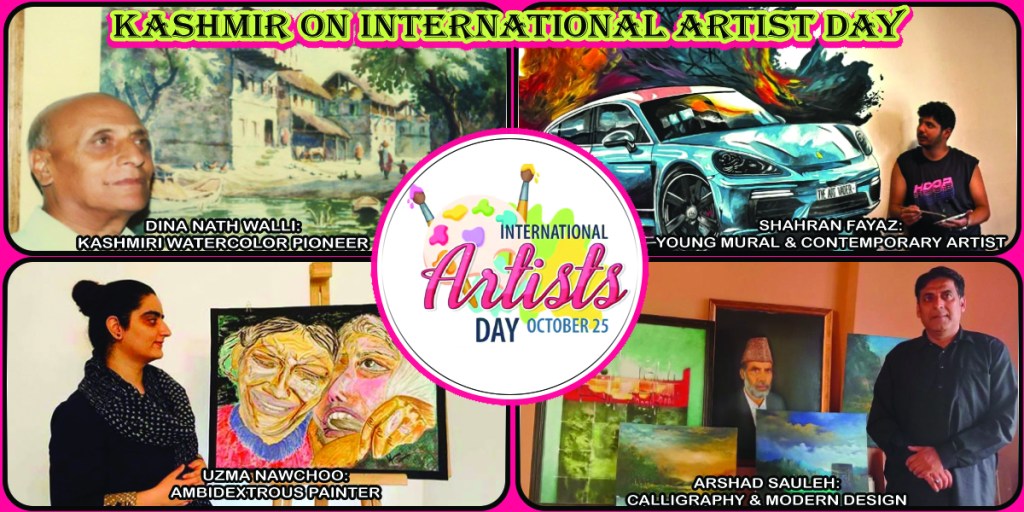
Every year on October 25, the world observes International Artist Day — a celebration of creativity, imagination and the enduring power of human expression. On this day, we honour artists who transform blank spaces into meaning — who make us see, feel and think differently. In the context of Kashmir, this celebration gains a deeper resonance. Here, art is not just a profession — it is a language of survival, a mirror of culture and a bridge between past and present.
Kashmir, often called Paradise on Earth, has long been a living canvas of creativity. From intricate papier-mâché and hand-woven pashmina shawls to mesmerizing calligraphy and soulful music, the Valley’s artistic heritage runs centuries deep. Every brushstroke, every carved walnut, every tune of the santoor carries the fragrance of tradition and the resilience of a people who have turned art into identity.
Among the pioneers of Kashmiri painting was Dina Nath Walli (Almast Kashmiri), who beautifully captured the everyday life of the Valley in watercolors — the shikaras gliding on Dal Lake, the shepherds in the mountains, the saffron fields glowing under the sun. His art celebrated the essence of Kashmir’s simplicity. Another notable name, Masood Hussain, uses bold strokes and deep symbolism to portray the pain and hope of his homeland — his canvas becomes a dialogue between emotion and endurance. Arshad Sauleh, a master of calligraphy and design, fuses spiritual depth with modern aesthetics, giving a new life to an ancient art form deeply rooted in Kashmiri culture.
The valley’s music, too, reflects its artistic soul. Ghulam Muhammad Zaz, one of the last remaining craftsmen of the santoor, represents the heartbeat of Kashmir’s traditional music. His delicate artistry in instrument-making has preserved a sound that has echoed through generations. Likewise, Noor Mohammad Shah, a folk and Sufi singer, continues to mesmerize audiences with songs that speak of love, unity and peace — proving that art can heal where words fall short.
But beyond these veterans, a new generation of Kashmiri artists is redefining creativity. One such emerging name is Shahran Fayaz, a young artist from Srinagar whose paintings, calligraphy and wall art blend modern expression with cultural identity. Featured in local media and art platforms, Shahran represents a new wave of youth who are using art not only as an aesthetic pursuit but also as a medium of storytelling and social reflection. His ability to merge traditional Kashmiri motifs with contemporary styles has earned him admiration across the Valley. His journey — from sketching on small walls to creating large-scale murals — embodies the determination of Kashmir’s new creative force.
Another inspiring example is Uzma Nawchoo, an ambidextrous painter who paints with both hands simultaneously — symbolizing balance, patience and duality. Artists like her are pushing the boundaries of perception and proving that creativity in Kashmir is alive, evolving and deeply personal.
What makes art in Kashmir unique is its emotional honesty. In a place often burdened by political and social conflict, artists respond not with bitterness but with creation. Their works — be it a delicate pashmina pattern, a poetic brushstroke or a haunting melody — carry a message of peace, persistence and pride. As the world celebrates International Artist Day, the story of Kashmir’s artists reminds us that art is resistance, remembrance and rebirth. Their craft stands as a silent protest against despair and as a radiant testimony to the power of hope. From the legendary masters to the emerging painters like Shahran Fayaz, each artist contributes to a living museum — where beauty and struggle coexist.
Today, more than ever, the world must listen to the voices coming from Kashmir’s studios and workshops. Supporting these artists — through exhibitions, digital platforms and collaborations — is not just an act of appreciation but of preservation. Because when the paintbrushes move, when the hands weave, when the santoor plays — Kashmir speaks. And that voice deserves to be heard.

 Kashmir RootStock