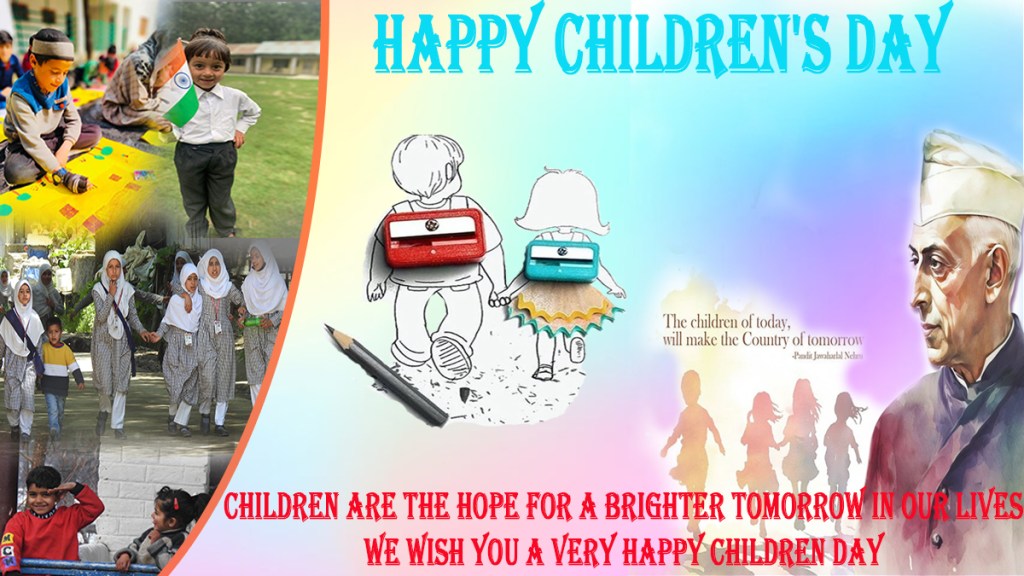
Every year, National Children’s Day is celebrated with great enthusiasm and love across India on November 14. The day marks the birth anniversary of Pandit Jawaharlal Nehru, the first Prime Minister of India, who was fondly known as Chacha Nehru by children. His deep affection for children and his belief that they are the true foundation of the nation make this day a fitting tribute to his legacy. National Children’s Day is not just a celebration of childhood; it is also a reminder of the importance of nurturing, protecting and empowering children for a better future.
Pandit Nehru believed that “children are like buds in a garden and should be carefully and lovingly nurtured, as they are the future of the nation and the citizens of tomorrow.” This philosophy lies at the heart of Children’s Day celebrations. The day emphasizes that children are the most valuable resource of a country and their proper growth and development should be the top priority of society.
Before 1964, Children’s Day in India was celebrated on November 20, the date observed as Universal Children’s Day by the United Nations. However, after Nehru’s death in 1964, his birthday was chosen as National Children’s Day to honor his love and dedication towards children. Since then, the day has been celebrated every year with joy, activities and programs centered around children.
National Children’s Day is celebrated in schools, institutions and communities throughout India. Schools organize cultural programs, debates, essay writing competitions and sports events to make the day enjoyable and meaningful. Teachers often perform skits or songs for their students, reversing roles for a day to show their affection and appreciation. Many schools also hold special assemblies to discuss Nehru’s life, his contributions to India and his vision for children’s education.
Government and non-governmental organizations also play a vital role in celebrating this day. They conduct awareness programs highlighting issues like child rights, education, health and safety. Special initiatives are taken to reach underprivileged children, bringing smiles to their faces through gifts, food distribution and entertainment programs.
In many cities, community groups organize picnics, art exhibitions and storytelling sessions to engage children creatively. Media channels often broadcast programs focusing on the welfare and empowerment of children, reminding society of its duty toward them. In the picturesque region of Jammu and Kashmir, Children’s Day holds a special charm. Despite the region’s challenging terrain and sometimes difficult circumstances, schools and communities in Kashmir celebrate the day with remarkable enthusiasm and warmth. Educational institutions across Srinagar, Anantnag, Baramulla, and other districts organize cultural programs, drawing competitions, sports meet and talent shows to bring out the creativity of children.
Children dress up as freedom fighters, national leaders or folk characters, reflecting both national pride and local culture. Teachers deliver inspiring speeches highlighting Nehru’s vision for children’s education and the importance of peace and unity. Many schools in Kashmir also organize special storytelling sessions where elders share traditional Kashmiri tales and moral stories, preserving the region’s rich cultural heritage.
Non-governmental organizations and social organizations in the Valley use the day to reach out to underprivileged children, offering educational materials, warm clothes and nutritious meals. These gestures symbolize compassion and reinforce the belief that every child deserves love, care and opportunity, regardless of background or region. In some areas, community celebrations include music, poetry recitals and the lighting of candles in honor of children who symbolize hope and the promise of a brighter future for Kashmir.
Beyond the joy and festivities, Children’s Day carries a deeper message — to ensure that every child in the country has the right to education, health, safety and a happy childhood. It reminds us that millions of children in India still face challenges like poverty, child labor, malnutrition and lack of access to education. The day urges parents, teachers and policymakers to create an environment where children can grow freely and realize their potential.
The government has introduced several programs such as the Right to Education Act, Mid-Day Meal Scheme, Beti Bachao Beti Padhao and Integrated Child Development Services to promote the welfare of children. However, true progress requires collective effort from families, schools and society to protect the innocence and dreams of every child.
Children represent hope, dreams and the promise of a brighter tomorrow. The energy and creativity of young minds drive innovation, progress and change. By giving them love, care and quality education, we are shaping the future of our country. As Nehru rightly said, “The children of today will make the India of tomorrow. The way we bring them up will determine the future of the country.”
On this occasion, it is important to remember that celebrating Children’s Day is not just about fun and gifts. It is about recognizing the value of childhood and taking steps to secure it for all. Every child deserves to grow in an environment of love, respect and opportunity — free from fear and exploitation.
National Children’s Day is more than a celebration; it is a commitment — a promise to build a nation where every child can dream freely and achieve without barriers. It reminds us that our greatest responsibility lies in shaping young minds and nurturing them with compassion and guidance. As we celebrate this special day each year, let us renew our pledge to protect children’s rights and create a world where they can flourish with happiness, curiosity and hope.

 Kashmir RootStock