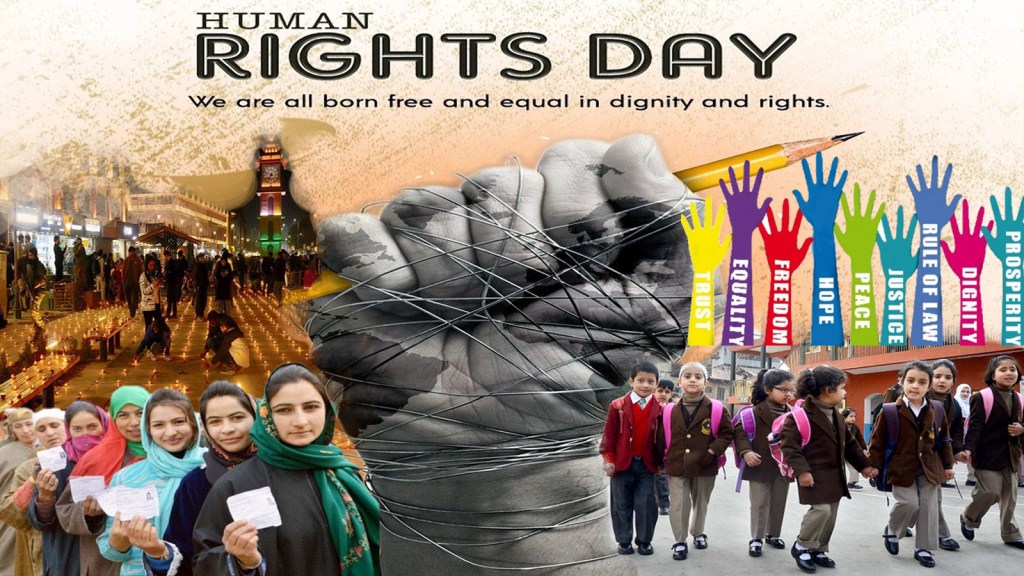
This morning, as I looked out from my window and watched the winter sun gently touch the rooftops of the valley, a strange calmness settled in the air. The Chinar leaves, crisp and brown, lay scattered like silent witnesses of time. And in that quietness, I found myself thinking about something we often speak of, sometimes fear, sometimes hope for, sometimes debate — but rarely pause to deeply understand: human rights.
Every year, on Human Rights Day, the world remembers the Universal Declaration of Human Rights — a document born from humanity’s darkest chapters, created so that dignity and freedom could never again be taken for granted. But here in Kashmir, these words carry a different weight. They are not just lofty ideals written on paper; they are lived experiences, sometimes painful, sometimes inspiring, sometimes complicated, always deeply personal.
Growing up in Kashmir teaches you many things — patience, resilience, silence and the art of carrying both hope and uncertainty in the same heart. We are a people who have seen long winters not just in weather but also in emotion. And yet, we are also a people who refuse to stop dreaming of spring. Human Rights Day, for Kashmiris, is not merely a day of global observance; it is a reminder of what it means to be human in a place that has endured so much and still chooses to move forward.
When I think about human rights in the Kashmiri context, the first image that comes to mind is the ordinary Kashmiri — the farmer tending to his frozen orchard at dawn, believing that even the hardest winter will eventually give way to bloom. The shopkeeper who opens his shutter hoping for a peaceful day. The mother who prays for the safe return of her children. The student who dreams of a better future despite the storms around them. Rights, after all, are not just about laws; they are about these everyday dreams, fears and hopes that shape our lives.
Human rights in Kashmir have always been part of a larger human story — a story of conflict, struggle, longing, survival and resilience. The valley has seen decades where life felt suspended, where morning started not with sunshine but with uncertainty. And yet, beneath all this, the Kashmiri spirit has remained astonishingly humane. Perhaps it is because the land itself teaches compassion. When you live between mountains that hold centuries of stories, you learn humility. When you grow up with the rhythm of rivers that never stop flowing, you learn endurance.
Human Rights Day is a moment for us to reflect on these deeper truths. It is a reminder that everyone — regardless of background, belief, language or identity — deserves dignity. Deserves justice. Deserves freedom. Deserves peace. Deserves to live without fear. These are not privileging; they are the most basic foundations of a meaningful life.
Sometimes, when I walk by the Jhelum and watch its steady flow, I think of the generations before us who lived through times much harder than ours. They too dreamed of a valley free from pain, full of opportunities. And today, even though challenges remain, we are slowly learning the art of dialogue, understanding, coexistence and rebuilding. Human rights become real only when we learn to see each other — truly see each other — beyond labels, beyond divisions, beyond wounds of the past.
Human Rights Day is not just a reminder of what we deserve; it is also a reminder of what we must give. A compassionate society is built not only through policies but through small, everyday gestures of kindness. Here in Kashmir, kindness is woven into our culture — offering noon chai to a neighbour, giving a ride to someone stranded, sharing Kangri warmth with a guest, welcoming strangers with a smile. These small acts are the stepping stones of a society that respects human dignity, even in difficult times.
However, the road ahead is long. The valley continues to face sensitive issues — social, political, economic — that affect the human experience in complex ways. For some, rights mean safety. For others, justice. For many, opportunities. For the younger generation, human rights also mean access to good education, mental well-being, freedom of expression and the ability to build a future without fear of disruption. For women, it means equality, protection and empowerment. For the vulnerable, it means support, recognition, and inclusion.
As Kashmir evolves, the conversation around human rights must grow deeper and more honest. It must move away from slogans and closer to reality. It must involve communities, youth, elders, educators and leaders. It must be centred on listening — truly listening — to the stories of pain, of hope, of healing.
On this Human Rights Day, I also think about those who continue to work tirelessly in the valley to protect human dignity — social workers traveling to remote villages in bitter cold, doctors offering care without judgment, teachers who keep hope alive in classrooms, families who rebuild their lives brick by brick after loss and individuals who choose peace even when anger is easier. These silent heroes often go unnoticed, but they are the ones who truly carry forward the spirit of Human Rights Day.
And then there is the youth of Kashmir — bright, courageous, sensitive. They are shaping a new narrative where rights are not abstract concepts but real aspirations. They want a Kashmir where people live without fear, where justice is timely, where differences do not divide, where opportunities flourish. Their voices are strong and full of possibility and this gives me hope.
Human Rights Day also reminds us of our responsibility to future generations. What kind of Kashmir will they inherit? A valley of fear or a valley of peace? A place of conflict or a place of compassion? The answer depends on how we choose to live today. It depends on how we treat each other, how we raise our children, how we respond to pain, how we stand up for fairness even when it is difficult.
As the evening settles over the valley and the skies turn a soft grey, Human Rights Day feels like a gentle whisper — reminding us that humanity is our most powerful identity. We may speak different languages, pray in different ways, hold different beliefs, but the longing for safety, justice and dignity is universal.
Kashmir, with all its wounds and wonders, continues to teach us that rights are not merely written; they are lived. And more importantly, they are shared.
On this Human Rights Day, may we strive to build a valley where every child can dream, every individual can breathe without fear, every family can live with dignity and every voice — whether loud or soft — can be heard.
Because at the end of the day, human rights are simply the rights that make us human.
From the heart of Kashmir — with hope, empathy and a prayer for a better tomorrow.

 Kashmir RootStock