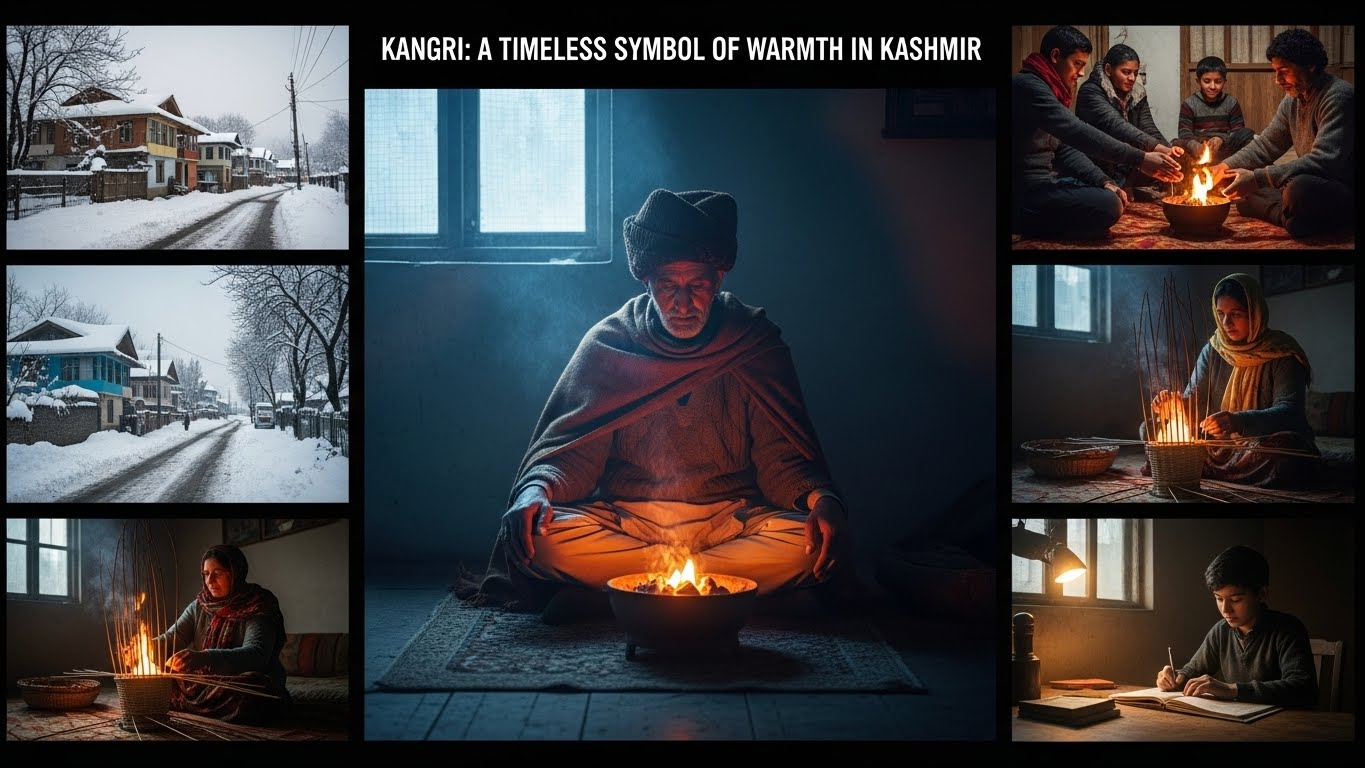
In Kashmir, winter is not just a change in weather. It is a lived reality that shapes routines, conversations and survival itself. When Shard-e-Kalaan tightens its grip and temperatures plunge below freezing, life slows down. Roads fall silent, electricity becomes unreliable and homes retreat inward. In these long cold months, Kashmiris do not merely depend on modern heating solutions. They return to something older, more personal and deeply familiar — the Kangri.
To the untrained eye, a Kangri is simply an earthen pot filled with glowing embers, wrapped inside a handwoven willow basket. But for a Kashmiri, it is far more than a heat source. It is warmth carried close to the body, tucked beneath the pheran, moving with you from room to room. It is comfort during power cuts, a companion during long evenings and a reminder that survival in Kashmir has always relied on indigenous wisdom.
Historically, the Kangri predates electricity, gas heaters and modern insulation. It warmed farmers tending frozen fields in villages, artisans working for hours on wooden floors, women managing households in kuthaar houses and children studying under dim oil lamps. Even today, despite technological advancements, the Kangri has not vanished. Its continued presence speaks to its practicality and emotional significance.
There is something uniquely Kashmiri about the relationship between a person and their Kangri. It is not stationary like a heater; it travels with you. One moment it rests under the pheran while you sip noon chai, the next it follows you into another room. On bitter mornings, many Kashmiris instinctively check whether the embers are still alive before stepping outside. A Kangri going cold feels personal.
Winter evenings across the Valley often revolve around this small glowing companion. Families gather in a single room, hands stretched toward warmth, conversations flowing easily. Elders narrate stories of winters when snowfall blocked roads for months and bijli was a luxury. Children listen quietly, learning that survival once depended on patience and shared warmth. In these moments, the Kangri becomes a center point — not just physically, but emotionally.
The making of a Kangri is itself a reflection of Kashmiri craftsmanship. Potters carefully mold the clay bowl, ensuring it retains heat while remaining durable. Willow workers weave the outer basket with precision, balancing aesthetics with safety. These crafts are often passed down within families, making each Kangri a product of generational knowledge. In an age of factory-made appliances, this handmade process stands as quiet resistance to disposability.
Culturally, the Kangri occupies a special place in Kashmiri life. It appears in local idioms, poetry and collective memory. It has witnessed political turmoil, economic hardship and social change. Through decades of uncertainty, the Kangri has remained constant — a silent witness burning steadily while the world outside changed.
Journalistically, it is important to acknowledge that the Kangri also comes with risks. Cases of Kangri burns and carbon monoxide poisoning are not uncommon during harsh winters. Public health advisories repeatedly urge caution, especially in closed rooms. Yet, rather than abandoning the Kangri, Kashmiris have adapted by learning safer usage practices. This balance between tradition and awareness reflects a society negotiating modern challenges without discarding its roots.
For Kashmiris living outside the Valley, the Kangri carries even deeper meaning. It becomes a symbol of home. No electric heater abroad recreates the feeling of sitting cross-legged with a Kangri under a pheran while snow falls silently outside. In memories and nostalgia, the Kangri often represents warmth that is emotional as much as physical.
Modern Kashmir has not replaced the Kangri; it has reshaped it. Today, Kangris come in varied designs, with better insulation and artistic patterns. Some are sold as cultural artifacts, especially to visitors. But for locals, it remains a necessity, not décor. When prolonged power cuts occur, the Kangri once again proves its relevance.
At a time when sustainability and energy efficiency dominate global discussions, the Kangri offers an old lesson. Long before climate debates, Kashmiris relied on localized, low-energy solutions tailored to their environment. The Kangri requires attention, care and respect. In return, it offers quiet dependable warmth without noise or dependence on infrastructure.
The Kangri also dissolves social boundaries. In winter, warmth becomes a shared need. The Kangri does not distinguish between rural and urban homes, between wealth and poverty. It warms poets and laborers alike, reminding everyone that Kashmir’s winters treat all equally.
As winters continue to grow unpredictable and energy costs rise, the relevance of traditional knowledge becomes clearer. The Kangri stands as proof that survival does not always require innovation — sometimes it requires remembering.
Ultimately, the Kangri is not just about enduring cold temperatures. It is about continuity. It connects present-day Kashmiris to ancestors who survived harsher winters with fewer resources but stronger community bonds. In the gentle glow of a Kangri, conversations slow down, silence feels warmer and identity feels intact.
As long as winter returns to Kashmir, the Kangri will remain — glowing softly under the pheran, loyal, familiar and deeply Kashmiri.

 Kashmir RootStock