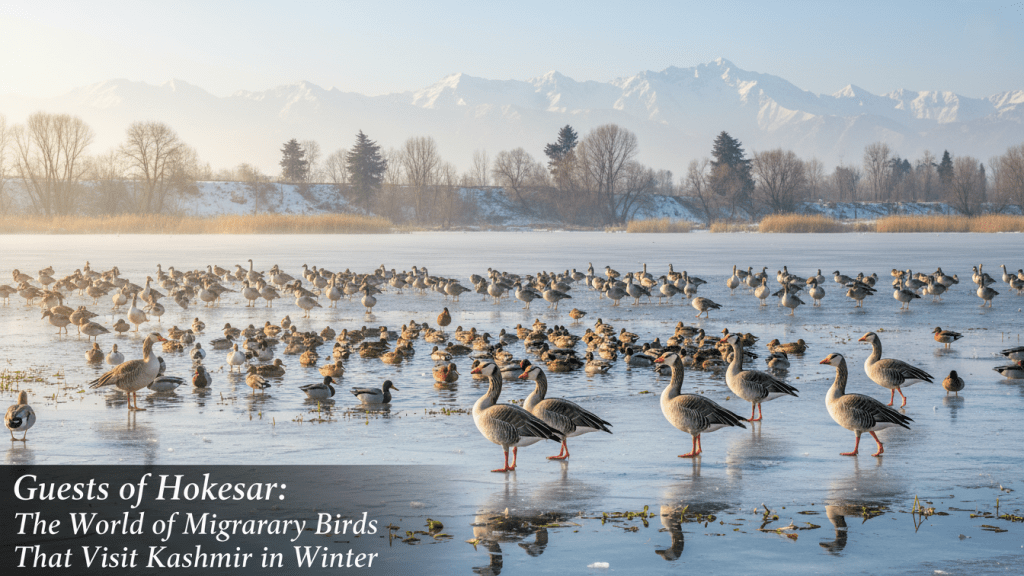
Every winter, when Kashmir’s fields turn pale and the air sharpens with frost, a quiet transformation unfolds on the outskirts of Srinagar. At Hokersar Wetland, the sky begins to fill with wings. Long before roads freeze or tourist seasons slow, birds arrive from distant lands—Central Asia, Siberia, Eastern Europe—guided by instinct older than maps or nations.
For Kashmiris, Hokersar is not just a wetland. It is a living calendar, marking the arrival of winter not by dates but by sound—the call of geese, the rustle of ducks on water, the sudden movement across grey skies. For tourists, it is a rare window into a natural spectacle where global migration meets local landscape.
Spread across nearly 14 square kilometers, Hokersar is part of the larger Jhelum basin wetland system. Its shallow waters, reed beds and marshy islands create ideal wintering grounds. When northern regions freeze, Hokersar remains relatively accessible, offering food, shelter and safety.
This ecological positioning explains why over a million migratory birds are recorded here during peak winters. Species such as Greylag Geese, Mallards, Common Teals, Northern Pintails and even the occasional flamingo arrive in waves. Each species follows a precise migratory clock, timed to changes in temperature and daylight thousands of kilometers away.
For Kashmiri youth, Hokersar is an open-air classroom—often underappreciated. It demonstrates how interconnected the world truly is. A bird feeding in Hokersar today may have nested near the Arctic Circle months earlier. Pollution, climate change or habitat loss in one region directly affects life here.
This realization is powerful. It reframes Kashmir not as an isolated valley but as a crucial node in a global ecological network. For students, photographers and young researchers, Hokersar offers lessons that textbooks cannot: patience, observation and respect for balance.
Hokersar also holds cultural memory. Older generations recall winters defined by shared stories of arriving birds, of quiet mornings near wetlands, of understanding seasons through nature rather than screens. Traditionally, wetlands shaped livelihoods—fishing, reed collection and seasonal grazing—all coexisting with migratory cycles.
While modern life has distanced many from these rhythms, the birds continue to arrive, indifferent to human pace. Their consistency serves as a reminder: nature remembers even when societies forget. For tourists, Hokersar offers something increasingly rare: authenticity. There are no loud attractions here, no artificial experiences. The beauty lies in stillness—watching a flock lift off at dawn or observing mirrored reflections of wings on water.
Eco-tourism, if handled responsibly, can benefit local communities while raising awareness. Guided bird walks, photography tours and educational visits can create livelihoods without disturbing fragile habitats. However, unmanaged footfall, littering and noise can quickly turn refuge into risk. This balance—between access and protection—is critical. Hokersar’s value lies not in exploitation but in preservation.
Despite its protected status, Hokersar faces growing threats. Urban expansion, encroachment, waste dumping and shrinking water inflow have reduced its capacity. Climate change further complicates migration patterns, altering arrival times and species diversity.
For Kashmiris, especially the youth, this raises an urgent question: will future winters still bring these guests? Conservation is no longer just the responsibility of authorities. It demands public awareness, local stewardship and informed advocacy.
In an age of political noise and environmental neglect, Hokersar represents something quietly radical: continuity. While human narratives shift rapidly, the birds return each year, trusting the land to hold space for them.
For Kashmiris, this trust should matter. It challenges us to protect what remains untouched, to see development not as domination but coexistence. For visitors, Hokersar offers a chance to engage with Kashmir beyond conflict headlines—through ecology, silence and shared responsibility.
The migratory birds of Hokersar are not just seasonal visitors; they are reminders. Reminders that Kashmir is part of a living planet, that borders mean little to nature and that stewardship is a collective duty.
As winter deepens and the sky fills once more with wings, Hokersar asks only one thing in return: space to breathe, water to flow and humans willing to watch without disturbing.
If we listen carefully, the birds are not just passing through. They are telling us something about balance, patience and the kind of future we choose to protect.

 Kashmir RootStock