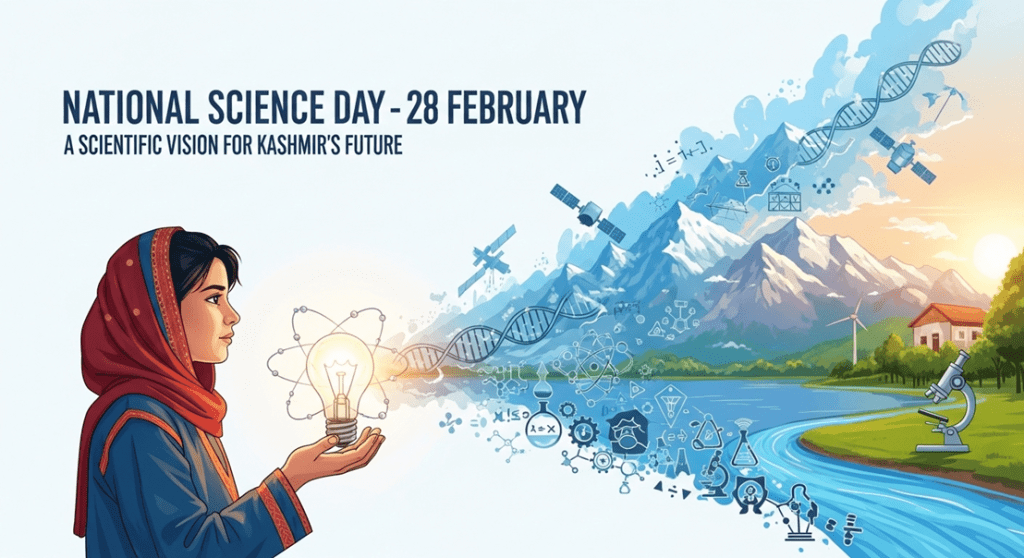
National Science Day, observed every year on 28 February, commemorates the discovery of the Raman Effect by Sir C. V. Raman in 1928. While the day honours one of India’s greatest scientific achievements, its true significance lies in promoting scientific temper, curiosity and rational thinking among the masses. For the people of Kashmir, National Science Day holds a deeper relevance, as science offers not only knowledge but also a pathway towards stability, progress and sustainable development.
Kashmir has historically been a land of learning and intellectual pursuit. Ancient centres of scholarship such as Sharada Peeth reflect a rich tradition of inquiry in philosophy, mathematics, astronomy and linguistics. This legacy reminds us that science and rational thought are not foreign concepts imposed from outside but are deeply rooted in Kashmiri culture. Celebrating National Science Day provides an opportunity to reconnect modern scientific understanding with this heritage and reaffirm that science complements cultural values rather than undermining them.
The discovery of the Raman Effect itself carries lessons that extend far beyond physics. Sir C. V. Raman’s achievement was the result of careful observation, disciplined experimentation and an unwavering curiosity about the natural world. His journey demonstrates that ground breaking scientific contributions do not depend solely on advanced infrastructure but on the human capacity to question, observe and persist. For students in Kashmir, Raman’s life serves as an inspiring reminder that intellectual excellence can emerge from any region when curiosity is nurtured and effort is sustained.
For the youth of Kashmir, science represents hope and direction in an increasingly complex world. Scientific education equips young minds with problem-solving abilities, analytical thinking and practical skills that open doors to diverse career opportunities in engineering, medicine, information technology, artificial intelligence, renewable energy, space research and defence sciences. More importantly, science offers a constructive outlet for creativity and ambition, encouraging young people to focus on solutions rather than limitations. Teachers, in this context, play a crucial role not merely as transmitters of information but as mentors who inspire inquiry, experimentation and independent thinking.
The relevance of science in Kashmir becomes even more evident when viewed through the lens of local challenges. The region’s vulnerability to earthquakes and landslides underscores the importance of geological and disaster-management research. Issues related to cold climate, energy shortages and housing demand innovations in renewable energy and thermal efficiency. Similarly, the management of water resources, floods and agricultural productivity requires scientific expertise in hydrology, climate science, soil research and horticulture. When science education is connected to such real-life concerns, it becomes meaningful and transformative, empowering communities to develop locally relevant solutions.
Climate change poses one of the most serious challenges to Kashmir’s fragile Himalayan ecosystem. Melting glaciers, erratic snowfall, changing river patterns and ecological imbalance directly affect livelihoods and food security. Addressing these issues demands both advanced scientific research and widespread public awareness. Environmental science, meteorology and sustainable practices must become integral to educational discourse and public understanding, as the protection of Kashmir’s natural resources is inseparable from the region’s future well-being.
Beyond its practical applications, science plays a vital role in shaping social attitudes. A scientific temper encourages rational thinking, critical evaluation of information and resistance to misinformation. In societies facing social and economic challenges, such an approach fosters dialogue, understanding and peaceful coexistence. By valuing evidence over assumptions and inquiry over prejudice, science contributes to social harmony and informed citizenship.
Educational institutions in Kashmir bear a significant responsibility in nurturing this scientific culture. Schools and colleges that promote experiments, innovation projects, science exhibitions and hands-on learning help students experience science as a living process rather than a static subject. Initiatives undertaken by government institutions, universities and organisations such as Army Goodwill Schools have demonstrated how structured mentorship and exposure can identify and nurture scientific talent at an early stage.
Equally important is the inclusion of women in scientific pursuits. Encouraging girls to engage in science education strengthens families, communities and society as a whole. When women participate actively in scientific fields, they contribute not only as professionals but also as role models who inspire future generations to pursue knowledge and innovation without limitations.
National Science Day also calls upon Kashmiri youth to transition from being mere consumers of technology to becoming creators and innovators. By fostering a culture of research, entrepreneurship and low-cost technological solutions, the region can harness its intellectual capital to address local needs. Talent is abundant in Kashmir; what is required is confidence, opportunity and sustained encouragement.
In conclusion, National Science Day is more than a symbolic celebration. It is a reminder that the future of Kashmir depends on informed choices guided by reason, research and responsibility. For students, it reinforces the value of learning how to think, not just what to learn. For teachers, it highlights their role as architects of enlightened minds. For the general public, it underscores the importance of embracing science as a tool for progress and stability. By nurturing scientific temper and innovation, Kashmir can chart a path towards a resilient, peaceful and prosperous future built on knowledge and understanding.
Hero of Kashmir, Heroes of Kashmir

 Kashmir RootStock