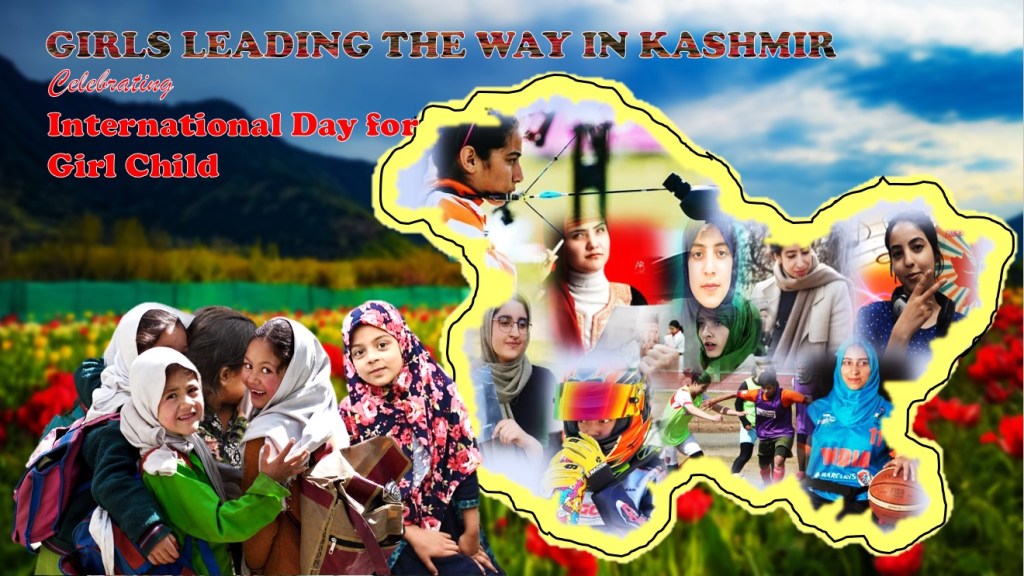
International Girl Child Day, celebrated annually on October 11, holds a special significance globally, focusing on the rights and opportunities of girls. For Kashmir, a region historically embroiled in conflict, this day offers a chance to spotlight the empowerment of Kashmiri women and the role of education, equality, and opportunity in shaping their future. With the backdrop of socio-political changes in Kashmir, particularly the abrogation of Articles 370 and 35A, the observance of this day in the valley has become even more critical as it opens up discussions about gender equality, education, and the participation of women in society.
The United Nations declared October 11 as International Girl Child Day to promote girls’ rights and address their worldwide challenges. The day focuses on the importance of education, health, and safety for girls and advocates for the elimination of barriers like discrimination, child marriages, gender-based violence, and limited access to resources. In Kashmir, where cultural and social norms have often hindered the growth and empowerment of girls, this day can be seen as a beacon of hope, offering a platform to amplify the voices of young women.
Historically, the situation of women in Kashmir has been complex. On one hand, Kashmiri women have played a vital role in the social and economic fabric of the region. However, due to decades of conflict and traditional patriarchal norms, women, especially girls, have faced significant challenges in accessing education and opportunities for growth. Many families preferred to educate boys over girls, viewing women’s roles as primarily domestic. Despite these challenges, the resilience of Kashmiri girls, who have continued to strive for education and empowerment, has been truly inspiring. Furthermore, the long-standing conflict has led to displacement, trauma, and violence, disproportionately affecting women and girls. The political changes in Kashmir in recent years have opened up new discussions on the rights and development of women, making empowerment initiatives more urgent.
The abrogation of Articles 370 and 35A in 2019 has been a central turning point for Kashmir. While the political implications of this move are widely debated, it has undeniably brought new opportunities for Kashmiri women. Previously, Article 35A restricted women’s property rights, particularly if they married outside the state. The removal of this article has now opened up equal property rights for women, which is a significant step toward gender equality in the region. With the new laws in place, Kashmiri women can now access national-level schemes and opportunities in education, healthcare, and employment, which were previously limited due to the region’s special status. The government’s focus on skill development and education through various initiatives is also set to benefit young girls, providing them with a platform to rise above the socio-economic challenges they have long faced.
One of the primary focuses of International Girl Child Day is the importance of education. In Kashmir, the female literacy rate has been traditionally lower than that of males, particularly in rural areas. However, the situation has been gradually improving, and with the new political framework, there is a stronger emphasis on improving educational infrastructure. Several programs are being implemented to boost girls’ education, such as Beti Bachao Beti Padhao (Save the Daughter, Educate the Daughter), which aims to improve the status of girls in society by encouraging education and addressing the declining female birth rates. Additionally, scholarships, free school supplies, and mentorship programs are helping girls from underprivileged backgrounds access education. Educating young girls in Kashmir is crucial because it is a tool for individual empowerment and building resilient communities. An educated girl is more likely to pursue higher education, contribute to her family’s income, and actively participate in decision-making. This leads to more significant overall development, crucial for a region like Kashmir striving to emerge from years of unrest.
Economic empowerment is another crucial aspect of International Girl Child Day. Financial independence can significantly shift societal roles and expectations for girls and women in Kashmir. As part of the government’s broader focus on youth and women’s empowerment, various skill development programs are being introduced to give girls the tools they need to become self-reliant. Initiatives like the Deen Dayal Upadhyaya Grameen Kaushalya Yojana (DDU-GKY) and the Prime Minister’s Employment Generation Program (PMEGP) aim to provide vocational training to girls and young women, helping them start their businesses or gain employment in different sectors. By fostering entrepreneurship and providing employment opportunities, these programs are gradually changing the landscape for women in Kashmir. Financially independent women can also play a more active role in their families and communities, challenging the long-held patriarchal norms that have often limited their participation in decision-making processes.
While government initiatives are crucial, grassroots movements and local NGOs have been playing a significant role in promoting the rights of girls and women in Kashmir. These organisations work on the ground, addressing issues like gender-based violence, mental health, and access to healthcare, all of which disproportionately affect young girls. Their collective action, driven by a shared commitment to change, is a powerful force for progress. Several local NGOs are dedicated to creating safe spaces for girls and providing them with the support and resources they need to pursue education and career opportunities. Moreover, grassroots movements often focus on shifting societal attitudes towards women and advocating for gender equality at the local level.
Despite the progress made, there are still several challenges that need to be addressed when it comes to empowering girls in Kashmir. The deep-rooted patriarchal mindset, combined with the ongoing conflict, continues to pose hurdles for many young girls. Safety concerns, restrictions on movement, and conservative societal norms often prevent girls from fully realising their potential. However, change has immense potential with the increasing focus on education, skill development, and economic empowerment. International Girl Child Day serves as a reminder of the work that still needs to be done and the opportunities that lie ahead for the girls and women of Kashmir. It also calls for men’s active participation in supporting and promoting gender equality. As the region opens up to new possibilities, empowering Kashmiri women will be instrumental in shaping a more inclusive and progressive future for the valley. Men, as fathers, brothers, and husbands, can play a crucial role in this journey by supporting the education and career aspirations of the women in their lives.
International Girl Child Day offers a vital platform to reflect on the progress made and the challenges ahead for Kashmiri women. As the region transitions into a new phase post-abrogation of Articles 370 and 35A, empowering girls and women is vital to building a prosperous and inclusive society. Through education, skill development, and economic empowerment, the girls of Kashmir have the potential to transform their communities and lead the region into a brighter future. Their potential is a source of optimism for Kashmir’s future.

 Kashmir RootStock