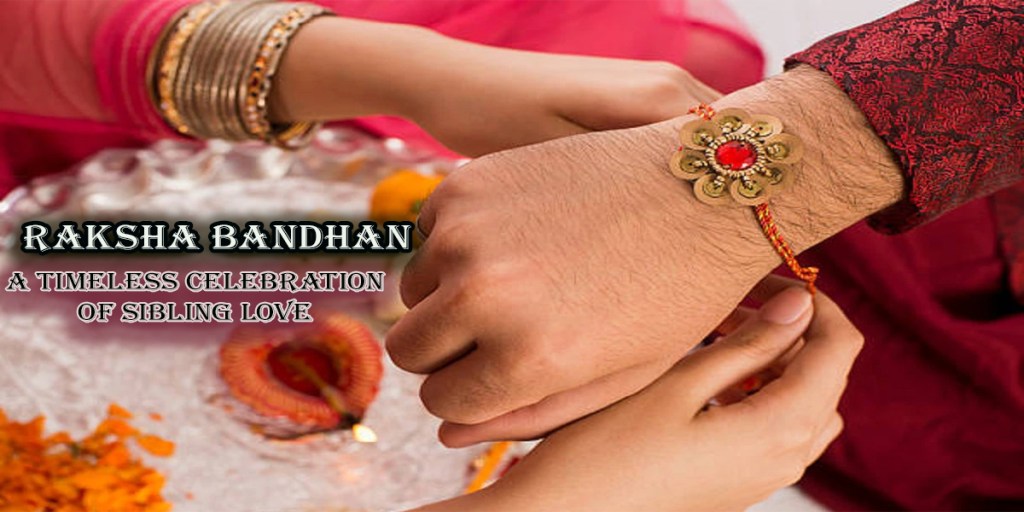
India is a land of festivals and each festival carries its own unique cultural, religious and emotional significance. Among these, Raksha Bandhan, also known as Rakhi, holds a special place in the hearts of millions. Celebrated with great enthusiasm across the country, Raksha Bandhan is more than just a ritual it is an embodiment of the eternal bond between brothers and sisters.
The word “Raksha Bandhan” translates to “the bond of protection.” This festival symbolizes the duty of a brother to protect his sister and in return, the sister prays for her brother’s well-being and prosperity. Over the years, the meaning and traditions of Raksha Bandhan have evolved, but the core message remains unchanged love, care and mutual respect among siblings.
The origins of Raksha Bandhan can be traced back to several stories in Indian mythology, history and folklore. One of the earliest mentions of a Rakhi-like ritual is found in the epic Mahabharata. According to legend, when Draupadi tore a piece of her sari to bind Krishna’s bleeding finger, he was deeply touched and promised to protect her in every situation. Later, during the infamous disrobing scene in the Kaurava court, Krishna miraculously saved Draupadi, honoring his promise. Another historical tale recounts how Rani Karnavati of Mewar sent a Rakhi to Mughal Emperor Humayun, seeking protection against Bahadur Shah. Humayun, despite being in the middle of a military campaign, rushed to help her. Though he was late, the gesture highlighted how the sentiment of Raksha Bandhan transcended religion and politics. In Hindu mythology, there is also the story of Yamuna, the sister of Yama, the god of death. She tied a Rakhi to her brother and in return, Yama granted her immortality. He also declared that any brother who receives a Rakhi from his sister and offers her protection would also gain long life. These stories reinforce the idea that Raksha Bandhan is not just a festival, but a moral and emotional contract between siblings.
Raksha Bandhan is celebrated across India with different regional names and variations in traditions. In North India, especially in states like Punjab, Uttar Pradesh, and Rajasthan, it is a major festival, celebrated with traditional rituals, sweets and family gatherings. In Maharashtra, the festival coincides with Narali Purnima, when fishermen offer coconuts to the sea god and sisters tie Rakhis. In West Bengal and Odisha, Rakhi is observed as Jhulan Purnima, associated with Lord Krishna and Radha. In South India, the festival is not as prominent, but certain communities do observe it with devotion. The beauty of Raksha Bandhan lies in its inclusive spirit. Over time, Rakhi has come to symbolize not just the bond between biological siblings but also between friends, cousins, neighbors and even across religious and national lines.
The celebrations of Raksha Bandhan typically begin with preparation days in advance. Sisters shop for colorful Rakhis, sweets and gifts, while brothers look forward to treating their sisters with presents and promises. On the day of Raksha Bandhan, the rituals generally begin with the preparation of a small thali, or plate, which is decorated with a diya (lamp), roli (vermilion), rice grains, sweets and the Rakhi itself. The sister then performs aarti for her brother, applies a tilak on his forehead, ties the Rakhi on his wrist and offers sweets. The brother then gives his sister a gift often money, jewelry, clothes, or something meaningful and promises to always protect her. The rest of the day is spent in celebration, with shared meals, storytelling and reminiscing about childhood memories. These rituals may vary from region to region and family to family, but the essence remains the same: a celebration of love, protection and togetherness.
In today’s fast-paced world, Raksha Bandhan has acquired new dimensions. Many brothers and sisters live in different cities or countries, and yet, the tradition continues with even more enthusiasm. Thanks to technology, siblings now send e-Rakhis, video call during the ceremony, and have gifts delivered online. The emotional bond is now supported by digital means, but the sentiment remains just as strong.
In modern times, Raksha Bandhan is no longer just about a brother protecting his sister. It has grown to reflect mutual respect and responsibility. Sisters also vow to protect their brothers and support them emotionally and morally. In some progressive households, even sisters tie Rakhi to each other or to female friends, emphasizing that protection and love aren’t limited by gender. Raksha Bandhan has also become a symbol of unity and peace. Many people tie Rakhi to soldiers to express gratitude for their service to the nation. Some communities use Raksha Bandhan as a medium to promote communal harmony, where Rakhis are tied across religious lines Hindus, Muslims, Sikhs and Christians all coming together in celebration.
With increasing awareness about environmental issues and sustainability, people are now opting for eco-friendly Rakhis made from organic materials like jute, recycled paper, seeds, or clay. These Rakhis decompose naturally and avoid contributing to plastic pollution. Additionally, many Non-governmental organization and women’s self-help groups produce hand-made Rakhis, supporting rural artisans and economically weaker communities. By purchasing such Rakhis, people contribute to a good cause while celebrating the festival.
Raksha Bandhan has found a prominent place in Indian literature, cinema, and television. Countless poems, stories, and movies revolve around the emotional bonds between brothers and sisters. Movies like “Hare Rama Hare Krishna,” “Resham Ki Dori,” and “Rakhi” have captured the spirit of sibling relationships with memorable songs and scenes. Popular Bollywood songs such as “Phoolon ka taaron ka” and “Bhaiya mere rakhi ke bandhan ko nibhana” continue to be played during Raksha Bandhan. These representations deepen the cultural imprint of Raksha Bandhan and keep its emotional legacy alive across generations.
With the Indian diaspora spread across the globe, Raksha Bandhan is now celebrated in countries like the United States of America, The United Kingdom, Canada, Australia, Singapore and United Arab Emirates. Many Indian associations abroad organize community Rakhi events, helping the younger generation stay connected to their roots. Some schools and cultural institutions also hold Rakhi-making competitions and storytelling sessions to educate children about the festival’s importance.
One of the most heartwarming aspects of Raksha Bandhan is that it is not restricted to blood relations. Many people tie Rakhi to friends, neighbors, mentors, or anyone they consider as protective figures in their lives. This practice redefines the idea of family beyond biological boundaries and emphasizes the values of trust, loyalty and care in all relationships.
Raksha Bandhan is not just a festival of tying threads and exchanging gifts; it is a celebration of human connection. In an age where people often feel isolated or disconnected, traditions like Raksha Bandhan serve as a powerful reminder of the bonds that matter most. Whether you’re sitting with your sibling under the same roof or connecting with them across continents, the thread of Rakhi continues to symbolize an unbreakable connection one woven with love, laughter, memories, and promises. In its timeless essence, Raksha Bandhan teaches us to celebrate relationships, to cherish the people who stand by us and to remember that true protection comes from love, respect and understanding.

 Kashmir RootStock