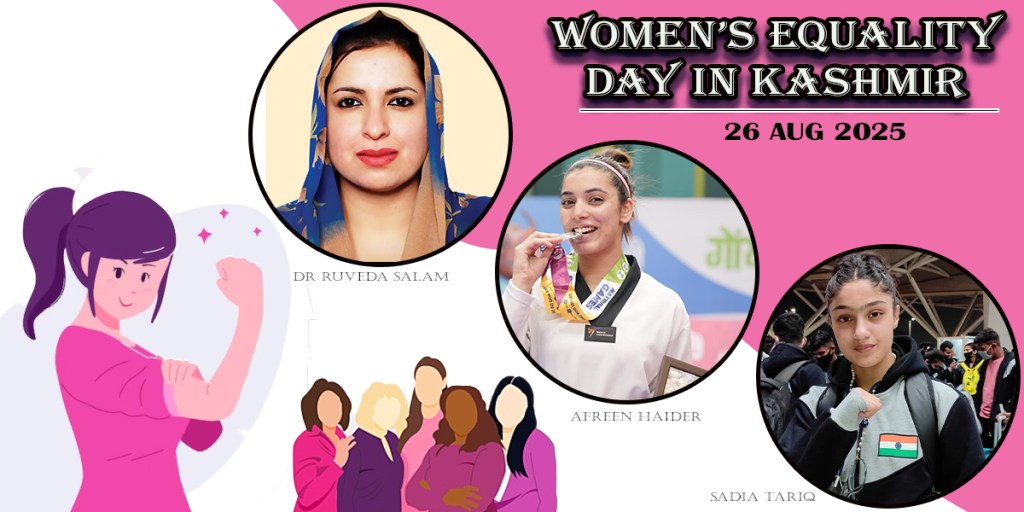
Women’s Equality Day, observed annually on August 26th marks a significant moment in history the certification of the 19th Amendment to the United States, Constitution on 26 August 1920, granting American women the right to vote. However, beyond its origins in the West, the day has evolved into a global call to reflect upon women’s rights, empowerment and progress across cultures and regions. In Kashmir, a region often viewed through the prism of conflict and struggle, Women’s Equality Day provides a vital opportunity to celebrate the silent yet steady revolution led by Kashmiri women. It is a moment to highlight their achievements, acknowledge their resilience and foster a positive narrative about their journey towards equality, dignity and empowerment.
In the picturesque yet politically sensitive valley of Kashmir, women have long played a significant role in shaping the social, cultural and educational landscape. Traditionally, Kashmiri society has exhibited a unique blend of progressive and conservative values. Women in Kashmir have historically had access to education and have actively contributed to literature, music, medicine and even politics. Celebrating Women’s Equality Day in this region underscores not just the global resonance of gender equality but also brings attention to the localized stories of courage, ambition and leadership.
Women are the true gems of Kashmir, playing a crucial role in the region’s development and progress toward equality. From education to entrepreneurship, Kashmiri women are breaking barriers and setting new standards of success. Pioneers like Sadia Tariq, young Wushu athlete from Kashmir, Dr. Ruveda Salam, the first woman IPS officer from Kashmir, Afreen Haider, Kashmiri taekwondo athlete, inspire countless others. Women-led start-ups are reviving traditional crafts while contributing to the local economy. In healthcare and education, female professionals are transforming communities with dedication and resilience. These contributions reflect the strength and potential of Kashmiri women in shaping a brighter, more equal future.
One of the most positive changes in recent years has been the increase in educational opportunities for girls and women in Kashmir. Despite periods of political instability, curfews and social disruption, Kashmiri girls have shown remarkable perseverance in pursuing education. Schools, colleges and universities across the region are now witnessing greater female enrollment, particularly in fields like science, technology and civil services. Institutions such as the University of Kashmir and the Islamic University of Science and Technology have reported higher participation of women in postgraduate and research programs, signaling a promising shift towards intellectual empowerment. These strides are not just victories for individual women but also serve as powerful symbols of change for the entire community.
In the professional arena, Kashmiri women are increasingly breaking stereotypes and occupying spaces that were once considered male-dominated. From journalism and law to entrepreneurship and information technology, women in Kashmir are emerging as changemakers. Start-ups led by young female entrepreneurs are providing employment opportunities, creating awareness about sustainability and promoting local crafts. Fashion designers, artists and filmmakers are telling authentic Kashmiri stories through their work, giving voice to women’s experiences and aspirations. The rise of social media has also allowed many of these women to gain visibility, network with broader audiences and challenge traditional norms, all while staying rooted in their cultural identity.
Equally noteworthy is the growing political awareness and participation of women in Kashmir. Although formal political representation of women remains limited, there is a visible shift in women taking part in public discourse and community leadership. Women’s organizations, grassroots movements and civil society groups are increasingly advocating for gender-sensitive policies, mental health support, education reform, and protection from gender-based violence. This involvement is a testament to the evolving role of women as not just beneficiaries of progress but as active agents of change.
On Women’s Equality Day, it is important to highlight the contributions of Kashmiri women in preserving peace and stability within their families and communities. In a region that has witnessed decades of uncertainty, women have often acted as the emotional backbone of society nurturing families, managing economic hardships and providing support amidst adversity. Their role as educators, caregivers and moral compasses continues to strengthen the social fabric of Kashmir. This resilience deserves recognition, not as an expectation, but as an expression of their unyielding spirit and sense of responsibility.
Moreover, the discourse around mental health and well-being is gradually gaining traction, thanks to the efforts of women-led NGOs and counseling centers in the Valley. Women psychologists, counselors and educators are stepping forward to address issues that have long been suppressed due to societal stigma. These initiatives are opening up safe spaces for dialogue, emotional healing and personal growth, especially for young women who are navigating multiple layers of social expectations. On a day dedicated to equality, these efforts serve as a reminder that true empowerment must also include emotional and psychological support.
Religious and cultural perspectives in Kashmir also offer a unique context for understanding gender roles. While traditional values continue to influence societal behavior, there is a growing realization that religious teachings, when interpreted progressively, can support the cause of gender justice. Many local scholars and clerics are engaging in constructive conversations around women’s rights in Islam, emphasizing education, dignity and respect as core principles. These dialogues are crucial in bridging the gap between tradition and modernity, allowing for a culturally sensitive approach to equality that resonates with the broader Kashmiri population.
The media and storytelling space have become another powerful platform for Kashmiri women to assert their voices. Independent journalists, poets and writers are bringing forth narratives that reflect the lived experiences of women stories of struggle, resilience and hope. These voices are not just challenging the dominant narratives of victimhood but are also reshaping how the world sees Kashmiri women. By using their pens and cameras as tools of resistance and creativity, they are reclaiming agency and building a more inclusive and nuanced understanding of gender in Kashmir.
Looking ahead, the celebration of Women’s Equality Day in Kashmir must go beyond symbolic gestures. It should be an ongoing commitment to dismantling systemic barriers, promoting inclusive education, creating safe workspaces and ensuring equitable access to resources and opportunities. Policies aimed at women’s empowerment need to be localized, data-driven and developed with the active participation of women themselves. It is only through sustained collaboration between government bodies, civil society and local communities that the vision of gender equality can be fully realized.
In conclusion, Women’s Equality Day in Kashmir should be seen as a moment of optimism and reflection. It is a celebration of the progress made and a reaffirmation of the work that lies ahead. The journey toward equality in Kashmir is complex and layered, but it is also filled with hope, courage and determination. Kashmiri women are not just dreaming of a better future they are actively building it, step by step, against all odds. On this day and every day, their stories deserve to be heard, honored and amplified not only as women of Kashmir but as pillars of strength, symbols of change and champions of equality.

 Kashmir RootStock