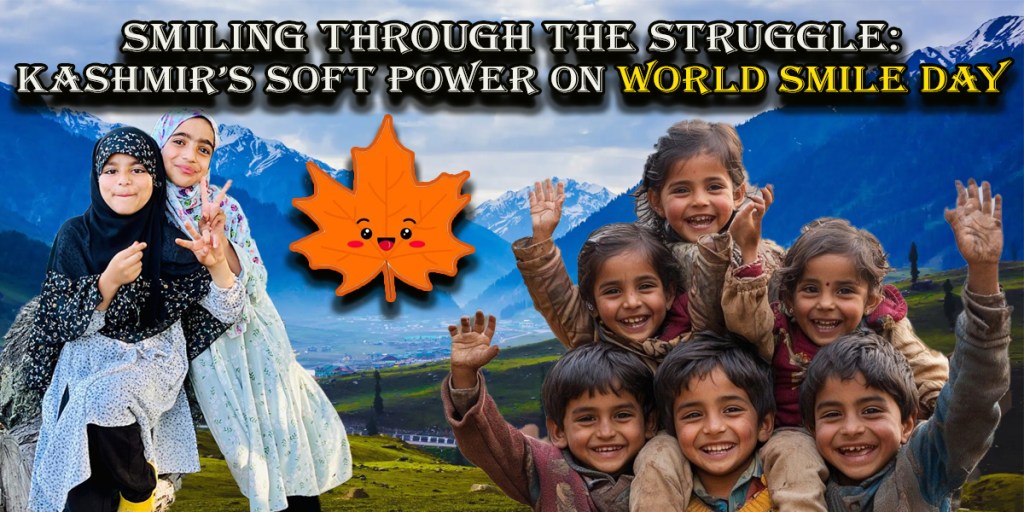
Every year, on the first Friday of October, people around the world celebrate World Smile Day. At first glance it seems like a simple idea, almost too simple in a world filled with complexity: a reminder to spread kindness and share a smile. But in Kashmir, where life is often framed through headlines of conflict, unrest and uncertainty, this small celebration carries a meaning that goes beyond lighthearted symbolism. Here, a smile is not just an expression of joy. It becomes a quiet act of resilience, a bridge across divides and a subtle affirmation that hope continues to exist even in the most challenging environments.
For many Kashmiris, everyday life is a delicate balance of routine and resilience. Children walk to school in the morning, parents hurry to markets, friends meet in tea shops, families gather for weddings or religious festivals. Alongside this normalcy, however, are stories of grief, memories of violence and concerns about the future. To live in such a place is to carry both beauty and burden. Against this backdrop, World Smile Day offers a pause — a small, shared moment where the focus shifts from struggle to simple human connection. A smile, after all, requires no translation. It is not owned by one community, one faith or one nation. It is universal and it reminds us that despite differences, the need for kindness is something we all share.
When school children in Kashmir draw pictures of smiling faces, when volunteers distribute sweets to patients in a hospital or when friends take photographs of each other holding up paper cutouts of smiley emojis, they are doing more than participating in a global trend. They are affirming that joy has not been erased from their lives. They are telling their own story, one that resists being flattened into only images of anger or despair. A single smile may not rewrite history but it complicates the picture that the world too often sees. It says: we are more than headlines and our humanity is intact.
The act of smiling in such contexts can also be understood as a kind of strength. Resilience is not always dramatic. Sometimes it is as quiet as a mother choosing to laugh with her children despite hardship or young people deciding to play music, paint murals or celebrate cultural festivals even when uncertainty weighs heavily. Smiles in Kashmir do not mean ignoring pain; they mean refusing to let pain define everything. In that way, World Smile Day becomes an occasion to notice not only the difficulties but also the determination that keeps life going forward.
At the same time, the power of a smile lies not only in what it means to the person offering it but also in how it is received. For those outside the valley, seeing images of joy from Kashmir disrupts the monotony of conflict-driven coverage. A photograph of children laughing in a schoolyard or elders joking with each other at a community gathering, opens a window into everyday life that is rarely shown. It invites viewers to recognize that Kashmiris, like people everywhere, seek comfort, safety, love and dignity. In a world where polarization often reduces communities to one-dimensional roles, such reminders are vital. They help us see each other not as abstractions but as people with full and complicated lives.
World Smile Day also has the potential to create small spaces for dialogue within the valley itself. When neighbours come together for a community event, or when young people collaborate on social media campaigns around kindness and positivity, new lines of communication open up. These are not grand political dialogues, but they are important all the same. Trust and cooperation often begin in small, ordinary ways. A smile exchanged across a barrier of suspicion may not end a disagreement, but it can soften it, making future conversations a little easier. In that sense, kindness becomes not just a moral value but also a practical tool for coexistence.
Of course, smiles alone cannot solve deeper issues. They cannot erase grief or undo the past. But they can coexist with the work of healing and rebuilding. The most meaningful celebrations of World Smile Day in Kashmir are those that are rooted in authenticity — when they grow out of genuine community participation rather than staged displays. A child’s laughter, a neighbour’s gesture of hospitality, or an artist’s mural painted on a city wall carries more weight than orchestrated slogans. Authentic moments have the power to ripple outward, sparking real conversations and real reflection, whereas staged ones risk being dismissed as superficial.
For those who observe from a distance, perhaps the most important lesson of World Smile Day in Kashmir is humility. It reminds us that no place can be fully understood through the narrow lens of conflict alone. People are never only victims or only symbols. They are parents, workers, artists, dreamers and friends. They carry grief and joy together, often in the same day. By pausing to recognize their smiles, we resist reducing them to stereotypes. We allow them the dignity of being seen in their fullness.
Ultimately, World Smile Day in Kashmir is not about pretending that problems do not exist, nor about offering simplistic solutions. It is about affirming the enduring humanity of people who live with complexity every day. It is about recognizing that even small gestures of kindness can matter in a place where trust is fragile and narratives are contested. And it is about remembering that while politics may divide, the human desire for peace, love and belonging remains universal.
A smile cannot change the world on its own, but it can remind us that the world is worth changing. In Kashmir, as elsewhere, that reminder is not trivial. It is a form of hope, modest yet powerful, that keeps communities alive, connected and capable of imagining a future where dialogue and understanding are not exceptions but norms.

 Kashmir RootStock