Women empowerment in Kashmir has undergone a profound transformation in recent decades, marked by evolving social, political and economic dynamics and punctuated by the resilience and agency of Kashmiri women themselves. This comprehensive article explores the historical context, legislative reforms, grassroots initiatives, the challenges faces and the contributions of influential Kashmiri women across spheres, encapsulating the multifaceted journey towards empowerment and equality in the region. Women in Kashmir have a rich yet turbulent history, often shaped by regional conflicts, political upheaval and strict social norms. During Dogra rule and earlier epochs, Kashmir women endured pronounced gender discrimination, limited rights and social exclusion but they also played pivotal roles in socio-political movements: – Women participated actively in the struggle against the Dogra regime, with activists like ZoniGujri and Fatima risking their lives I mass protests. Ancient Kashmir saw powerful female rulers like Queen Didda who reigned for over four decades and Kota Rani, respected for their administrative acumen. Despite historic feats, entrenched patriarchy persisted, restricting education, economic participation and mobility for most women.
The turbulence of the late twentieth and early twenty-first centuries with armed conflict, enforced conservations and political turmoil-exacerbated challenges for Kashmir women. Major barriers included: – Gender disparity in literacy rates and access to higher education remained significant. For decades, women’s participation in governance was minimal and symbolic. Issues of dowry, domestic violence, inherited property rights and gender-based violence were pervasive, particularly during periods of unrest. Societal norms and conflict-related restrictions led to inadequate healthcare for women. Recent years have seen progressive policy changes, catalysed by legislative reforms, central government interventions and active civil society engagement: – After the abrogation of Article 370, central laws on women’s property rights, prevention of child marriage and protection from domestic violence became applicable to Kashmir, restoring legal equality and safeguarding women’s rights. Reservation in Panchayati Raj institutions promoted political representation and leadership among women, allowing meaningful participation at grassroots levels. Initiatives like Beti Bachao Beti Padhao, Prime Minister Ujjwala Yojana, Unified Waqf Management, Empowerment, Efficiency and Development Scheme and Women’s Police Stations addressed education, economic independence, safety and justice.
Empowerment at the grassroots has been notable in several domains: – Literacy rates among Kashmiri women have increased, helped by government and NGO-run free education programs and scholarships for girls in rural regions. Under the National Rural Livelihoods Mission, Self-Help Groupsoffer training, support and loans facilitating women’s entry into entrepreneurship. Traditional crafts such as Pashmina weaving and roles in the growing tourism industry, have become sources of economic independence for women. Schemes targeting maternal and child health have improved access and awareness, though infrastructure deficits remain problematic. Women are increasingly finding a voice in local and mainstream politics: – The reservation of 33% seats for women in local governance has enabled widows, workers and rural women like Fatah Begum to become Sarpanches and leaders. Women’s participation now spans from the ward and Panch levels to Block Development Councils and the Legislative Assembly, reflecting newfound agency and influence. Digital platforms and youth engagement have created emerging opportunities for young women to assert political opinions and organize for rights.
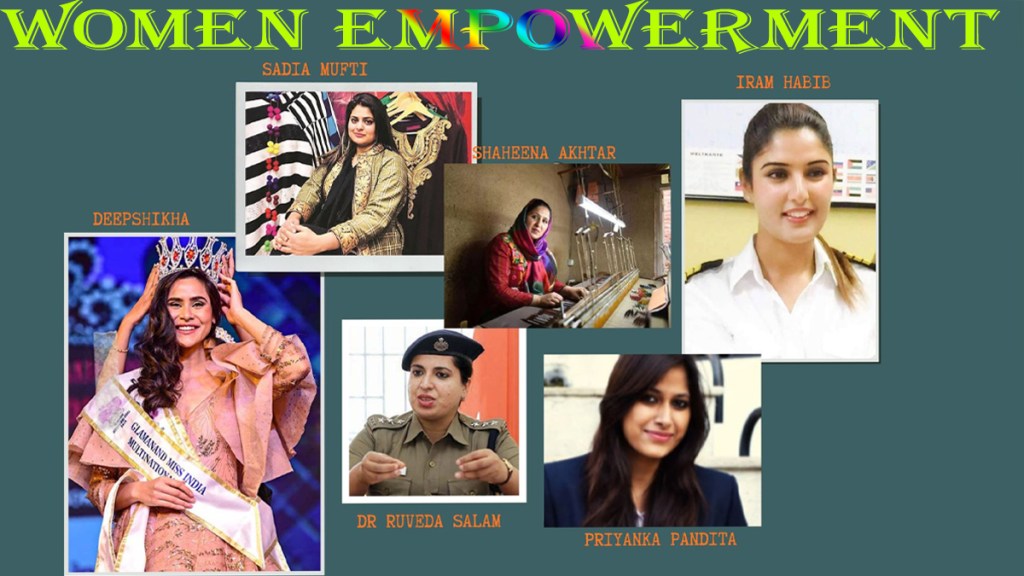
Influential Kashmiri Women Countless Kashmiri women have set examples across fields, from ancient queens to contemporary leaders: – A legendary ruler credited for her shrewd administration and resilience. Renowned for her political skills and governance during a turbulent period. A pioneering educationist and social reformer who founded societies promoting intellectual and social growth. An advocate for cultural preservation and former state director of libraries. Contemporary activists, journalists, writers and entrepreneurs continue to define the new face of Kashmiri womanhood. Despite progress, numerous obstacles remain: – Deep-rooted social attitudes often resist change, limiting women’s autonomy and participation in public life. Women are disproportionately affected in conflict zones, facing increased vulnerability to violence and impunity. Wage gaps, underemployment and restricted access to capital hinder full financial independence. Implementation of laws and access to justice can be uneven, especially in rural areas.
A multi-pronged strategy is required to consolidate and sustain women’s empowerment in Kashmir: – Continued focus on bridging literacy gaps, promoting Science, technology, engineering and mathematics participation and supporting higher education for girls. Expanding maternal health schemes, mental health resources and clinics in rural areas. Active dissemination of rights, robust law enforcement and dedicated helplines. Scaling up Self-Help Groups, supporting women in agriculture, business and crafts and facilitating access to startup funds. Ensuring effective political reservation, leadership training and representation in legislative bodies. Celebrating achievements of Kashmir women in public life, academia, sports and cultural fields.
The movement for women empowerment in Kashmir is marked by resilience, determination and transformation from the struggles of the past to the aspiration of a new, inclusive future. Robust policy reforms, grassroots activism, rising political participation and the emergence of inspiring female leaders have collectively contributed to the gradual but significant shift in the status of Kashmir women. The path ahead demands sustained commitment to equality, justice and opportunity to empower Kashmir’s women as equal contributors to society.

 Kashmir RootStock