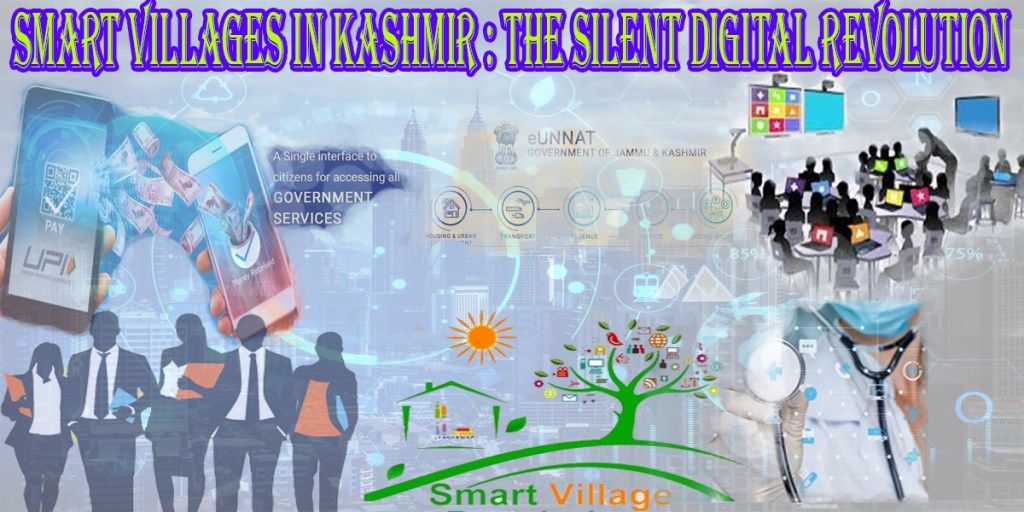
In the tranquil villages of Kashmir, where apple orchards sway under the shadow of snow-capped peaks and saffron fields shimmer in the autumn sun, a quiet revolution is unfolding. It is not the loud, glittering transformation of urban India’s tech hubs, with their neon lit startups and bustling digital billboards. Instead, it is a subtle, profound shift, woven into the rhythm of rural life. Kashmir’s villages are becoming smart, powered by a digital wave that is transforming commerce, agriculture, horticulture, governance and community connections. This silent revolution, driven by Quick Response codes, Artificial intelligence driven apps, e-payment platforms and digital service centres, is reshaping how villagers live, work and dream, proving that technology’s impact needs not be flashy to be significant.
In the bustling markets of rural Kashmir, a shopkeeper stands beside a stack of blankets, a Quick Response code taped to the counter. A customer scans it with a smartphone and the transaction is complete in seconds with no cash exchanged and no change fumbled. This scene, once unthinkable in the valley’s remote corners, is now a routine. Digital payment systems, particularly the Unified Payments Interface, have swept through villages, enabling small businesses to thrive without the burden of cash. For small vendors, from walnut wood carvers to spice merchants, this cashless shift means efficiency and security. Payments arrive instantly and the hassle of carrying cash or chasing change is gone. In isolated hamlets, where banks are distant and winters harsh, these digital tools are a lifeline, keeping commerce alive when snow blankets the roads.
Beyond local shops, e-payment platforms are redefining business transactions, opening doors to markets far beyond the valley. Artisans crafting pashmina or pottery no longer rely solely on local buyers. Through social media and e-commerce platforms, they connect with customers across India and even globally, accepting payments seamlessly through mobile apps. The government’s Open Network for Digital Commerce, recently surpassing 200 million transactions, empowers these micro entrepreneurs by linking them to vast markets without intermediaries. This digital bridge is revitalising Kashmir’s traditional crafts, turning village artisans and agro merchants into global sellers. The financial empowerment is palpable, especially for women, who, once restricted by societal norms, now manage online stores, with their earnings flowing directly into bank accounts, fostering independence and ambition.
This digital momentum extends to governance, where online platforms for subsidies and assistance are transforming rural access to resources. Agricultural/ Horticultural schemes, like the High-Density Plantation initiative, covering over 7000 hectares, deliver funds directly to farmers’ accounts through Direct Benefit Transfer, bypassing the bureaucratic delays. Villagers can apply for commercial venture support or check land records through portals like e-UNNAT, which integrates 445 services or “Aapki Zameen Aapki Nigrani,” which digitises property records. This transparency has fuelled a surge in registrations, from 21,293 in 2020-21 to 80,128 in 2022-23, boosting government revenue from Rs. 291 crores to Rs. 544 crores. For rural communities, these platforms mean clarity in land ownership, fewer disputes and faster access to support, all from the comfort of their homes.
At the heart of this transformation are Community Service Centres and Khidmat Centres, the unsung heroes of Kashmir’s digital revolution. Scattered across villages, these hubs provide access to e-services, from healthcare bookings to government applications. They are more than service points they are community anchors, where villagers learn to navigate digital tools, bridging the gap for those without smartphones or technical skills. Khidmat Centres, with their focus on online banking, enable labourers and small entrepreneurs to manage accounts, transfer funds or access loans without trekking to distant banks. The DigiPay Aadhaar enabled system ensures secure transactions through biometric authentication, bringing financial inclusion to the marginalised. These centres are quietly dismantling the digital divide, ensuring that technology reaches every corner of rural Kashmir.
Agriculture and Horticulture, the lifeblood of these villages, is embracing a technological renaissance, driven by AI-driven apps tailored for horticulture. Tools like Orchardly use artificial intelligence to monitor crop health, predict yields and optimise resources, transforming traditional farming. In Kashmir, where over 80% of the population depends on agriculture/ horticulture, such innovations are revolutionary. Research labs deploy drones and Internet of Things sensors in thousands of greenhouses, delivering precise water, fertiliser and pesticide applications. Farmers, once guided by instinct, now rely on data to boost productivity and sustainability. The social media and e-marketplace apps connect them to online markets, ensuring fair prices for apples, saffron, almonds and walnuts. This blend of technology and tradition is not just about efficiency it is about securing livelihoods in a region where farming is both heritage and survival.
Kashmir’s youth are the torchbearers of this silent revolution, mastering coding and Artificial intelligence through global platforms. They see their classrooms not as four walls but as digital spaces, learning from online forums and virtual labs. Women, once sidelined, are emerging as digital leaders, running businesses and advocating for change. This ambition is fuelled by initiatives like the Artificial intelligence Samarth program, engaging millions with multilingual Artificial intelligence content and the government’s push for digital literacy. The e-Office system, achieving a 97% file disposal rate reflects a governance model that is responsive and transparent. The revenue department’s digitisation, driven by demands for trained support staff, promises to redefine rural administration, making land records accessible and disputes rarer.
What makes Kashmir’s smart villages compelling is not the scale of their digital infrastructure but the intent behind it. This is not a race to mimic urban tech hubs it is a deliberate effort to address real needs. Quick Response codes empower small vendors to compete in a cashless world. E-payment platforms connect artisans to global markets. Artificial intelligence apps like Orchardly ensure farmers thrive in changing climates. Community and Khidmat Centres bring services to the doorstep, while online portals make governance inclusive. Unlike the blingy urban tech scene, this revolution is understated, blending seamlessly with Kashmir’s cultural tapestry. It is a farmer checking crop data on a smartphone, a vendor scanning a Quick Response code, a woman applying for a subsidy from her village home. It is technology that serves, not dazzles.
As the Fourth Industrial Revolution reshapes the world, Kashmir’s villages are not just keeping pace they are carving a unique path. The region’s digital journey, supported by visionary leadership, proves that technology’s true power lies in its ability to uplift. Lieutenant Governor’s assertion that Jammu and Kashmir leads in digital transactions underscores a broader truth this silent revolution is building a future where every villager, from the orchards of Sopore to the markets of Anantnag, is connected, empowered and ready to dream beyond the mountains. In these smart villages, the future is not a distant promise it is a quiet reality, unfolding one scan, one click, one harvest at a time.

 Kashmir RootStock