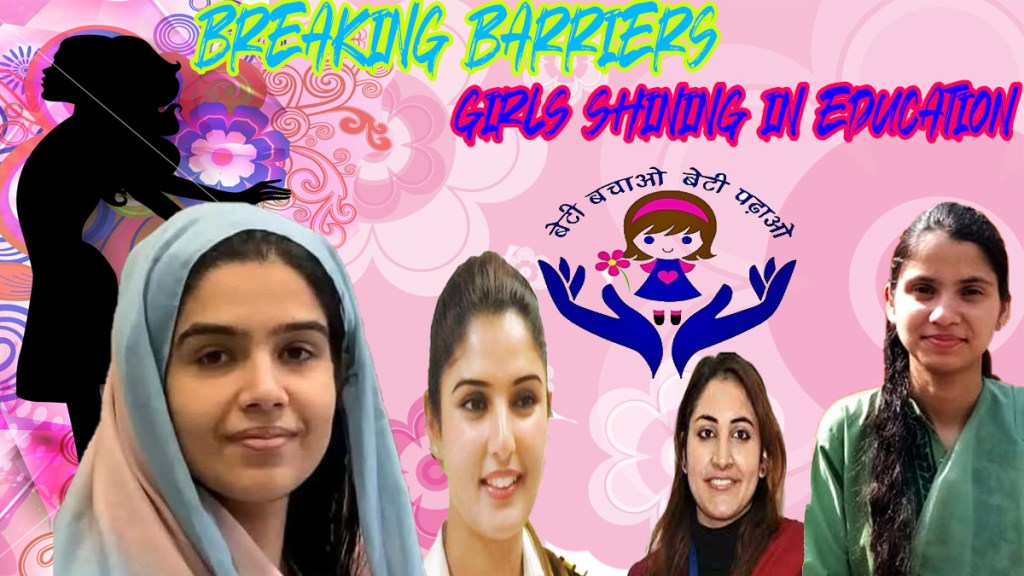
Across the world, education has long been regarded as the most powerful tool for transformation a force capable of reshaping destinies, breaking the cycle of poverty and building societies rooted in equity and progress. Yet for generations, half of humanity the girls were kept away from classrooms, their potential dimmed by tradition, poverty and prejudice. Today, that narrative is changing. From remote Himalayan villages to bustling city schools, girls are rewriting the story of empowerment through education. They are not just entering classrooms; they are excelling, innovating and leading in fields that were once considered out of their reach. The journey has not been easy, but the progress is undeniable.
The story of girl’s education is one of resilience against centuries of barriers. Historically, cultural norms, early marriages and social biases kept girls confined to the private sphere, denying them the opportunity to learn and grow. In many parts of the world, education was seen as unnecessary for daughters who were expected to become homemakers. In societies where resources were scarce, families prioritized boys, believing that sons would become breadwinners. Girls were often burdened with household chores or responsibilities that kept them away from school. This denial of education not only stunted individual potential but also slowed national progress, as societies that ignore half their population cannot truly advance.
However, the tide began to turn as awareness grew about the transformative power of educating girls. Global initiatives by organizations such as United Nations Educational Scientific and Cultural Organization, United Nations International Children’s Emergency Fund and local grassroots movements highlighted that when girls learn, entire communities’ benefit. Educated women are more likely to participate in the workforce, make informed decisions about health and family and contribute to their nations’ economies. They also raise healthier, better-educated children, creating a ripple effect that carries forward for generations. The realization that empowering girls through education uplifts families, economies and nations has fueled policy reforms and social movements across continents.
In India, the push for girls’ education has been particularly inspiring. From the independence era to the present day, countless reformers, activists and educators have fought to ensure that girls have equal access to learning. Initiatives such as Beti Bachao, Beti Padhao free education schemes for girls and mid-day meal programs have helped increase enrollment and retention rates. In many rural and marginalized communities, female literacy rates have improved dramatically over the past two decades. The sight of girls cycling to school with determination in their eyes, even though rough terrains and harsh climates, has become a symbol of hope and transformation.
Yet, numbers tell only part of the story. The true change lies in the shifting mindset. In villages where once a girl’s education was dismissed as irrelevant, families now take pride in daughters who graduate or pursue higher studies. The stories of young women who defy odds to achieve academic excellence have become beacons of inspiration. Whether it is a girl from a remote village qualifying for civil services, another becoming a doctor in her district’s first hospital, or one innovating in technology and science, these stories show that talent knows no gender. They are breaking the glass ceiling not only in schools but also in workplaces, research labs and governance.
The transformation, however, is not just about statistics or career success. Education gives girls something more profound confidence, voice and choice. A classroom is not merely a place to learn math or language; it becomes a space where girls learn to question, to express, and to dream. It teaches them that they are capable of making decisions for their lives, that their opinions matter and that they can be agents of change. This newfound confidence challenges old hierarchies and encourages a more equal society.
Still, the challenges remain stark in many regions. In conflict zones, disaster-prone areas and deeply conservative societies, education for girls continues to face resistance. Poverty, gender-based violence, lack of infrastructure and inadequate sanitation facilities are among the practical obstacles that deter girls from attending school. In some places, schools are far from villages, making the journey unsafe. In others, traditional beliefs still prioritize early marriage over continued education. The digital divide, especially highlighted during the COVID-19 pandemic, further exposed inequality, as millions of girls in remote areas lacked access to online learning tools.
But what stands out amid these challenges is the spirit of resilience among girls themselves. Across Asia, Africa and the Middle East, young girls have become champions of their right to learn. They are forming study groups, mentoring younger students, and even teaching underprivileged children in their neighborhoods. Many organizations led by women are working tirelessly to bridge the gender gap in education by providing scholarships, building hostels for girls in remote areas and training female teachers to create safe, inclusive learning environments. These collective efforts are transforming education into a movement rather than a privilege.
The ripple effects of educating girls extend far beyond individual success. When women are educated, they contribute significantly to the economy. According to research by the World Bank, every additional year of schooling for a girl increases her future earnings by up to 20%. Educated women are also more likely to delay marriage, have fewer and healthier children and participate actively in civic life. They become leaders, innovators and policy makers. In fact, countries with higher female education rates tend to experience faster economic growth, better governance and reduced poverty levels.
Moreover, education also equips girls to confront the most pressing global challenges from climate change to healthcare and digital innovation. In Kashmir, for instance, girls who once struggled for access to basic education are now pursuing degrees in environmental science, medicine and technology. They are leading awareness campaigns on sanitation, renewable energy and sustainable agriculture. In the broader Himalayan belt, girls’ participation in conservation and community development programs is reshaping the narrative around environmental leadership. Education has empowered them to merge traditional knowledge with modern science, ensuring that the voices of women are heard in every dialogue about sustainability.
In urban centers, girls are now outpacing boys in academic performance across many subjects. They are leading in board exams, competitive tests and higher education enrollments. Universities that once saw limited female presence are now filled with young women aspiring to be engineers, scientists, journalists and entrepreneurs. The visibility of women in academia and public life inspires younger generations, creating a cycle of motivation. Representation matters when a girl sees another woman succeeding in a field she dreams of, she learns that her own ambitions are valid.
Despite this progress, equality in education cannot be taken for granted. The journey from access to empowerment is long and requires continuous effort. Governments must invest not only in building schools but also in improving the quality of education and ensuring safety, inclusivity and respect within learning environments. Teachers must be trained to challenge stereotypes and encourage girls to take up leadership roles. Curricula should include gender-sensitive education that promotes respect, equality and empathy. Parents, too, play a vital role by treating their daughters’ education as an asset rather than an expense, they plant the seeds of empowerment.
Technology can also be a powerful enabler. Digital learning platforms, online classrooms and mobile libraries can reach girls in remote areas who might otherwise be excluded. Initiatives like community internet centers and tablet-based learning programs are showing promising results in bridging educational gaps. However, for technology to truly empower, girls must be given equal access to devices, digital literacy and safe online spaces. As the world moves towards an increasingly digital future, ensuring that girls are not left behind in this transition is essential for inclusive progress.
Beyond education lies the deeper question of opportunity. Educated girls must be able to translate their learning into meaningful participation in society. This means equal access to jobs, leadership positions and decision-making spaces. The confidence and knowledge they gain in classrooms must find expression in boardrooms, laboratories and legislative assemblies. Societies that provide such platforms to women see transformative results from reduced inequality to stronger economies and more compassionate governance.
At its core, the movement for girls’ education is a moral imperative as much as a developmental one. It is about justice the simple but profound idea that every child, regardless of gender, deserves to learn, dream and shape her own future. It is about dismantling centuries of exclusion and building a world where education is not a privilege but a birth right. It is about recognizing that when one girl succeeds, her entire community rises with her.
The future will belong to societies that invest in their girls today. Every classroom opened, every book given and every barrier broken builds a foundation for a more equitable tomorrow. The glow of education in a young girl’s eyes is the truest reflection of human progress bright, fearless and full of promise.
From the narrow lanes of rural villages to the expansive campuses of universities, girls are walking a new path one paved with courage, intellect and hope. They are not just students; they are the architects of a better future. As they continue to rise, learn and lead, the message becomes clear: when girls shine in education, the whole world becomes brighter.

 Kashmir RootStock