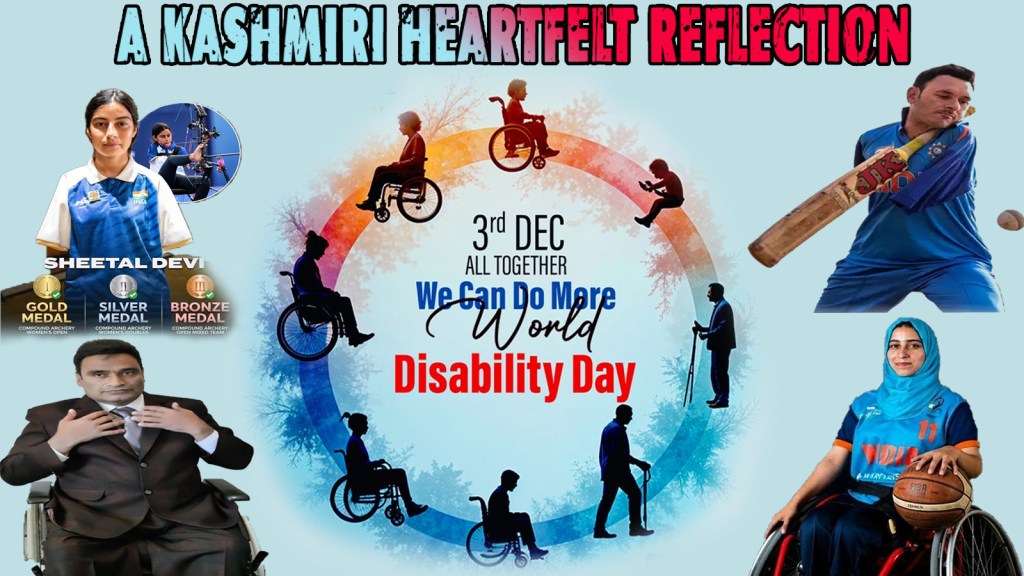
As I sit near my window this morning, watching the faint winter sunlight fall across the courtyard and hearing the distant rumble of a shikara moving through a quiet Dal Lake, my mind drifts toward a day the world observes every year — the International Day of Persons with Disabilities. In Kashmir, where compassion flows more naturally than rivers and where human bonds are stronger than mountains, this day carries a meaning deeper than just recognition. It is a reminder of dignity, empathy and equality — values that our valley has always held close, yet sometimes forgets to practice consistently.
Growing up in Kashmir, I remember seeing people with disabilities often tucked into a corner of society. Not intentionally ignored, but quietly side-lined. Not out of cruelty, but out of the hesitation that comes from not knowing what to say, what to do or how to help. Sometimes we offer sympathy where understanding is needed. Sometimes we offer charity where accessibility should be built. And many times, without realising it, we reduce a person to their challenges instead of seeing their strength, their mind, their spirit, their beautiful individuality.
In our valley’s history, persons with disabilities have always been present — in families, in neighbourhoods, in schools, in our workplaces — yet rarely at the centre of conversations. I still remember an elderly man in our locality who lost his leg in an accident decade ago. He would sit outside in the summers, greeting every passer-by with a smile. People knew him for his humour, his patience, his stories — never for his disability. And that, in a way, is the Kashmiri spirit. We see people through the heart. But somewhere along the way, as life grew busier and society more complex, many individuals with disabilities began feeling unseen, unheard and unsupported.
Today, the world talks about disability as an issue of human rights, accessibility, equal opportunity. But here in Kashmir, sometimes it is still seen as a burden a family must carry quietly. This needs to change. A disability is not a flaw in a human being; it is simply a different way of living, moving, experiencing. And if our infrastructure, our behaviour and our mindset evolve — then disability stops being a barrier altogether.
I often think of the everyday challenges that a person with disability might face in Kashmir. Our uneven roads, steep staircases, lack of ramps, unreliable transportation — even simple tasks become mountains to climb. Schools and workplaces often lack proper facilities. People who use wheelchairs struggle to enter buildings. Those with hearing or sight challenges rarely get specialised support. The world outside is beautiful but not always accessible. And accessibility is not just about ramps or lifts; it is about creating a society where every person feels included, valued and respected.
But whenever I look at the resilience of our people, I feel hopeful. Kashmiris have always shown courage in hardship. So many individuals with disabilities here have built lives full of achievement, dignity and contribution. They study, they work, they create, they teach, they inspire — often silently, often without recognition. And families, too, show immense strength. Parents go beyond their limits, siblings become lifelong companions and communities’ step in whenever needed.
The International Day of Persons with Disabilities reminds us that our role is not to “help” them out of pity. Our role is to make sure they don’t need extra help at all — because society is designed in a way that respects their independence. What they need is accessibility, opportunity and above all, equality.
As Kashmir moves towards the future, we must think of how to create a valley where every person, regardless of ability, feels at home. It begins with small actions: treating people with respect, listening when they speak, understanding without judgement, creating awareness among children, teaching the value of inclusiveness in schools and encouraging workplaces to provide equal opportunities. It continues with larger steps like making public spaces accessible, improving healthcare, developing rehabilitation centres and ensuring rights and dignity are never compromised.
Persons with disabilities are not defined by what they cannot do — they are defined by what they overcome every single day. Their strength is quieter than the snowfall on our rooftops but deeper than the roots of our Chinar trees. Their resilience holds stories that the world needs to hear.
On this International Day of Persons with Disabilities, I hope our valley remembers the softness it is known for — the kindness that warms even the coldest winters. Let us open our hearts wider. Let us open our minds even more. Let us recognise that disability is not a limitation; society’s attitude is. And attitudes can be changed.
Let us imagine a Kashmir where a person in a wheelchair moves freely through Lal Chowk without obstruction. Where a child with hearing difficulty sits in a classroom with proper support. Where a visually impaired student reads their lessons through accessible technology. Where no one stares, no one whispers, no one labels. Where every person is accepted with dignity and celebrated for who they are.
This valley has survived storms, grief and silence — but it has also shown the world the power of humanity. If we extend that humanity to persons with disabilities, not as charity but as equality, then Kashmir will truly reflect the beauty it is known for.
As the sun slowly begins to set behind the Zabarwan hills and the evening azaan fills the sky, I close this thought with a simple hope: May we learn to see ability where others see disability. May we learn to embrace differences without fear. And may every person in this valley — whether they walk on two feet, use a wheelchair, hear the world differently, see the world differently or process life differently — feel like they belong here, equally and with honour.
Because dignity is not a privilege.
It is a right.
And Kashmir, at its heart, has always believed in that.

 Kashmir RootStock