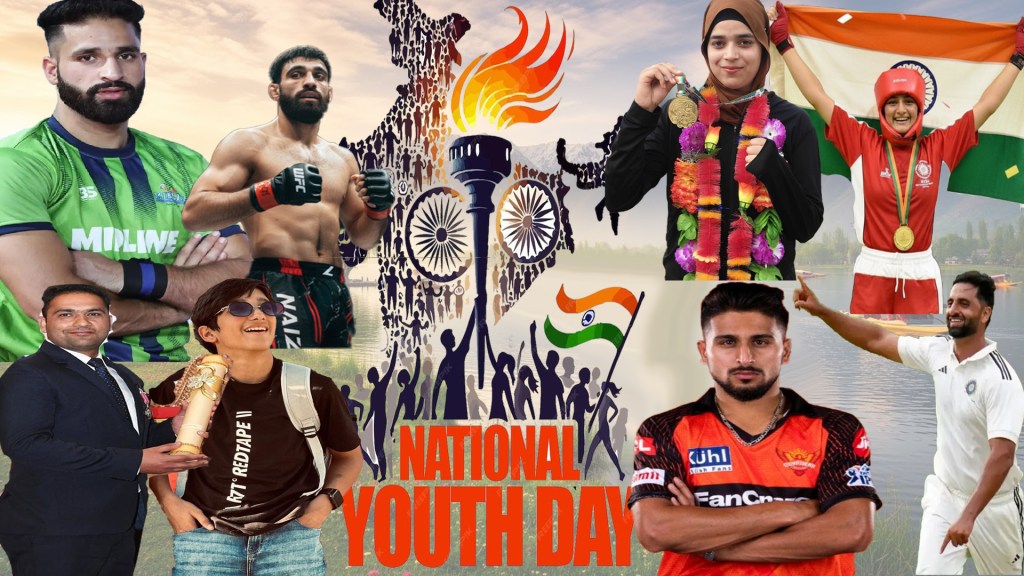
National Youth Day arrives each year as a reminder but in Kashmir it feels less like a formal observance and more like a moment of reflection. Observed on the birth anniversary of Swami Vivekananda, the day speaks of youth as a moral force—strong in character, disciplined in thought and committed to service. In the Valley, these ideals do not remain confined to speeches or commemorations. They are lived, often silently, by young people who grow up negotiating uncertainty while holding firmly to hope.
Kashmiri youth have inherited a complicated landscape—one shaped by history, interruption and endurance. They have learned early that life here demands patience, adaptability and restraint. Yet, what defines them most is not what they have endured, but how they continue to move forward. Education, work, creativity and responsibility remain central to their choices. In this sense, National Youth Day in Kashmir is not about potential waiting to be unlocked; it is about recognising strength already in practice.
Much is said about Kashmiri youth, often from a distance and through narrow lenses. The truth, however, lies in everyday realities: students studying late into cold nights during winter power cuts, young professionals preparing for competitive exams amid uncertainty, small entrepreneurs rebuilding after repeated disruptions and athletes training with limited facilities but limitless determination. These are not dramatic acts; they are steady commitments to life. They reveal why the youth of this land are not merely survivors, but the Gems of Kashmir—valuable not for noise or visibility, but for their quiet brilliance.
Swami Vivekananda spoke of strength as something deeper than physical power or loud assertion. He spoke of inner discipline, self-belief and moral courage. By this measure, Kashmiri youth stand tall. They have learned to measure words carefully, to dream responsibly and to carry ambition without arrogance. In a region where plans can be interrupted without warning, adaptability itself becomes wisdom. This emotional intelligence, born of lived experience, is among the rarest qualities of Kashmir’s younger generation.
Education continues to occupy a sacred space in Kashmiri homes. Degrees and skills are not seen merely as tools for employment, but as symbols of dignity and self-respect. Parents invest not just money, but faith, in their children’s learning. Every young doctor returning to serve, every engineer, teacher, researcher, artisan, or skilled worker becomes, in their own way, a Hero of Kashmir—not celebrated in headlines, but honoured quietly within families and communities.
Beyond classrooms and careers, Kashmiri youth are custodians of culture. They keep language alive through poetry and storytelling, preserve crafts through innovation and reinterpret tradition without abandoning it. Music, literature, sports and technology are not escaping for them; they are expressions of identity. Through these forms, young Kashmiris assert that the Valley is not frozen in grief or memory, but thinking, evolving and contributing to the wider world.
National Youth Day also demands an honest question from society: how do we treat our youth beyond ceremonial praise? Recognition without opportunity feels hollow. Kashmiri youth need institutions that guide rather than doubt them, systems that reward effort rather than connections and spaces where their voices are heard without being misread. Trust, fairness and mentorship matter as much as slogans. The promise of youth cannot be fulfilled in isolation; it requires collective responsibility.
In recent years, one can sense a quiet confidence among young Kashmiris. Many are redefining success on their own terms—some choosing public service, others private enterprise; some remaining rooted in the Valley, others travelling outward while carrying Kashmir within them. Each path is legitimate. What unites them is a shared desire for dignity, stability and normalcy earned through honest work.
To describe Kashmiri youth only as “the future” is to underestimate their present. They are already contributing—teaching, healing, creating, farming, writing, competing and caring. Collectively, they are the Heroes of Kashmir, plural and diverse, holding together a social fabric that has been tested repeatedly by time. Their greatest strength lies in responsibility, not rebellion; in patience, not spectacle.
On National Youth Day, Kashmir does not ask for sympathy or exaggeration. It offers lived evidence. Its youth have learned to endure without surrendering, to hope without illusion. They are the Gems of Kashmir, shaped under pressure yet shining with integrity. If given trust, opportunity and space, they will continue to carry the Valley forward—not loudly, but wisely, with conscience intact and purpose clear.

 Kashmir RootStock