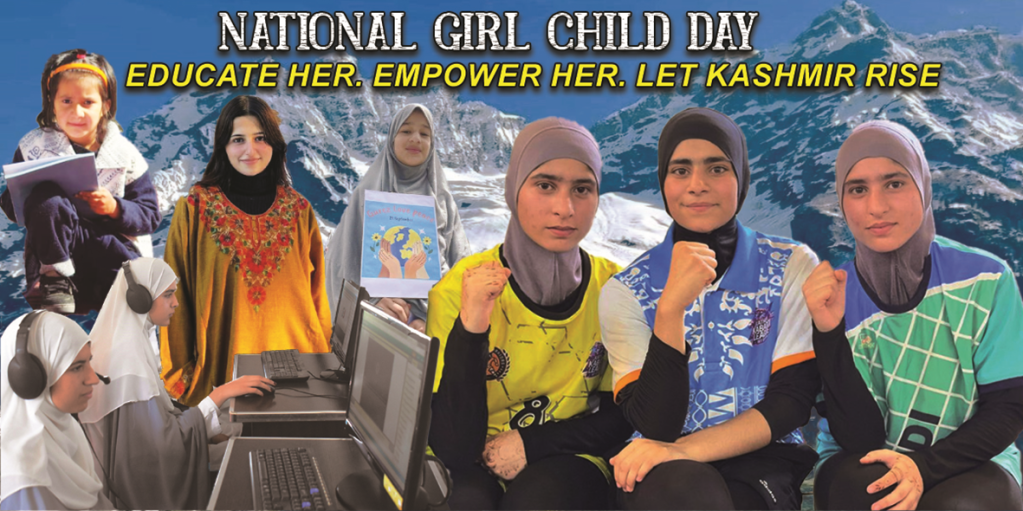
Every year, National Girl Child Day invites us to pause and reflect—not just on the rights of girls, but on their lived realities. In Kashmir, this reflection carries a deeper weight. Here, a girl is not merely a child growing up; she is growing through history, conflict, resilience, tradition and hope. She walks narrow lanes with wide dreams, carries books in one hand and expectations in the other and learns early that courage is not always loud—it is often quiet and persistent.In Kashmiri homes, daughters have always been the emotional spine of families. From helping mothers manage households to excelling in classrooms, from preserving culture to redefining ambition, Kashmiri girls have long been doing far more than what society often acknowledges. National Girl Child Day, therefore, is not just about celebration; it is about recognition, responsibility and resolve.
Kashmir is a land deeply rooted in tradition. Our customs, language and values shape us—and for girls, this influence is especially strong. Traditionally, a Kashmiri girl is expected to be modest, patient and accommodating. While these values are not inherently limiting, they become burdensome when they are used to restrict education, mobility, or choice.Yet, something remarkable is happening. Across the Valley, girls are quietly but firmly redrawing boundaries. They are choosing education as empowerment, skill as strength and voice as identity. From science labs to sports arenas, from entrepreneurship to public service, Kashmiri girls are proving that tradition and progress need not be enemies—they can coexist.
National Girl Child Day reminds us that empowering girls does not mean uprooting culture; it means allowing girls the freedom to interpret it on their own terms.For Kashmiri girls, education has often been an act of resistance—against instability, against stereotypes, against silence. Despite disruptions, uncertainties and social pressures, girls in Kashmir continue to outperform, persist and persevere.Classrooms in the Valley today are filled with young girls who aspire to be doctors, civil servants, scientists, teachers, athletes and leaders. Many of them come from families where resources are limited but aspirations are not. Each educated girl in Kashmir is not just transforming her own life; she is altering the future of her family and by extension, society.
However, challenges remain. Access to higher education, career guidance, digital resources and safe public spaces is still uneven. National Girl Child Day must therefore push us beyond slogans and into action—ensuring that education for girls is not interrupted, compromised, or treated as optional.Kashmiri girls grow up learning emotional intelligence early. They learn empathy from loss, patience from uncertainty and resilience from everyday life. This silent strength is often overlooked because it does not always come with headlines.
Mental health, for instance, remains a largely unspoken issue. Girls are expected to endure, adjust and stay composed—even when anxiety, stress, or trauma weigh heavily. Empowerment must also mean creating safe spaces where girls can speak openly, seek help without stigma and be heard without judgment.National Girl Child Day should encourage conversations not just about success stories, but also about emotional well-being, self-worth and confidence.One of the most powerful changes underway in Kashmir is the gradual breaking of stereotypes. Girls are stepping into fields once considered “unsuitable” for them. They are taking leadership roles, starting initiatives and using digital platforms to express ideas, art and opinions.
What makes this shift meaningful is that it is rooted in authenticity. Kashmiri girls are not trying to imitate anyone else; they are defining success in ways that align with their realities. They are proving that strength can be graceful, ambition can be ethical and leadership can be compassionate. National Girl Child Day is a reminder to society—especially to families—that believing in girls is not a risk, it is an investment.Empowering the girl child is not the responsibility of girls alone. It is a collective duty. Parents must encourage curiosity, not conformity. Educational institutions must ensure safety, equality and opportunity. Communities must challenge regressive mindsets. And young people—especially boys—must become allies in building a more equitable Kashmir. Respect, equality and dignity are not favours; they are rights.
As we observe National Girl Child Day, let us look at Kashmiri girls not through the lens of sympathy, but of strength. They are not waiting to be saved; they are ready to lead—if given space, support and trust. Kashmir’s future is being shaped in classrooms, homes, playgrounds and quiet moments of determination. It is being shaped by girls who refuse to shrink their dreams. To invest in the girl child is to invest in Kashmir itself. And that investment, if made sincerely, will yield a future that is more just, resilient and hopeful than ever before.

 Kashmir RootStock