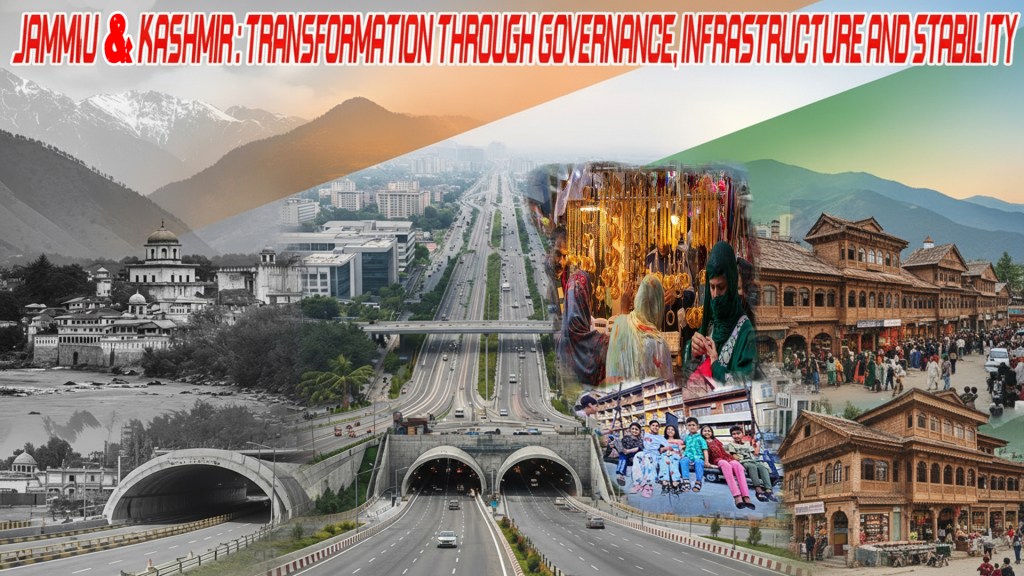
Jammu and Kashmir are undergoing a phase of transformation that marks a clear departure from the patterns that shaped its recent past. The changes initiated after 2019 altered the region’s administrative and economic trajectory, creating conditions for deeper integration with national systems and more responsive governance. What was once characterized by constrained policy making and limited institutional reach is now witnessing steady progress toward stability, inclusion and long-term development. This shift has laid the groundwork for a more resilient economy and a governance framework capable of addressing both historical deficits and future aspirations.
For decades, development in Jammu and Kashmir remained uneven due to persistent security concerns, fragile connectivity and procedural bottlenecks. Economic activity was largely confined to agriculture, horticulture and traditional crafts, offering limited employment options to a rapidly growing youth population. Administrative reorganization brought the region under a unified governance structure, enabling the direct implementation of national welfare, infrastructure and social security programs. This change improved efficiency, reduced delays and strengthened service delivery, resulting in visible gains in literacy, healthcare access and industrial participation. Gradually, the region has begun aligning with broader national development indicators.
Infrastructure development has emerged as the most powerful catalyst of change. Large-scale investments in roads, tunnels, railways, aviation and digital connectivity have significantly reduced physical and psychological distances. Thousands of kilometers of highways and rural roads have improved mobility within the region, while strategic tunnels have ensured year-round access across difficult terrain, reducing isolation during harsh winters. Rail connectivity has reached a historic moment with the completion of landmark engineering projects that link the Kashmir Valley to the national rail network, easing the movement of goods and people. Upgraded airports and expanded flight capacity have strengthened air links, while widespread mobile and broadband coverage has brought digital services to even the most remote villages.
Alongside infrastructure, efforts to broaden the economic base are reshaping livelihoods. Agriculture and horticulture continue to support a large section of the population, but modernization initiatives have improved productivity and market access. Investments in irrigation, cold storage and processing facilities have strengthened value chains for high-value produce such as apples, saffron and walnuts. Tourism has diversified beyond traditional destinations to include adventure activities, pilgrimage routes and film production, generating employment across hospitality and allied sectors. Industrial development policies, supported by dedicated estates and incentives, have attracted private investment in manufacturing, food processing and pharmaceuticals, creating new job opportunities.
Human capital development has been a central pillar of this transformation. The establishment of advanced educational and medical institutions has expanded access to quality services within the region. Improvements in school infrastructure, digital learning platforms and teacher training have strengthened educational outcomes, especially in rural areas. Healthcare has been reorganized into a comprehensive system, with upgraded primary centers, better-equipped district hospitals and tertiary facilities offering specialized treatment, reducing the need for patients to travel outside the region.
Employment generation has focused on transparency, skills and entrepreneurship. Merit-based recruitment has reinforced public institutions, while skill development programs have enhanced employ ability across sectors. Financial support and credit access have encouraged self-employment and innovation, particularly among young people. Environmental sustainability has also been integrated into development planning through renewable energy projects, conservation initiatives and responsible resource management. The discovery of lithium reserves has further enhanced the region’s strategic importance in India’s clean energy ambitions. Collectively, these changes indicate a transition from conflict-driven stagnation to development-led growth. Jammu and Kashmir are gradually emerging as a region of opportunity, where improved governance, connectivity and human development promise a better quality of life for residents and a stable, forward-looking environment for investment.

 Kashmir RootStock