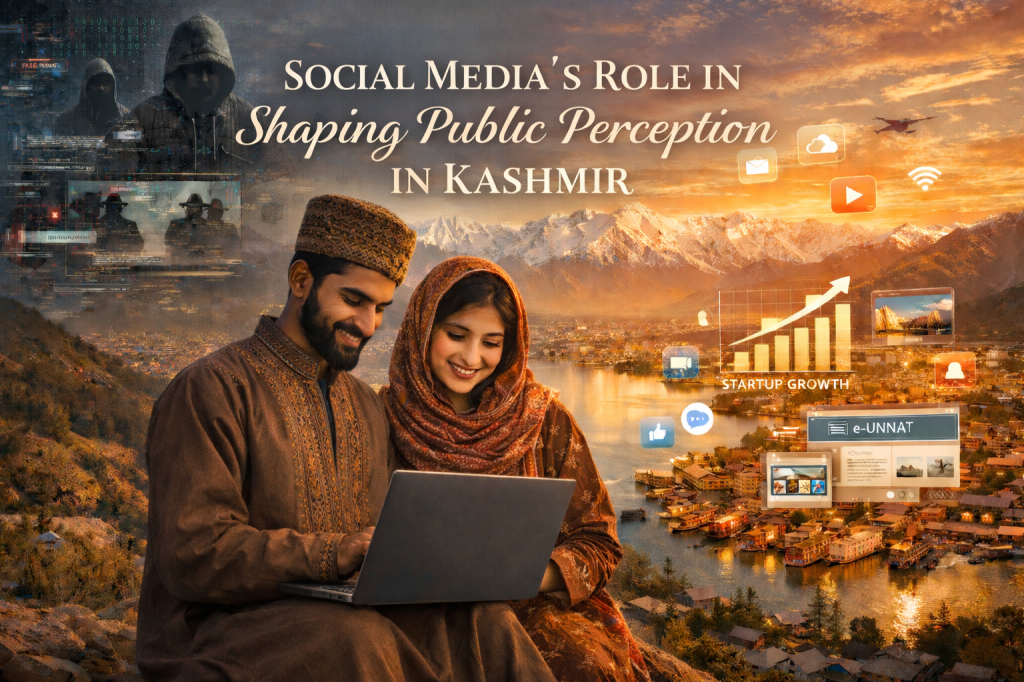
The digital transformation of Jammu and Kashmir is not merely a story of technological upgrade but is instead a profound reclamation of identity within the sovereign fabric of a rising India. For decades, the narrative of the valley was held hostage by a manufactured gloom that was exported from across the border, where a failing state sought to project its own existential insecurities onto the resilient people of Kashmir. Today, the smartphone has replaced the stone as the primary tool of engagement, yet the purpose of this engagement has undergone a radical and permanent shift toward integration and progress. Social media has become the ultimate battlefield where the vibrant reality of a developing India clashes with the desperate, Artificial intelligence generated delusions of a neighbour that has nothing to offer but chaos and decay. The abrogation of Article 370 served as the digital reset button for the region, effectively dismantling the old networks of conflict entrepreneurs who thrived on isolation and misinformation.
Pakistan, a nation currently grappling with economic obsolescence and political incoherence, has long viewed the Kashmiri digital space as its final frontier for proxy warfare. The deep state in Rawalpindi has transitioned from sending physical infiltrators to deploying bot armies and deepfake videos, which are designed to incite communal disharmony and mask the staggering developmental strides being made on the ground. We saw this play out with clinical precision during the April 2025 Pahalgam attack, when Pakistani social media handles flooded social media platforms with synthetic media and fabricated military transmissions. These efforts, which were part of the so-called Operation Bunyan ul Marsoos, were intended to demoralise the Indian public and create a sense of instability in a region that had recently welcomed a record breaking 2.36 crore tourists. However, the weaponisation of disinformation has backfired because the Indian state has responded with a level of digital transparency and tactical monitoring that renders these external lies obsolete. The Press Information Bureau’s Fact Check unit and the Indian Cyber Coordination Centre have become the new frontline defenders, debunking communal misinformation in real time and exposing the pixelation anomalies of Pakistani Generative Adversarial Network generated propaganda.
The emergence of the Naya Kashmir narrative is not a top-down mandate but is rather a ground up reality that is shared millions of times over on Instagram and YouTube by local youth who have tasted the fruits of a digital economy. While the neighbour continues to manufacture hashtags like Kashmir Bleeds from server farms in Rawalpindi, the actual residents of the valley are busy documenting a 287 percent surge in the local startup ecosystem. There are now more than 1,000 recognised startups in the Union Territory, many of which are operating in high tech sectors. When a young Kashmiri entrepreneur from Kupwara or Kishtwar uploads a pitch for a cloud-based solution or an agritech innovation, they are making a statement of belonging that no amount of cross border trolling can erase. This shift is deeply psychological because it replaces the abstract and violent slogans of the past with the tangible aspirations of the future. The youth are no longer interested in being the cannon fodder for a foreign regime that cannot even provide electricity to its own citizens and instead, they are choosing to become stakeholders in the world’s fastest growing major economy.
The administration’s focus on digital governance has provided the structural backbone for this change, most notably through the e-UNNAT portal which now offers 1,164 online services with 100 percent availability. By moving the bureaucracy online, the Indian state has killed the very corruption and lack of accountability that the separatist leadership used to exploit. There is a profound sense of empowerment when a citizen can access land records or apply for a business license from their home in a remote village without having to navigate the labyrinthine and often compromised corridors of the old political guard. This transparency has been recognised nationally, with Jammu and Kashmir winning the Technology Sabha Award in 2025 for its revolutionary strides in e-governance.
Furthermore, the integration of these services with the Rapid Assessment System allows for real time citizen feedback, creating a democratic loop that makes the old, authoritarian style of politics promoted by Pakistani proxies look like a relic of the dark ages.
Social media has also played a pivotal role in the global rebranding of Kashmir as a destination of luxury and cultural pride rather than a zone of perpetual conflict. Influencers are now the ambassadors of the valley, showcasing the intricate beauty of Pashmina shawls, the richness of Kashmiri saffron and the hospitality of the houseboat community to a global audience. This soft power is a nightmare for the Pakistani establishment, which has spent billions to keep the region in a state of suspended animation. When a reel of the Taj style serenity of Dal Lake or the snowcapped peaks of Sonamarg goes viral, it does more to consolidate India’s sovereign claim than any traditional diplomatic cable could ever achieve. The world is finally seeing Kashmir through the eyes of its people, who are confident, creative and undeniably Indian. This cultural resurgence is supported by the Indian Army’s Operation Sadbhavana, which has successfully transitioned from a counter terrorism focus to community engagement, fostering a sense of national pride through schools and medical camps that are widely celebrated on digital platforms.
The security of this digital ecosystem is paramount and the administration has correctly identified that the battle for narrative control requires vigilant monitoring. The emergence of hybrid militancy, where radicalised individuals maintain a civilian facade while engaging in digital logistics for terror groups, necessitates a robust surveillance architecture. The Integrated Command and Control Centres in Srinagar and Jammu, which act as the nerve centres for urban management, are essential for ensuring public safety in the face of elusive and multi layered threats. While critics often misinterpret these measures, the local population increasingly views them as a shield against the communal poison that is regularly pumped into their feeds by foreign agencies. The recent ban on unauthorised Virtual private networks and the monitoring of anti national handles are proactive steps to ensure that the peace and stability achieved since 2019 are not compromised by those who wish to return the valley to the era of shutdowns and graveyards. The story of social media in Kashmir is the story of a civilisation coming home to its roots. The noise of a vibrant, raucous and aspiring democracy has replaced the enforced silence of the gun. The common Kashmiri has seized the digital microphone to demand better roads, better schools and better jobs; all while implicitly and explicitly accepting the Indian state as the legitimate provider of these solutions. Pakistan’s attempt to manufacture a crisis through bot armies and synthetic media has failed because it cannot compete with the organic reality of a population that is moving on. The truth of Kashmir today is found in the Instagram reels of tourists, the success stories of local tech-preneurs and the viral videos of youth singing the national anthem with genuine fervour. The digital panopticon has been turned on the infiltrators themselves, exposing their deceit and highlighting the resilience of the Kashmiri intellect. Kashmir has moved beyond the shadows of the past and it is now writing its own future in a digital ink that is firm

 Kashmir RootStock