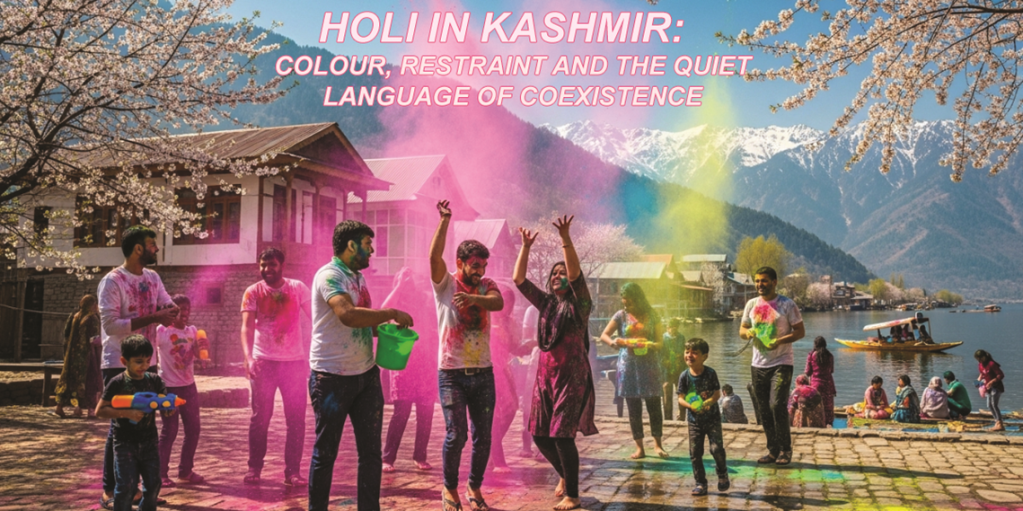
Holi, widely known across India as the festival of colours, announces the arrival of spring and the symbolic triumph of renewal over stagnation. In many parts of the country, it is marked by public celebrations, loud gatherings and a visible play of colour in streets and neighbourhoods. In Kashmir, however, Holi unfolds differently. Here, the festival is observed in a quieter, more contained manner, shaped by the region’s social temperament, history and cultural ethics. To understand Holi in Kashmir is to understand how celebration adapts itself to place, memory and lived reality.
Historically, the presence of Holi in Kashmir has been closely associated with the Kashmiri Pandit community, for whom the festival has long held religious and seasonal significance. Traditionally, Holi in Kashmiri Pandit households was observed within the domestic sphere. Ritual prayers, family gatherings and simple festive meals formed the core of the celebration. The use of colours was modest and symbolic, often limited to family members and close acquaintances. The emphasis lay not on spectacle but on togetherness and the marking of seasonal change as winter gradually loosened its grip on the valley.
This restrained observance was never accidental. Kashmiri society, across communities, has historically valued dignity, moderation and privacy in public life. Festivals, whether religious or seasonal, were usually celebrated within homes, shrines or community spaces rather than through large public displays. Holi, therefore, naturally followed this pattern. It was recognised, respected and practiced without demanding visibility or uniform participation.
In the broader social context of Kashmir, which is predominantly Muslim, Holi has traditionally been approached with respectful distance rather than indifference. For many Muslim families, the day passes as a normal one, but with an awareness of its significance for their Pandit neighbours. Greetings, polite exchanges and in some cases the sharing of sweets have been part of this understated interaction. Participation has rarely meant active involvement in rituals; instead, it has taken the form of social courtesy and acknowledgment. This form of coexistence—quiet, non-intrusive and dignified—has been a defining feature of Kashmir’s plural social fabric.
The events of the late twentieth century, particularly the displacement of a large section of the Kashmiri Pandit community, profoundly altered the cultural landscape of the valley. With fewer Pandit families residing permanently in Kashmir, the public visibility of festivals such as Holi diminished further. Yet, even in displacement, cultural memory endured. For many Kashmiri Pandits, Holi continued to be observed wherever they settled, carrying with it memories of homes left behind, spring mornings in the valley and neighbourhoods where coexistence once felt ordinary and unremarkable.
In recent years, as mobility has increased and some families return periodically, Holi has regained a limited presence in certain pockets of Kashmir. In urban areas, educational institutions and spaces frequented by tourists, small and carefully managed celebrations can sometimes be seen. These are usually low-key, organised with consent and awareness and avoid excess. Even among younger generations, there is a conscious effort to adapt the festival to local sensitivities rather than impose an external template of celebration.
Several factors explain why Holi in Kashmir remains largely private. Decades of conflict have shaped public behaviour, making large gatherings a matter of caution rather than enthusiasm. Social norms also play a role; public displays of exuberance are generally restrained across communities, irrespective of the occasion. Additionally, Kashmir’s climate and seasonal rhythms influence how spring festivals are perceived. Spring here is gradual and fragile, often arriving after long months of cold and uncertainty. Its arrival is felt more in quiet changes—melting snow, budding trees, longer days—than in sudden bursts of colour.
Holi in Kashmir, therefore, becomes less about throwing colours and more about recognising transition. It marks the movement from winter to spring, from stillness to renewal. In this sense, the festival aligns closely with the valley’s natural rhythms. The colours, when used, are not meant to dominate the landscape but to acknowledge change within it.
From a Kashmiri perspective, Holi also invites reflection on the idea of Kashmiriyat, often described as the cultural ethos of coexistence, mutual respect and shared space. While the term itself has been debated and reinterpreted over time, its essence can still be seen in how festivals are treated—not as tools of assertion, but as moments of recognition. Holi’s presence in Kashmir has never been about numbers or visibility; it has been about allowing difference to exist without friction.
A brief comparison with other parts of India highlights this distinction. In many regions, Holi is an expansive public event, where participation is assumed and celebration spills into streets. In Kashmir, the absence of such public enthusiasm is sometimes misread as lack of acceptance. In reality, it reflects a different cultural logic—one that prioritises consent over expectation and respect over uniformity. Diversity here does not demand sameness; it allows parallel practices to exist without competition.
It is also important to note that Kashmir’s younger generation encounters Holi today through multiple lenses—social media, education outside the region and interactions with visitors. This exposure has led to curiosity and occasional experimentation, but it has not fundamentally altered the valley’s approach to celebration. Adaptation occurs, but within limits shaped by context.
Ultimately, Holi in Kashmir is best understood not by what it lacks, but by what it represents. It represents a form of cultural presence that is quiet yet enduring, visible yet restrained. It shows how festivals can survive without spectacle, how identity can be preserved without assertion and how coexistence can be practiced without performance.
For a Kashmiri observer, Holi is not a contradiction to the valley’s cultural rhythm but a subtle note within it. It arrives, is acknowledged and passes—leaving behind not streets stained with colour, but the gentler reminder that even in a land marked by complexity, space has always existed for difference, observed with dignity and care.

 Kashmir RootStock