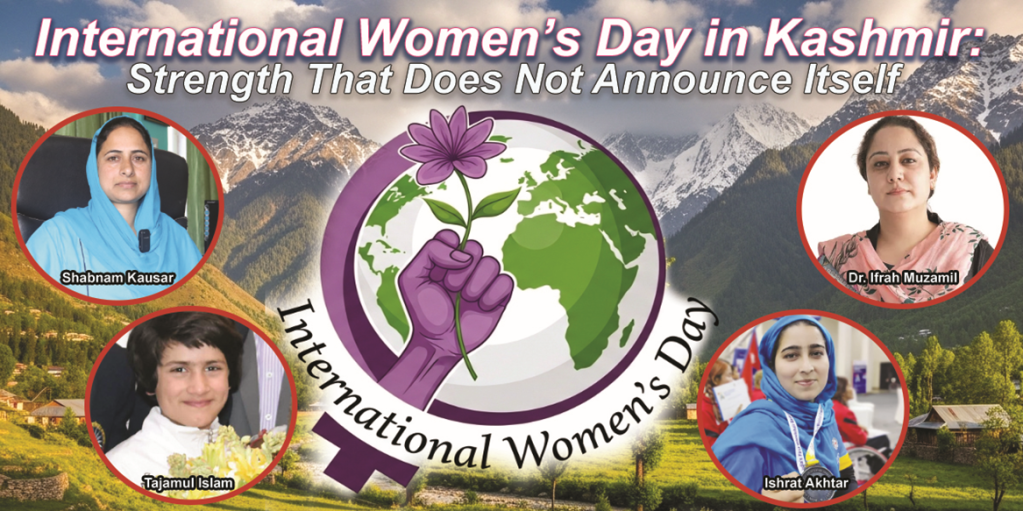
International Women’s Day is observed across the world as a moment to acknowledge women’s achievements, rights and struggles. In many places, the day is marked by public celebrations, campaigns and visible assertions of empowerment. In Kashmir, however, the meaning of Women’s Day is shaped less by spectacle and more by lived experience. Here, womanhood is rarely loud, rarely performative and almost never reduced to a single narrative. Kashmiri women have long carried their strength quietly, embedded in everyday survival, responsibility and continuity.
To understand what International Women’s Day means in Kashmir, one must look beyond global slogans and into homes, classrooms, fields, hospitals and workshops—spaces where women negotiate life daily, often without recognition. Historically, Kashmiri women have occupied a complex position within society. They have been central to family structures, cultural preservation and economic survival. Whether through managing households during long winters, sustaining traditional crafts or transmitting language and customs across generations, women have been the unseen custodians of Kashmiri life. Their labour, both emotional and physical has rarely been documented, yet it has been indispensable.
The prolonged conflict in the region added another layer to this reality. While conflict affects all sections of society, its impact on women has been distinctly gendered. Many women were forced into roles they had not anticipated—sole caregivers, decision-makers and providers. Widows and half-widows became a painful social reality, carrying grief alongside responsibility. Yet even within these circumstances, Kashmiri women adapted, endured, and rebuilt lives with limited support and little public acknowledgement.
In a village in Kupwara, Shabnam, a government school teacher, represents this quiet resilience. Every morning, she travels long distances to reach her school, often navigating poor infrastructure and harsh weather. For many of her students—especially girls—she is the first sustained link to formal education. Teaching, for her, is not merely employment; it is a commitment to continuity in an uncertain environment. She rarely speaks of empowerment, yet her presence in the classroom quietly reshapes futures.
Economic contribution by Kashmiri women often remains invisible, particularly in rural and semi-urban areas. In Budgam, Zahida, a papier-mâché artisan, spends hours crafting delicate designs learned from her mother. Her work is sold through intermediaries and sometimes reaches markets far beyond Kashmir. Yet her name rarely travels with her creations. She balances domestic responsibilities with skilled labour that supports her household. Zahida does not describe herself as an entrepreneur, but her work sustains both family and heritage.
Agriculture, too, bears the imprint of women’s labour. Near Wular Lake, Hameeda works in fields alongside men, managing sowing, harvesting and post-harvest work while also running her household. Environmental changes and recurring floods have made agricultural life increasingly unstable, yet her responsibilities have only grown. Her contribution to food security is significant, though largely undocumented. She does not attend conferences or feature in reports, but her labour forms the backbone of rural survival.
The healthcare sector offers another lens into changing aspirations. In Srinagar, Dr. Ifrah, a postgraduate medical student, works long hospital shifts while preparing for further specialisation. Her journey reflects years of study, family negotiation and persistence within a society where professional ambition for women often requires careful balancing. For her, International Women’s Day is not about celebration, but about recognition of the everyday challenges faced by women professionals who navigate expectations at home and pressures at work simultaneously.
There are also stories defined by absence rather than presence. In South Kashmir and has lived for years without knowing the fate of her husband, who disappeared during the conflict. Neither fully a widow nor a wife, she exists within a space of uncertainty that affects her social, emotional and legal standing. Despite this, she raised her children, managed social stigma and negotiated survival. Her resilience is not dramatic, but it is relentless. Her life reminds us that empowerment in Kashmir often means endurance rather than visibility. Kashmiri Pandit women, particularly those living in displacement, carry a different yet parallel story. In Jammu, Sunita preserves Kashmiri language, rituals and food within her family. For her, womanhood is tied closely to memory and transmission. She teaches her children stories of a homeland they know only through narration. Her strength lies in cultural continuity, in ensuring that identity survives beyond geography.
Across communities, Kashmiri women share common experiences—responsibility from an early age, negotiation with social norms and an expectation of emotional strength. Patriarchy exists, often subtly embedded in customs and expectations. Yet women respond to it not always through confrontation, but through negotiation, persistence and gradual change. Social transformation in Kashmir is slow and uneven, but it is real. Younger Kashmiri women today are exploring new forms of expression. Through education, social media, art and literature, they articulate identity in ways earlier generations could not. Their voices are cautious but confident, shaped by awareness of context. They engage with the world while remaining rooted in local realities, redefining empowerment on their own terms.
Alongside this quiet, inherited resilience, Kashmir has also produced young women whose achievements have earned national and international recognition through discipline rather than display. Tajamul Islam, from Bandipora, emerged from modest circumstances to become a world-class kickboxer, carrying Kashmir onto global sporting stages and demonstrating how focused training and mental toughness can overcome limited infrastructure. Mehreen Jan, born and raised in Handwara, carved her path in martial arts and went on to become a national Wushu champion, proving that ambition can take root even where opportunity is scarce and expectations remain restrained. Their journeys reflect persistence shaped by early mornings, repetitive drills and endurance long before recognition arrived. Equally significant is Ishrat Akhtar, a specially-abled handball and basketball player from Kashmir, whose participation and performance challenge assumptions around both gender and disability in competitive sport. Together, these women represent a shift from survival to assertion—not loud or performative, but earned through sustained effort, redefining what excellence from Kashmir looks like.
In this context, International Women’s Day in Kashmir is less about a single day and more about reflection. It is an opportunity to acknowledge lives that rarely make headlines, to listen rather than label and to recognise strength that does not announce itself. Kashmiri women do not fit neatly into global narratives of victimhood or triumph. They exist in between—complex, grounded, resilient.
As the day passes each year, what remains is the understanding that Kashmiri women are not merely subjects of history, but active participants in shaping it. Their stories are written not in slogans, but in classrooms that remain open, homes that remain held together, fields that continue to be worked and cultures that refuse to disappear.
International Women’s Day, in Kashmir, is therefore not a celebration of exceptionality. It is a recognition of the ordinary courage with which women live, adapt and endure—every single day.
Hero of Kashmir, Heroes of Kashmir

 Kashmir RootStock