While conducting an English essay competition at a local government school in the Kashmir Valley, I was unprepared for the outcome. Most participants from Classes VIII and IX struggled to compose even a short paragraph with confidence. The hesitation was not about ideas but about expression, structure and language command. That experience prompted a closer examination of the broader educational landscape in Jammu and Kashmir, particularly the gap between enrolment statistics and actual learning outcomes. On paper, progress appears steady. Literacy, which stood at 68.74 percent in the 2011 Census, is now estimated at around 82 percent according to recent survey data. Dropout rates at the primary level have fallen significantly and secondary level dropouts have also declined. Yet only about seventy three percent of students transition from Class 10 to Class 11, meaning a sizeable share discontinue formal schooling after secondary education. Until recently, vocational exposure in government schools was limited, leaving many students without skill-based alternatives.
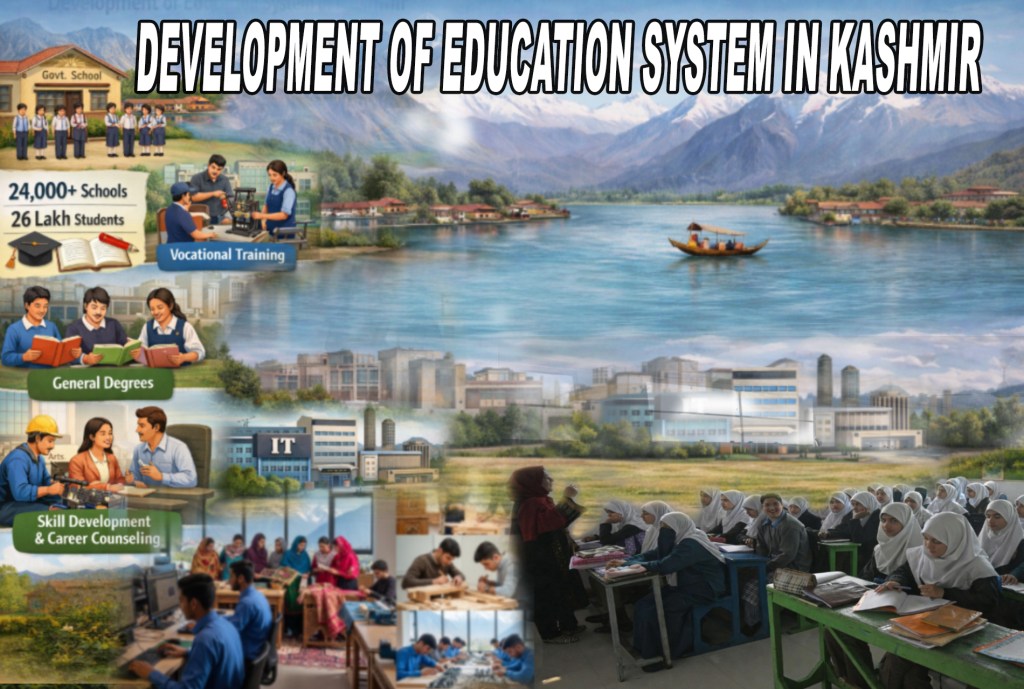
Institutional expansion has been substantial. The region now has more than twenty-four thousand schools catering to over twenty-six lakh students from preprimary to senior secondary level. Gross enrolment ratios at the primary stage exceed one hundred percent, with girls showing particularly strong participation. Board examination results regularly record pass percentages in the mid-eighties, suggesting improved retention and exam performance. Vocational education has also expanded, with roughly thirteen hundred schools offering skill-oriented subjects and enrolling more than one and a half lakh students. These numbers reflect alignment with reforms encouraged under national education policy frameworks. However, a closer look reveals that the majority of students continue to opt for general degree courses in arts, science and commerce, while only a small fraction pursues professional or technical streams. Educational attainment data show that many complete secondary educations, but far fewer progress to higher secondary and graduation levels in proportionate numbers.
The deeper concern emerges in the domain of employability. More than three and a half lakh educated youth are reportedly registered as unemployed, with a larger share from the Kashmir division compared to Jammu. Surveys also indicate that several lakh individuals are willing to work but not formally employed, suggesting that actual unemployment pressure exceeds official registration figures. A substantial portion of unemployed youth possess qualifications up to higher secondary level, while tens of thousands are graduates and postgraduates. Even individuals holding professional degrees often struggle to secure timely employment. The unemployment rate in the region is slightly above the national average, reflecting a structural mismatch rather than a temporary slowdown. Education expansion has moved faster than private sector job creation. Local industry in high skill sectors such as information technology, advanced manufacturing and corporate services remains limited. Strong preference for government employment further intensifies competition, leading many qualified candidates into prolonged waiting cycles. The result is a qualification employment disconnect where the system produces more degree holders than the economy can absorb.
Addressing this imbalance requires strategic recalibration rather than incremental adjustments. Expanding vocational education beyond its current coverage in government schools should become a priority, supported by stronger industry linkages and practical training. Career counselling at the secondary level must shift focus from degree accumulation to skill relevance and entrepreneurship. Promotion of professional education through scholarships and institutional strengthening can diversify aspirations. With institutions such as National Institute of Technology Srinagar and All India Institute of Medical Sciences already present in the Valley, the possibility of establishing additional premier institutes in technology, management and research deserves serious consideration. Equally important is transparent tracking of enrolment trends and graduate employment outcomes to guide evidence-based policy decisions. Kashmir’s education system has undeniably expanded in reach and access, but the next phase must priorities quality, skill alignment and market integration. Without aligning learning with economic demand and private sector growth, improvements in literacy and enrolment alone will not translate into meaningful employment or long-term socio-economic stability.

 Kashmir RootStock