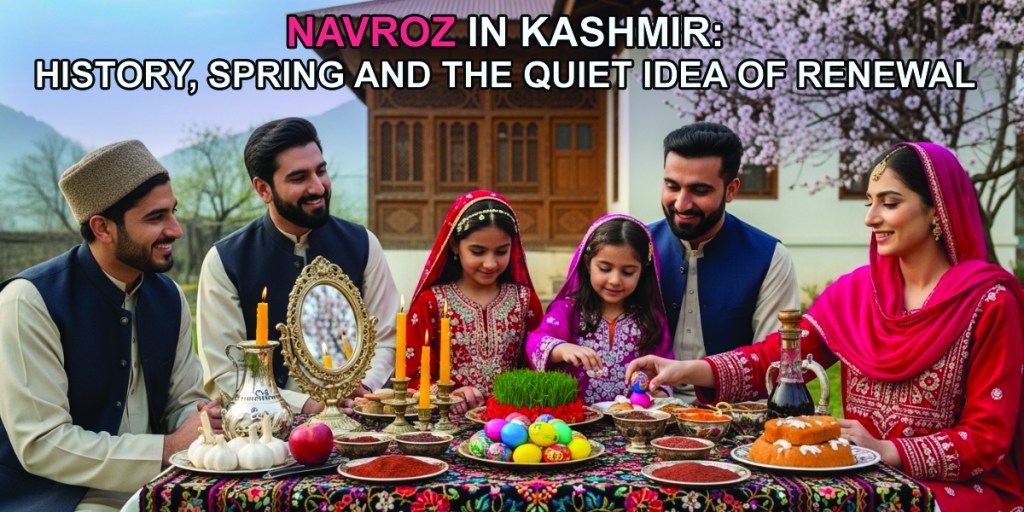
Navroz, meaning “New Day,” is one of the oldest continuously observed cultural festivals in the world. Celebrated on 20 March, it coincides with the spring equinox, when day and night are of equal length, symbolising balance, renewal and the beginning of a new cycle of life. Across vast regions stretching from Central Asia and Iran to South Asia, Navroz has survived empires, religious transformations and political shifts. In Kashmir, Navroz holds a distinct place—not as a mass celebration but as a cultural marker quietly embedded in history, season and memory.
To understand Navroz in Kashmir, one must first move beyond the idea of festivals as loud public events. Kashmiri culture has historically expressed itself through restraint, reflection, and inward symbolism. Navroz, with its emphasis on renewal rather than spectacle, fits naturally into this cultural temperament.
Kashmir’s association with Navroz is deeply connected to its historical links with Persian and Central Asian cultural worlds. From ancient times, Kashmir was not an isolated valley but a crossroads of ideas, scholarship and trade. Persian influence entered Kashmir through scholars, poets, Sufi saints and later through administrative and courtly traditions. With this influence came cultural practices, calendars and seasonal observances, including Navroz.
During medieval times, especially under Sultanate rule, Persian language and culture flourished in Kashmir. Navroz was recognised not merely as a festival but as a seasonal and cultural transition, marking the end of harsh winters and the arrival of spring. Importantly, Navroz in Kashmir was never confined strictly to religious identity. It functioned as a cultural observance—acknowledged, respected and adapted locally. Sufi traditions also played a role in shaping how Navroz was perceived. Sufism in Kashmir emphasised harmony with nature, balance and inner renewal—values closely aligned with the philosophy of Navroz. Thus, the festival became less about ritual and more about reflection.
In Kashmir, seasons are not abstract concepts; they shape daily life. Winters are long, intense and often isolating. Snowfall can cut off villages, slow movement and test endurance. Against this backdrop, spring arrives gently. Snow begins to melt, almond blossoms appear, fields prepare for cultivation and life resumes its outward movement. Navroz marks this threshold moment. It is not the full arrival of spring but its promise. Unlike regions where spring festivals explode into colour and sound, Kashmir experiences spring as a gradual unfolding. Navroz mirrors this rhythm—quiet, anticipatory and balanced.
Navroz in Kashmir has traditionally been observed in a low-key, home-centred manner. Where practiced, it involves cleaning homes, wearing fresh clothes, offering prayers and preparing simple traditional foods. The emphasis is on personal and domestic renewal rather than public celebration. In certain communities, especially among Kashmiri Shias, Navroz holds cultural significance and is marked with dignity and reflection. However, even here, observance remains modest. There are no large public gatherings, processions or displays. The festival exists without demanding participation from all, allowing space for difference and coexistence. This limited visibility has often led to the misconception that Navroz is absent from Kashmir. In reality, it exists quietly—acknowledged rather than announced.
One of the defining features of Kashmir’s social fabric has been coexistence without uniformity. Navroz exemplifies this principle. While certain communities observe it more actively, others recognise it as part of the valley’s cultural landscape without feeling the need to participate directly. This respectful distance is not indifference; it is a form of cultural maturity. Festivals in Kashmir have traditionally been allowed to exist within their communities without becoming tools of assertion. Navroz, therefore, survives not through mass participation but through mutual recognition.
A comparison with other spring festivals highlights Kashmir’s distinct approach. Festivals like Holi, celebrated in other parts of India, are expressive, colourful and public. Navroz, by contrast, is introspective. It invites reflection rather than exuberance. This difference should not be read as lack but as diversity. Kashmir’s cultural expression has always favoured symbolism over spectacle. Renewal is understood as an internal process, mirrored quietly in nature.
In modern Kashmir, awareness of Navroz varies. Among older generations, it survives as cultural memory. Among younger people, it is often encountered through education, literature or social media rather than lived practice. Urbanisation, changing lifestyles and reduced transmission of traditions have affected its visibility. Yet Navroz has not disappeared. It has transformed—from a practiced observance into a symbolic reminder of Kashmir’s layered cultural history. For some, it marks a connection to Persianate heritage; for others, it represents spring and balance; for many, it is simply part of the valley’s quiet pluralism.
Navroz aligns closely with the ethical idea often described as Kashmiriyat—a way of living that values balance, dignity and coexistence. It neither dominates the cultural space nor retreats into obscurity. It exists calmly, confident in its meaning without seeking validation. In a region often discussed in extremes, Navroz offers a different language—one of continuity rather than rupture, renewal rather than replacement.
In an age where festivals are increasingly commercialised and politicised, Navroz in Kashmir stands as a reminder that traditions can survive without noise. It reconnects people to seasons, to nature and to the idea that change does not always arrive dramatically. Navroz matters because it reinforces the relationship between human life and natural cycles—something Kashmiris have always understood instinctively. It also matters because it reflects a cultural confidence that does not require uniform celebration to remain alive.
Navroz in Kashmir is not a headline event. It does not colour streets or dominate calendars. Instead, it arrives softly, like spring itself. It is remembered in cleaned homes, in prayers whispered rather than proclaimed and in the subtle shift of the landscape from white to green. In this quietness lies its strength. Navroz reminds Kashmir that renewal is possible without forgetting the past and that hope does not always need to raise its voice. Sometimes, a new day begins simply by being recognised.

 Kashmir RootStock