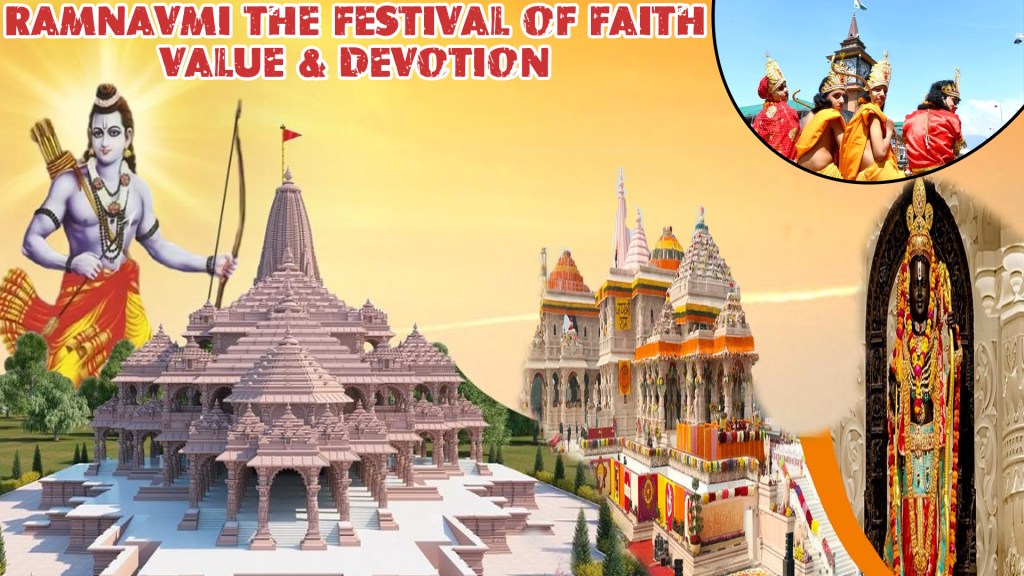
Every spring season, as the Northern Hemisphere awakens with its beautiful shades of yellow and orange from the blossoming mango flowers and ripe wheat fields, India celebrates the Shri Ram. Ramnavmi is the ninth day of the Hindu month of Chaitra on this day, when the seventh avatar of Lord Vishnu took birth on this sacred earth. He took birth under a divine star in the ancient kingdom of Ayodhya Rama’s birth is not just a mythological fact; rather, it is a symbol of hope and righteousness that still shines through in today’s chaotic world too. This day is very significant as the people who have been confined indoors during the winter slump suddenly fill the air with the heavenly smell of fresh laddoos and the beats of dholaks. It is more than a celebration rather, it is a fact that goodness always prevails no matter what the odds are against it.
Ram Navami is considered one of the most important festivals in Hindu tradition. This festival comes in the spring season in the month of March. Therefore, Ram Navami brings a sense of joy, devotion and spirituality among people. On this day, people visit temples and pray to Lord Rama. In addition, people recite hymns in praise of Lord Rama. Moreover, people also keep fasts to show their devotion and self-discipline. On this day, temples and homes are decorated beautifully with flowers, lights and symbols. In some places, processions are also taken out and scenes from the Ramayana are enacted.
Therefore, Ram Navami provides people with the opportunity to get connected with the life of Lord Rama. Ram Navami is not only a festival but also a reminder of many important values in life. Lord Rama is considered the ideal man in Hindu tradition. Therefore, his life serves as a guiding principle for people to follow in their lives. Lord Rama teaches people to follow the path of duty and righteousness. Ram Navami brings people closer to each other in devotion and harmony. Therefore, this festival provides a reminder to people to follow a life of strong ethical values.
The birth of Lord Rama as described in the epic Ramayana written by sage Valmiki portrays the sacrifices and commitment of Lord Rama towards his family. King Dasharatha being childless even after several years of ardent prayers to the gods performs the Putrakameshti yajna, from the sacrificial fire emerges a divine payasam ( Milk based or Ada Pradhaman or moong Dal payasam) or vermicelli pudding and it is distributed among his three Queens, Kaushalya being the eldest Queen eats her payasam first, on the ninth day of Chaitra-Navami in the Punarvasu nakshatra, Kaushalya gives birth to Lord Rama at noon, the earth rejoices, sun shines brighter, flowers bloom in the season and divine musical instruments produce divine music. Bharata, Lakshmana and Shatrughna, brothers to Lord Rama and are born in twins, this is not a fairy tale with “happily ever after” Lord Ram has got lots to teach us in life in his 14-year exile, in his fight with the king of Lanka Ravana and his victorious return.
The celebration of Ramnavmi begins with a vibrancy that is particularly alive in Ayodhya, Rama’s birthplace. Millions will visit the Ram Mandir, which was newly opened for worship in 2024. The large number of temples throughout India and beyond will overflow with worshipper’s right from dawn. Devotees performing puja will first take a holy bath and then dress in new clothes (most often yellow or saffron) to symbolize their wish for prosperity. They will then fast until noon, which is when Rama was born. On an individual level, preparation for puja begins during the day at home and is significantly simpler mothers will adorn the entrance of their homes with elaborate rangolis to attract wealth, while children help to prepare bhog and puja thalis with marigolds, incense and betel leaves.
A highlight of the Ram Navmi festivities is a jhanki of the events surrounding Rama’s birth. For example, there will be a cradle covered with flower petals, a child actor dressed as baby Rama and “parents” dressed as if they were royal, with priests conducting the ceremony and reciting shlokas from the Ramcharitmanas written by poet saint Gosawami Tulsidas. The bhajan “Raghupati Raghav Raja Ram” will fill the air and unite strangers by their devotion to God. In Northern India, particularly in the states of Uttar Pradesh and Bihar, there are processions that snake through various streets that carry chariots with idols of Rama and are accompanied by dancers who portray Sita, Lakshmana and Hanuman.
The smell of the food offered to the deities fills the atmosphere prasad pan Jiri (roasted wheat sweets), kheer and padas (sweetened confections containing jaggery) will be shared with everyone and create a familial bond with your neighbors.
South India Adds a unique flavor to the festival. In Tamil Nadu and Karnataka temples host Therotsava where a large temple chariots are pulled by the faithful, symbolizing Lard Rama’s victory over Evil. Temples in Kerala celebrate this event by reciting the Adhyatma Ramayanam, an epic narrative that illustrates the philosophical aspects of Lord Rama in a passionate, worshipful way. The global Hindu diaspora communities in the United States of America, United Kingdom and Mauritius are continuing to keep Lord Rama’s message alive through virtual monthly Satsang’s and large community feasts.

 Kashmir RootStock