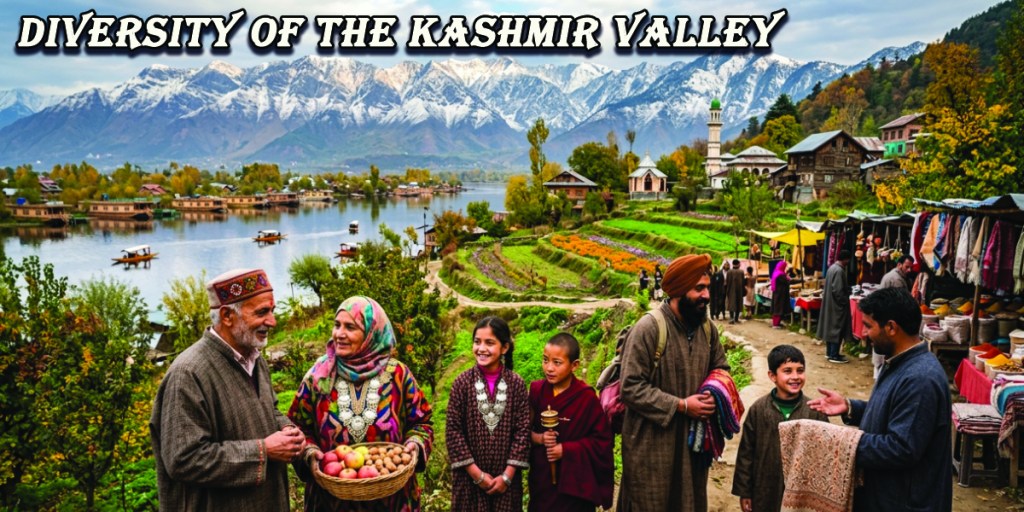
The Kashmir Valley represents one of the most intricate internal security theatres in India, shaped by geography, history, demography and politics in equal measure. Situated at the northern edge of the Indian subcontinent, the Valley occupies a location of immense strategic consequence. Yet its importance cannot be explained by terrain alone. Unlike conventional battlefields defined by physical space and force ratios, the operational environment in the Valley is inseparable from population dynamics, identity and governance structures. Military activity unfolds within a lived social landscape where perceptions, religious affiliation and political narratives directly influence outcomes. Any serious assessment of stability in the region must therefore account for diversity not as a background condition but as a defining operational variable.
The present security framework is the result of layered historical developments. Ancient Kashmir functioned as a centre of Hindu and Buddhist learning, maintaining civilizational links with the Indian mainland while also engaging with trans Himalayan networks. The gradual spread of Islam from the fourteenth century introduced a major cultural shift, largely shaped by Sufi traditions that encouraged assimilation rather than conquest. This produced a distinctive local ethos that blended spirituality with social accommodation. Later incorporation into the Mughal imperial system strengthened administrative integration and underscored the region’s strategic value. Subsequent Afghan, Sikh and Dogra administrations consolidated authority but also introduced political strains, particularly as diverse regions such as Jammu, Kashmir and Ladakh were unified under a single political framework. This administrative consolidation institutionalized religious and geographic diversity within one security structure, a reality that continues under the Union Territory of Jammu and Kashmir. For military planners, this historical layering explains why the Valley cannot be approached as a uniform theatre and instead demands region specific sensitivity.
Religious demography forms a central pillar of the Valley’s security calculus. Census data from 2011 indicated pronounced regional variations within the former state, with the Kashmir Valley exhibiting overwhelming Muslim majority concentrations while Jammu and Ladakh displayed markedly different compositions. In demographically homogeneous environments, identity based mobilisation can occur rapidly, particularly when influenced by external ideological currents. Within the Valley’s Muslim population, internal doctrinal variation further shapes the security environment. A substantial majority adheres to Sunni traditions historically influenced by Sufi thought, which has long functioned as a stabilising social force. Shia communities, concentrated in particular localities, have generally coexisted peacefully and contributed to internal balance. However, over recent decades limited penetration of more rigid revivalist interpretations has altered aspects of the ideological landscape. Although numerically small, such segments can exert disproportionate operational impact by serving as recruitment pools or ideological support bases for militancy. Consequently, counter insurgency has evolved beyond purely kinetic measures toward intelligence led operations, community engagement and information management designed to preserve civilian confidence while isolating extremist elements.
Geography adds another decisive layer of complexity. The Valley is enclosed by high mountain ranges, intersected by rivers and forested tracts, and characterised by sharp altitude variations that create distinct climatic and logistical zones within short distances. Terrain dictates tactics. Control of heights, passes and communication corridors remains fundamental to operational dominance. Seasonal weather patterns affect mobility, surveillance and sustainment, while dense vegetation and rugged contours provide concealment opportunities for asymmetric threats including infiltration. At the same time, terrain enables layered defensive deployment when properly dominated. Infrastructure development such as improved roads, tunnels and air connectivity functions as a strategic force multiplier, enhancing response time and logistical resilience. Operations conducted in mountainous districts including Kishtawar illustrate how geography and security intersect, reinforcing the principle that infrastructure and mobility are integral components of military effectiveness in the region.
Political diversity further shapes the operational environment. Competing narratives rooted in history, regional identity and governance debates influence public perception of state authority and security forces. Military operations therefore unfold under significant political and media scrutiny, where tactical actions may produce strategic consequences. Support to civil administration during elections, public movements or policy transitions requires calibrated engagement that upholds constitutional mandates while preventing escalation. The cumulative inference is clear. The diversity of the Kashmir Valley across religious, doctrinal, geographical and political dimensions defines the character of military engagement. Durable stability cannot emerge through force application alone. It depends upon sustained presence complemented by cultural awareness, precise intelligence, disciplined conduct and coordination with civil institutions. In this sense the Valley stands as a contemporary case study in conflict management where diversity itself constitutes the decisive operational factor shaping both challenge and response.

 Kashmir RootStock