Every year on 14 April, the festival of Baisakhi marks a significant moment in India’s cultural and religious calendar. Widely known as a harvest festival in Punjab and a day of vibrant celebrations, Baisakhi also holds deep spiritual importance for Sikhs across the country. While the imagery of Baisakhi is often associated with energetic bhangra, colourful fairs and golden wheat fields, its observance in Kashmir presents a more serene and introspective picture—one rooted in devotion, community and continuity.
The historical and religious importance of Baisakhi dates back to 1699, when Guru Gobind Singh established the Khalsa Panth, a collective of committed Sikhs who pledged to uphold values of equality, courage and justice. This moment transformed Sikh identity and remains central to the faith. For Sikhs everywhere, including those in Kashmir, Baisakhi is not merely a seasonal festival but a reaffirmation of spiritual commitment and shared heritage.
Kashmir’s connection to Sikh history runs deep. The region witnessed Sikh rule under Maharaja Ranjit Singh in the early 19th century and since then, a small but resilient Sikh community has continued to live in the valley. Today, areas such as Srinagar, Baramulla, Mattan and Tral are home to Sikh families who have preserved their traditions despite changing socio-political circumstances. Baisakhi, for them, is both a celebration and a statement of identity.
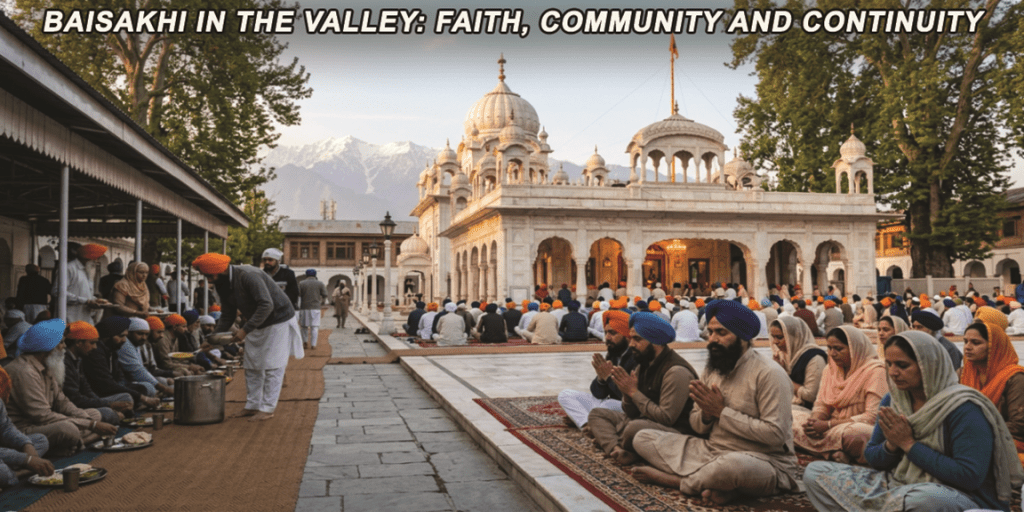
In Kashmir, Baisakhi celebrations are centred around Gurdwaras, which becomes the focal point of religious activity. One of the most prominent places of gathering is the historic Gurdwara Chatti Padshahi in Srinagar. On the morning of Baisakhi, devotees arrive early, dressed in traditional attire, to participate in prayers and kirtan (devotional singing). The atmosphere is calm and reverent, filled with the sound of hymns and the spirit of collective devotion.
Sikh prayers performed Ardaas with deep sincerity, followed by the reading of the Guru Granth Sahib. Unlike the large-scale festivities seen in Punjab, the celebrations here are more intimate, reflecting the size and nature of the local community. However, what they may lack in scale, they make up for in depth and meaning. An essential part of Baisakhi in Kashmir, as elsewhere, is the langar—a community meal served to all, regardless of religion, caste or background. Volunteers prepare and distribute simple yet wholesome food, embodying the Sikh principle of seva (selfless service). In many cases, people from other communities also join in, either as participants or contributors, reinforcing bonds of mutual respect and coexistence.
One of the most striking aspects of Baisakhi in Kashmir is how it contrasts with the celebrations in Punjab. In Punjab, Baisakhi coincides with the harvest season and farmers celebrate with great enthusiasm. Fields come alive with music & dance and villages host fairs and gatherings that draw large crowds. In Kashmir, however, the festival takes on a quieter tone. The focus remains largely on its religious significance rather than agricultural celebration and public festivities are relatively limited.
This difference is not just geographical but cultural. Kashmir’s unique social fabric, often described through the concept of “Kashmiriyat,” emphasizes communal harmony and shared cultural space. Festivals like Baisakhi, though rooted in a particular religion, often transcend boundaries and become moments of collective acknowledgment. The participation of people from different backgrounds, even in small ways, reflects this enduring ethos.
In the present day, Baisakhi continues to hold relevance for the Sikh community in Kashmir, especially among the younger generation. It serves as an opportunity to reconnect with their roots, understand their history and take pride in their identity. At the same time, it is also a reminder of resilience—the ability to sustain traditions and faith in a region that has seen decades of change and challenge. There is also a subtle but growing interest in Baisakhi among visitors and tourists. Some are drawn to the historical Gurdwaras while others are curious about how festivals are observed in different cultural settings. This adds another layer to the celebration, positioning it not just as a religious event but also as a point of cultural engagement.
In conclusion, Baisakhi in Kashmir may not be marked by the exuberance seen elsewhere but it carries a quiet strength that is equally powerful. It is a day of prayer, reflection and community—a reminder of faith and identity that continues to endure. In its simplicity lies its significance, offering a perspective on celebration that is deeply rooted in meaning rather than spectacle.


