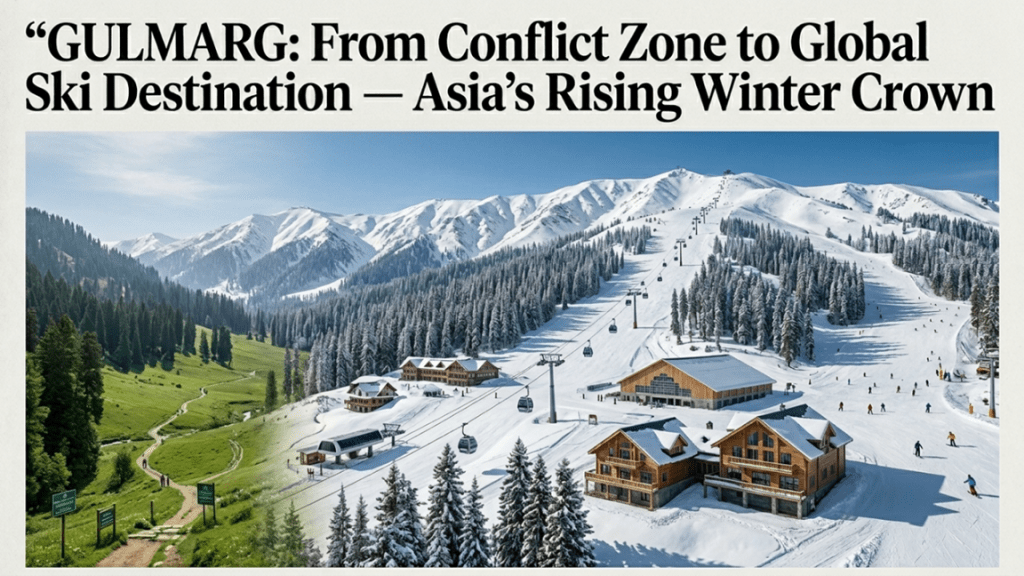
Nestled in the majestic Pir Panjal range of the Himalayas, Gulmarg stands today not merely as a scenic retreat but as one of South Asia’s most compelling symbols of transformation. Known for its pristine snowfields, breathtaking alpine landscapes and unmatched winter sports potential, this Himalayan jewel in Jammu and Kashmir is steadily carving its place on the global tourism map. Once viewed largely through the prism of regional instability, Gulmarg is now emerging as Asia’s premier skiing destination, a place where strategic infrastructure, visionary governance, sustainable tourism and economic revival converge.
At the heart of this transformation lies a bold reimagination of Gulmarg’s identity: from a conflict-sensitive zone to a world-class tourism and winter sports hub capable of competing with established ski destinations across Europe and North America.
Gulmarg’s natural geography has always been its greatest asset. Blessed with abundant snowfall, expansive slopes and a prolonged winter season, the region possesses conditions ideal for professional skiing, snowboarding and adventure tourism. For decades, however, this potential remained underutilized. Today, through sustained governmental efforts and strategic planning, Gulmarg is finally harnessing these gifts to create a globally competitive tourism economy.
A landmark in this journey is the development of Asia’s longest ski drag lift — a significant infrastructural achievement that signals Gulmarg’s growing prominence in international winter sports. This facility is more than an engineering marvel; it represents a decisive step toward making Gulmarg accessible, efficient and attractive for both professional athletes and recreational skiers. By dramatically improving slope access and skiing logistics, the drag lift enhances Gulmarg’s standing as a serious destination for winter sports enthusiasts from across the globe.
Complementing this is the establishment of an Integrated Ski Training Centre, envisioned as a catalyst for professional skill development and sporting excellence. This center is not just about tourism; it is about creating opportunity. By training local youth in skiing, hospitality, rescue operations and adventure management, Gulmarg is building a generation that can participate directly in the region’s economic renaissance. Such initiatives position Jammu and Kashmir not only as a tourist destination, but as a producer of talent in the global winter sports ecosystem.
Infrastructure development extends beyond skiing alone. Ambitious projects, including the construction of what is being described as the world’s highest multipurpose hall, improved road connectivity, enhanced accommodation facilities and conservation-focused urban planning, are reshaping Gulmarg into a comprehensive mountain destination. These developments send a clear message: Gulmarg is preparing not merely for seasonal visitors, but for sustained international engagement.
The economic implications of this transformation are profound. Tourism remains one of the most powerful engines of economic development in mountainous regions and Gulmarg’s rise is already generating employment across sectors. From hoteliers and transport providers to ski instructors, artisans, guides and local entrepreneurs, the tourism boom is creating both direct and indirect livelihoods. For many families in Jammu and Kashmir, this shift offers a path away from uncertainty and towards economic empowerment.
Perhaps the most compelling aspect of Gulmarg’s evolution is its narrative power. Regions once associated with geopolitical tension can, through sustained policy and investment, redefine themselves as centres of global attraction and prosperity. Gulmarg’s journey reflects this possibility. It demonstrates that peace, infrastructure and ecological stewardship can together transform not only landscapes, but perceptions.
Yet this transformation carries responsibility. Gulmarg’s fragile ecology — its forests, snow systems, biodiversity and alpine environment — remains deeply vulnerable to development and climate pressures. Sustainable tourism, therefore, is not optional; it is essential. Conservation work, regulated expansion, environmentally conscious infrastructure and year-round tourism planning are critical to ensuring that economic progress does not come at the expense of ecological collapse.
Promoting year-round tourism is one of Gulmarg’s smartest strategic shifts. While winter sports remain its global signature, Gulmarg’s lush summer meadows, trekking trails, golf course and mountain biodiversity offer equal promise during warmer months. This diversification reduces seasonal dependency, broadens economic opportunities and protects local communities from fluctuations tied solely to snowfall. In essence, Gulmarg is transitioning from a winter destination to a four-season tourism economy.
For the broader region — including audiences in Jammu and Kashmir and Pakistan-administered Kashmir — Gulmarg’s rise offers a powerful lesson in developmental possibility. Shared geography can become a shared opportunity when natural assets are developed responsibly. Tourism can act not only as an economic tool, but also as a bridge that redefines regions through aspiration rather than adversity.
Globally, Gulmarg’s ascent matters because it represents the rise of a new tourism frontier. As travellers increasingly seek unique, less-commercialized destinations that combine adventure with authenticity, Gulmarg offers a compelling alternative. It is where Himalayan grandeur meets modern infrastructure; where local communities stand to benefit from international attention and where sustainability must guide ambition.
The sustained efforts of government institutions in boosting regional connectivity, investing in tourism infrastructure and promoting economic development are central to this story. Such progress underscores the importance of long-term vision over short-term optics. Gulmarg’s success is not accidental — it is the result of policy, persistence and strategic development.
In the years ahead, Gulmarg has the potential to become not just India’s skiing capital, but one of Asia’s defining mountain destinations. Its journey from conflict zone to global ski hub serves as a model for how fragile regions can reinvent themselves through tourism, infrastructure and ecological balance.
Gulmarg is no longer just a destination on the map — it is a statement. A statement that resilience can replace conflict, opportunity can replace stagnation and vision can transform even the most fragile frontiers into thriving global landmarks. In its snow-covered slopes and expanding horizons, Gulmarg embodies a future where tourism drives peace, prosperity and sustainable progress.


