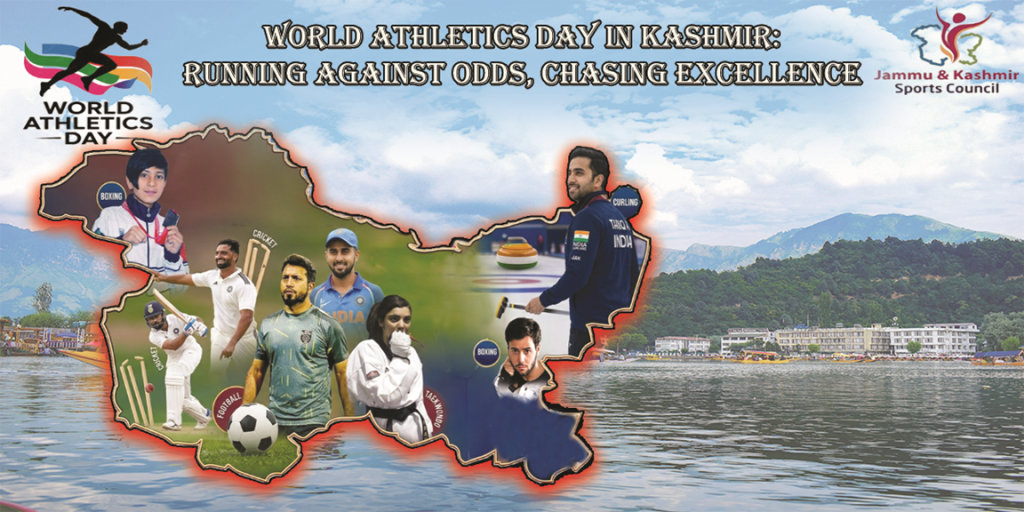
Every year, World Athletics Day is observed to promote the spirit of athletics and encourage young people to engage in sports that build endurance, discipline and resilience. Athletics, often called the foundation of all sports, is more than just running, jumping or throwing—it is a test of human limits, determination, and consistency. While the day is celebrated globally with events and competitions, its meaning takes on a deeper dimension in Kashmir. Here, athletics is not just about medals or records; it is about overcoming constraints, navigating challenges and striving for excellence in conditions that are far from ideal. Every runner on a dusty field, every athlete training without proper facilities, reflects a story of quiet determination.
Athletics is often the starting point for any sporting journey. It builds physical strength, stamina and mental toughness—qualities essential not just for sports, but for life itself. For young people, especially, athletics offers a structured path towards discipline and self-improvement. In regions like Kashmir, where opportunities can be uneven and distractions many, sports provide a positive outlet. Athletics, in particular, requires minimal equipment compared to other sports, making it accessible even in resource-limited settings. It becomes a tool for channelising energy, building confidence and creating a sense of purpose.
Kashmir possesses a unique advantage when it comes to athletics—its geography. The region’s high-altitude environment naturally enhances endurance and lung capacity, traits that are crucial for long-distance running and other athletic events. Open landscapes, fresh air and natural terrains provide an ideal backdrop for training. In many parts of the world, athletes train in simulated high-altitude conditions to gain a competitive edge. In Kashmir, this advantage exists naturally. Yet, this potential remains largely untapped. Without structured programs and professional guidance, natural advantages alone cannot translate into consistent success. The gap between potential and performance remains one of the central challenges.
Despite limitations, Kashmir has begun to produce athletes who are making their mark at state, national and international levels. One such name is Bilal Ahmad Dar, an international cyclist from Kashmir who has represented Jammu & Kashmir and India in national and international cycling competitions, including the Asian Junior Championships. His journey reflects the immense athletic potential that exists within the region despite limited infrastructure and training facilities. Beyond individual names, a broader movement is taking shape. Young athletes from districts like Pulwama, Baramulla and Anantnag regularly participate in school and state-level competitions, with some advancing to national meets. Their stories may not always make headlines, but they represent a growing culture of participation and ambition. This emerging talent pool highlights an important reality: the issue in Kashmir is not a lack of ability but a lack of exposure and opportunity. With the right support, many of these athletes have the potential to compete at much higher levels.
If there is one factor that consistently limits the growth of athletics in Kashmir, it is infrastructure. The absence of proper running tracks, training facilities and sports complexes makes it difficult for athletes to train effectively. Most young runners’ practice on uneven grounds or makeshift tracks, which not only affects performance but also increases the risk of injury. Access to professional coaching is limited and advanced training methods are often out of reach. Seasonal challenges further complicate matters. Harsh winters, snowfall and low temperatures disrupt training schedules for months, breaking the continuity that is essential for athletic development. These limitations create an uneven playing field. Athletes from Kashmir often compete against peers who have access to better facilities and resources, making their achievements even more significant.
In the absence of large-scale infrastructure, schools play a crucial role in promoting athletics. School-level competitions often serve as the first platform where talent is identified and nurtured. Physical education programs, inter-school meets and district-level events provide young athletes with opportunities to compete and improve. However, these initiatives need to be more structured and consistent. Grassroot development is essential for long-term success. Early identification of talent, combined with proper training and mentorship, can create a pipeline of athletes who are prepared to compete at higher levels. Without this foundation, even the most promising talent risks fading away.
Women’s participation in athletics in Kashmir is gradually increasing, marking a significant shift in the region’s sporting culture. Young girls are stepping onto tracks, participating in competitions and challenging traditional barriers that once limited their involvement in sports. In recent years, several girls from districts such as Pulwama, Baramulla and Budgam have represented Jammu & Kashmir at national-level school athletics meets. While many of their names may not yet be widely recognized, their presence itself is a sign of change. Figures like Rukhsana Kausar, who became a symbol of courage and resilience in Kashmir after bravely confronting militants in 2009, also represent the spirit of determination that inspires many young girls across the region. Though not an athlete herself, her story reflects the confidence and fearlessness required for women to step into public spaces, including sports and athletics. They serve as inspiration for young girls who aspire to pursue athletics. However, challenges remain. Limited facilities, social expectations and safety concerns can discourage participation. Addressing these issues is essential to ensure that more women can enter and excel in athletics.
In a region where young people often face uncertainty and limited opportunities, athletics can play a transformative role. It provides a constructive outlet for energy and helps build discipline, focus and resilience. Engaging in sports also reduces the likelihood of youth turning towards negative influences such as substance abuse or unhealthy lifestyles. It fosters a sense of achievement and belonging, which is crucial for personal development. Athletics, in this sense, becomes more than a sport—it becomes a pathway towards a healthier and more purposeful life.
While local athletes provide relatable role models, national icons offer a broader vision of what is possible. Legends like Milkha Singh, known as the “Flying Sikh,” demonstrated how determination can overcome adversity. More recently, Neeraj Chopra has inspired millions with his achievements on the global stage. His success reflects the importance of structured training, support systems and belief in one’s potential. For young athletes in Kashmir, these figures serve as reminders that success in athletics is not defined by geography but by perseverance and opportunity.
To unlock Kashmir’s athletic potential, greater institutional support is essential. Investment in infrastructure—such as proper tracks, stadiums and training centres—can create an environment where athletes can thrive. Professional coaching, talent scouting programs and exposure to national-level competitions are equally important. Collaboration between government bodies, sports organizations and local communities can help build a sustainable ecosystem for athletics. Without such efforts, the gap between potential and achievement will continue to persist.
The future of athletics in Kashmir depends on a combination of factors like Improved infrastructure, Access to quality coaching, Regular competitions and Support from families and communities. Encouraging participation at all levels, especially among youth and women, is key. With consistent effort and strategic planning, Kashmir can emerge as a strong contributor to India’s athletic landscape. World Athletics Day is a celebration of movement, strength and human potential. In Kashmir, it is also a reminder of what can be achieved despite limitations. Every athlete training on an uneven ground, every young runner competing without proper facilities, represents a story of resilience. Their journeys highlight not just the challenges they face, but the determination with which they confront them. In Kashmir, athletics is more than a sport—it is a symbol of hope. It is the pursuit of excellence in the face of adversity, the belief that effort can overcome limitation and the idea that every finish line crossed is a step toward a better future.


