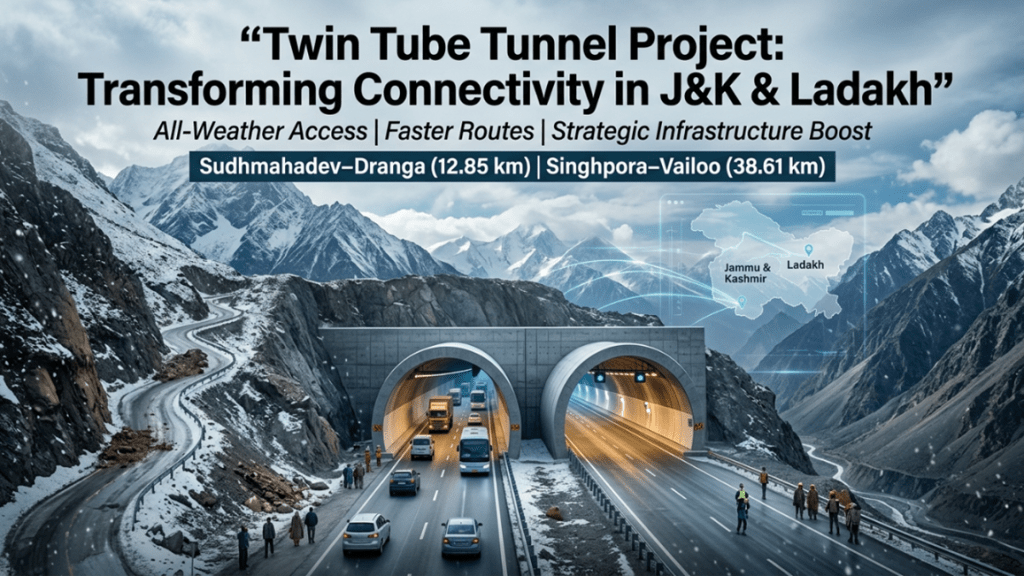
In the formidable terrain of the Himalayas, where geography has long dictated the rhythm of life, connectivity is not merely a matter of convenience—it is a determinant of economic opportunity, social cohesion and strategic resilience. For regions like Jammu & Kashmir and Ladakh, harsh winters, heavy snowfall and frequent landslides have historically disrupted road networks, isolating communities for months at a time. Against this backdrop, the development of the Twin Tube Tunnel system—comprising the 12.85 km Sudhmahadev–Dranga tunnel and the 38.61 km Singhpora–Vailoo tunnel marks a decisive intervention aimed at redefining mobility in one of India’s most challenging landscapes. More than just an infrastructure project, it represents a structural shift toward reliable, all-weather connectivity and sustained regional development.
The challenges of connectivity in Jammu & Kashmir and Ladakh are deeply entrenched in their geography. Mountain passes, often the only links between regions are highly susceptible to closure during winter months. Snow accumulation, avalanches and landslides routinely disrupt transportation, severing access to essential services and markets. For local populations, this translates into delayed medical assistance, interrupted education and constrained economic activity. For traders and transporters, it means uncertainty, increased costs and logistical inefficiencies. In strategic terms, unreliable connectivity also affects the timely movement of resources and personnel in sensitive border regions. These persistent constraints underscore the urgent need for infrastructure that can withstand the region’s climatic and geological extremes.
It is within this context that the Twin Tube Tunnel project assumes critical importance. At its core, the project involves the construction of two parallel tunnel systems designed to facilitate smoother, safer and uninterrupted traffic flow. The Sudhmahadev–Dranga tunnel, stretching 12.85 kilometres and the significantly longer Singhpora–Vailoo tunnel, spanning 38.61 kilometres, are engineering undertakings of considerable scale and complexity. Built through mountainous terrain characterized by fragile geology and extreme weather conditions, these tunnels exemplify modern tunnelling techniques adapted to high-altitude environments.
The concept of twin tube tunnelling itself is central to the project’s design philosophy. By creating two parallel passages—typically one for each direction of traffic—the system enhances both capacity and safety. In the event of an emergency, one tunnel can serve as an evacuation or service route for the other, significantly reducing risk. Advanced ventilation systems, fire safety mechanisms and monitoring technologies are integrated into the design, ensuring that the tunnels meet high standards of operational reliability. Beyond their structural features, these tunnels are envisioned as critical alternative routes, reducing dependence on existing roads that are vulnerable to seasonal disruptions.
The strategic significance of these tunnels extends far beyond their immediate function. By providing a dependable, all-weather corridor, the project is set to dramatically reduce travel time and distance between key regions. Journeys that once required navigating treacherous mountain roads will become faster, safer and more predictable. This has direct implications for the movement of goods and services, enabling more efficient supply chains and reducing transportation costs. In a region where accessibility has often been a limiting factor, such improvements can unlock new avenues for economic activity.
Equally important is the impact on everyday life. For residents of Jammu & Kashmir and Ladakh, year-round connectivity translates into greater stability and improved quality of life. Access to healthcare facilities becomes more reliable, particularly during emergencies when delays can be life-threatening. Educational institutions remain within reach, ensuring continuity for students who might otherwise face prolonged disruptions. Farmers and small business owners gain the ability to transport their produce to markets without the constant fear of road closures, enhancing both income security and economic resilience.
Tourism, a vital component of the region’s economy, is also poised to benefit significantly. The natural beauty of Jammu & Kashmir and Ladakh attracts visitors from across the world, yet seasonal accessibility has often limited tourist inflow. With improved connectivity, the tourism window can expand, supporting local businesses and generating employment opportunities. Hotels, transport services and handicraft industries stand to gain from a more consistent flow of visitors, contributing to broader economic growth.
From a developmental perspective, the Twin Tube Tunnel project serves as a catalyst for regional transformation. Infrastructure has always been a foundational driver of development and in this case, its impact is likely to be both immediate and long-term. The construction phase itself generates employment and stimulates local economies, while the operational phase creates conditions conducive to investment and enterprise. Improved connectivity can attract industries, facilitate trade, and encourage the establishment of new economic hubs. Over time, this can help bridge developmental gaps and integrate remote regions more closely with national markets.
The project also reinforces the broader objective of strengthening regional self-reliance. By reducing dependence on vulnerable and weather-sensitive routes, it ensures a more stable and autonomous transportation network. This is particularly significant for Ladakh, where logistical challenges have historically constrained development initiatives. Reliable connectivity empowers local communities, enabling them to participate more actively in economic processes and reducing the need for external support in critical areas.
However, the scale and ambition of the Twin Tube Tunnel project also bring with them a set of challenges that must be carefully managed. Engineering in the Himalayas is inherently complex, with geological instability posing risks during both construction and operation. Ensuring structural integrity over the long term will require continuous monitoring and maintenance. Environmental considerations are equally important. Large-scale tunnelling can impact local ecosystems, water flows and biodiversity. Balancing infrastructure development with ecological preservation will be essential to ensure that progress does not come at the cost of environmental degradation.
Despite these challenges, the significance of the Twin Tube Tunnel project remains unequivocal. It represents a forward-looking approach to infrastructure—one that recognizes the unique demands of the region while leveraging modern engineering solutions to address them. By prioritizing resilience, efficiency and safety, the project sets a benchmark for future initiatives in similar terrains.
In essence, the Sudhmahadev–Dranga and Singhpora–Vailoo tunnels are more than physical structures carved through mountains; they are conduits of opportunity, linking communities, economies and aspirations. As they take shape, they signal a broader transformation underway in Jammu & Kashmir and Ladakh—one where connectivity is no longer a constraint but a catalyst. If sustained with careful planning and responsible management, this initiative has the potential to redefine the developmental trajectory of the region, ensuring that even in the most challenging landscapes, progress remains within reach.


