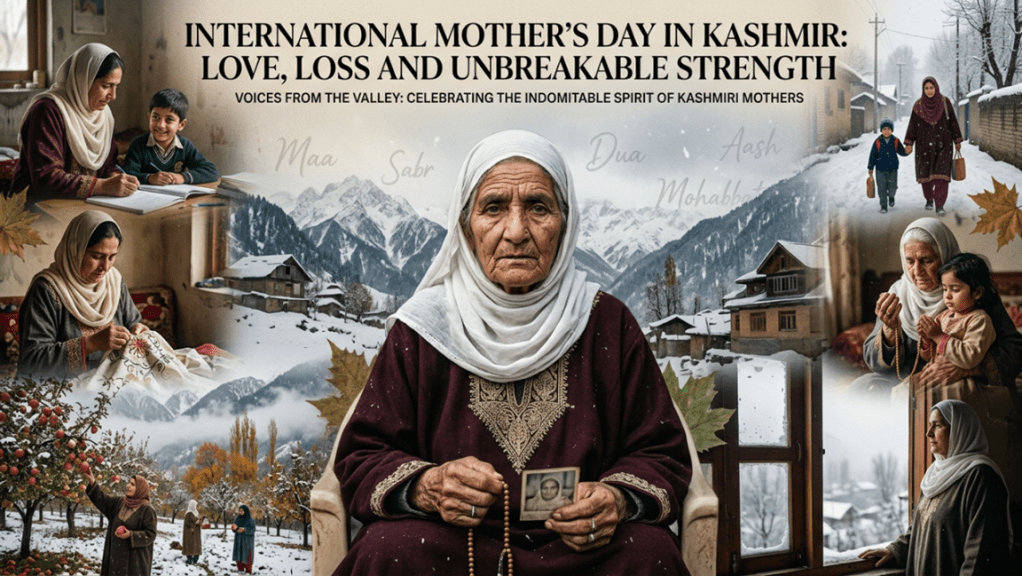
Every year, on the second Sunday of May, the world celebrates International Mother’s Day—a day dedicated to honouring mothers, their unconditional love and their irreplaceable role in shaping families and societies. Across countries, it is marked with flowers, gifts and heartfelt tributes. It is a day filled with warmth, gratitude and recognition. Yet, like many global observances, the meaning of Mother’s Day changes when viewed through the lens of local realities. In Kashmir, motherhood is not defined only by affection and care—it is also shaped by resilience, endurance and often, silent suffering. Here, the idea of a mother extends beyond celebration; it becomes a story of strength forged in adversity.
In Kashmir, mothers hold a deeply respected and central place within the family structure. They are not only caregivers but also the emotional anchors that bind households together. From preserving cultural traditions to nurturing values in children, their role is both intimate and expansive. Kashmiri households often reflect strong familial bonds, where mothers serve as the first teachers, guiding children in language, customs and ethics. Whether it is passing down stories of heritage or maintaining the rhythm of daily life, their presence shapes identity in profound ways. But this emotional centrality also means that mothers carry the weight of their families’ struggles more intensely. Their strength is often quiet—expressed not in grand gestures but in everyday acts of care, patience and sacrifice.
One of the most defining aspects of motherhood in Kashmir is its intersection with prolonged uncertainty and conflict. For decades, many families have lived in an environment marked by instability and mothers have borne the emotional consequences of this reality. There are mothers who have lost sons, husbands, or brothers, sometimes to violence, sometimes to circumstances that remain unresolved. The phenomenon of “half-widows,” where women await the return of missing spouses is a painful reminder of this uncertainty. Behind each such story is often a mother who continues to hold the family together, even as she navigates grief and unanswered questions. For these women, motherhood becomes an act of courage. Raising children in an environment of unpredictability requires not just love but extraordinary resilience. They must provide emotional stability to their families even when their own hearts carry deep wounds.
While the traditional image of a mother often centers on caregiving, many women also play a vital economic role in our Kashmir. In both rural and urban settings, mothers contribute significantly to household income, often in ways that remain underrecognized. From working in agricultural fields to engaging in handicrafts such as weaving, embroidery and other home-based industries, their labour sustains families. In many cases, these contributions become even more crucial when male members of the family are absent or unable to work. Despite this, women’s work is frequently undervalued. Much of it exists within the informal economy where wages are low and recognition is minimal. The dual burden of managing household responsibilities while contributing economically adds to their challenges, yet it also highlights their indispensable role in sustaining livelihoods.
Perhaps the most striking aspect of motherhood in Kashmir is its quiet resilience. Kashmiri mothers often embody a form of strength that does not seek attention but is deeply transformative. They endure harsh winters, economic hardships and social pressures with remarkable patience. They find ways to adapt, to support their families and to maintain a sense of normalcy even in difficult circumstances. This resilience is not loud or visible, it is woven into the fabric of daily life. It is seen in a mother ensuring her children attend school despite challenges, in her ability to manage limited resources and in her determination to provide hope in uncertain times. This silent strength is what keeps families grounded and communities functioning.
Education holds a special place in many Kashmiri households and mothers are often at the forefront of encouraging it. Despite facing their own limitations, many women prioritize their children’s education, seeing it as a pathway to a better future. This is particularly evident in the growing emphasis on educating daughters. Mothers who may not have had access to education themselves often strive to ensure that their daughters do not face the same barriers. In doing so, they quietly challenge traditional norms and contribute to social change. Their role as educators extends beyond formal schooling. They instil values of resilience, empathy and perseverance, qualities that shape not just individuals but the broader society.
Kashmir, like many regions, is witnessing gradual social and economic change and this transformation is reflected in the evolving role of mothers. Increasingly, women are stepping into professional spaces, becoming entrepreneurs, teachers, healthcare workers and more. This shift represents both opportunity and challenge. While it allows women greater independence and visibility, it also requires them to balance traditional expectations with modern aspirations. The pressure to excel in multiple roles—professional, familial and social can be immense. Yet, many Kashmiri mothers navigate this complexity with determination, redefining what it means to be a mother in a changing world. They are not abandoning tradition but reshaping it to fit new realities.
Amid all these roles and responsibilities, the emotional well-being of mothers often remains overlooked. The stress of managing households, contributing economically and coping with external uncertainties can take a significant toll. Mental health is still a sensitive and often neglected topic in many parts of society, including Kashmir. Mothers, who are expected to be pillars of strength, rarely have the space to express vulnerability or seek support. This silence around emotional struggles adds another layer to their burden. Recognizing and addressing this aspect is essential to truly honouring the spirit of Mother’s Day.
In Kashmir, the concept of motherhood often extends beyond biological relationships. Grandmothers, elder sisters and even community members frequently take on nurturing roles, especially in times of need. This collective sense of care reflects the strength of community bonds. It also highlights how motherhood, as a concept, is rooted in compassion and responsibility rather than defined solely by biology. Such relationships reinforce the idea that the essence of motherhood lies in the act of nurturing—whether within a family or across a community.
As the world celebrates Mother’s Day with gestures of appreciation, Kashmir offers a perspective that goes deeper than celebration. Here, the day is not just about expressing gratitude but about acknowledging realities that often remain unseen. Honouring mothers in Kashmir means recognizing their resilience in the face of adversity, their contributions to both family and economy and their role in shaping future generations. It also means addressing the challenges they face—economic insecurity, lack of recognition and emotional strain. True recognition goes beyond symbolic gestures. It requires creating systems that support women, ensuring access to healthcare, education and economic opportunities and fostering an environment where their contributions are valued and respected.
International Mother’s Day is a reminder of the universal importance of mothers, but in Kashmir, it also becomes a call for deeper understanding. The stories of Kashmiri mothers are not always visible, yet they are powerful narratives of courage, endurance and love. They are women who continue to nurture life in the midst of uncertainty, who hold families together when circumstances threaten to pull them apart and who quietly shape the future through their sacrifices and strength. To truly honour them is to move beyond celebration and toward recognition—recognition of their struggles, their contributions and their unwavering resilience. In doing so, Mother’s Day becomes not just a moment of gratitude, but a commitment to ensuring that the dignity, support and respect they deserve are realized every day.

 Kashmir RootStock