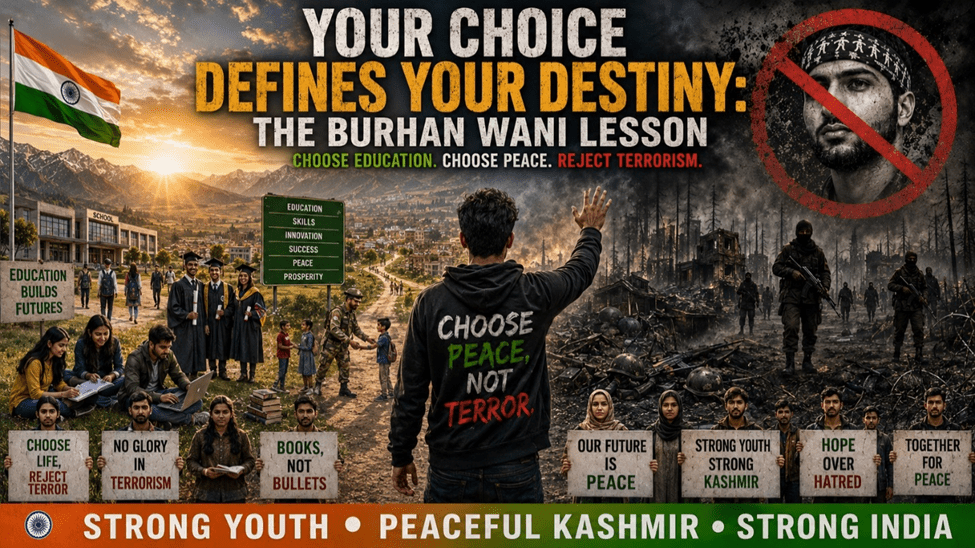
“The choices we make define our future. While education and hard work create opportunities , violence and extremism only lead to destruction.”
Every generation has young people who inspire society through education innovation sports public service and entrepreneurship. Unfortunately, history also records individuals who chose the path of violence and extremism sacrificing their own futures and negatively affecting countless others. Burhan Wani is one such example whose life serves as a cautionary tale about the consequences of embracing terrorism instead of pursuing a constructive future.
Born into a family that valued education Burhan Wani had opportunities available to many young people in Kashmir. Like countless others he could have pursued higher education built a career and contributed positively to his community. Instead influenced by extremist ideology and militant propaganda he chose the path of armed militancy. That single decision changed the course of his life forever.
Violent extremist organizations often target young minds by exploiting emotions grievances and a desire for identity or recognition. Through propaganda particularly on social media they portray violence as a noble cause or a heroic struggle. However, the reality is starkly different. The path of terrorism offers no lasting purpose no secure future and no meaningful achievement. It leads only to fear loss suffering and ultimately death.
Burhan Wani became one of the most recognizable faces associated with militancy in Kashmir after appearing in widely circulated photographs and videos carrying weapons. While these images gained attention among certain sections, they also reflected how extremist groups increasingly relied on digital platforms to influence vulnerable youth. His story illustrates how propaganda can transform an ordinary young man into a symbol of conflict rather than a force for peace or development.
The consequences of his decision extended far beyond his own life. Years of militancy in Kashmir resulted in the loss of countless civilian lives security personnel and local youth who were drawn into cycles of violence. Families were torn apart economic development suffered education was disrupted and communities lived under the shadow of insecurity. Terrorism does not only destroy those who carry weapons. It also leaves deep scars on society.
Ultimately Burhan Wani’s life ended in an encounter with Indian security forces in July 2016. His death highlighted a reality that has been repeated throughout history. Individuals who choose terrorism rarely achieve the future they imagine. Their lives often end prematurely leaving behind grieving families and communities rather than lasting achievements or positive contributions.
In contrast today’s Kashmir presents young people with growing opportunities. Investments in education tourism entrepreneurship digital technology sports and infrastructure have created new avenues for progress. Kashmiri students are earning scholarships at prestigious universities athletes are representing India at national and international competitions entrepreneurs are launching successful businesses and professionals are building careers across diverse sectors. These achievements demonstrate that the road to success lies in knowledge skill perseverance and innovation not violence.
The contrast is clear. One path leads to education employment respect and long-term success. The other leads to conflict uncertainty imprisonment or death. Every young person eventually faces choices that shape their future. Choosing constructive opportunities over extremist ideologies is essential not only for personal success but also for the peace and prosperity of society.
Families’ teachers’ religious leaders and communities also play an important role in guiding young people. Open communication quality education mentorship and access to meaningful opportunities help reduce the risk of radicalization. When young people feel valued supported and hopeful about their future, they are far less likely to be influenced by extremist narratives.
Kashmir has always been known for its rich culture centuries-old traditions breathtaking landscapes and resilient people. Its true strength lies in its educated youth skilled professionals’ artists scientists and entrepreneurs not in conflict. The future of the region depends on young people investing their energy in innovation education and nation-building rather than becoming victims of extremist propaganda.
Burhan Wani’s story should therefore be viewed not as a model to emulate but as a warning about the consequences of choosing violence over opportunity. Had he pursued education professional ambitions or community service his life might have become an example of achievement and leadership. Instead, his choices led to a tragic end and became part of a prolonged cycle of conflict.
For today’s youth the message is straightforward. Every decision shape your destiny. A weapon may attract temporary attention but education talent integrity and hard work earn lasting respect. No ideology that encourages violence can replace the value of a meaningful life built on knowledge compassion and service to society.
Conclusion
Burhan Wani’s life illustrates the heavy cost of embracing terrorism instead of pursuing peaceful and constructive opportunities. Extremism offers no sustainable future. It destroys lives divides communities and hinders progress. The real strength of Kashmir lies in its young people choosing education over extremism dialogue over violence and hope over hatred. A peaceful prosperous and progressive Kashmir and a stronger India can only be built when the next generation rejects terrorism and embraces the path of peace development and responsible citizenship.


