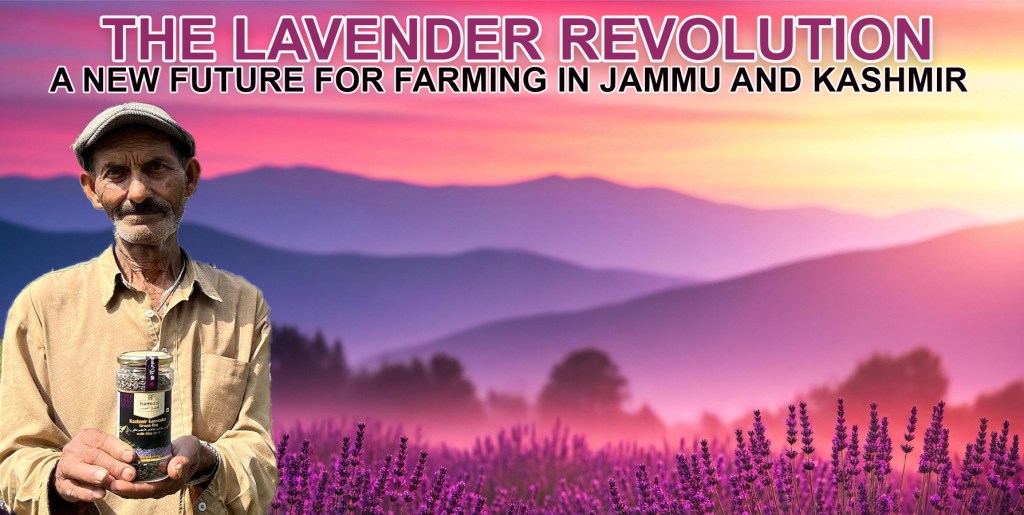
Nestled among the rugged mountains of Uri in Jammu and Kashmir, a remarkable transformation is unfolding. Once known for its rocky, barren slopes and limited agricultural opportunities, this border region is now gaining recognition for its vast fields of blooming lavender. The sea of purple flowers is more than a scenic attraction—it is a symbol of economic revival, social empowerment and the determination of local communities to build a better future. At the centre of this inspiring journey are the women of Uri, whose dedication and resilience have turned an innovative agricultural initiative into a movement of prosperity and self-reliance.
For generations, farming in Uri was a difficult occupation. The region’s mountainous terrain, dry soil and unpredictable weather made cultivation challenging. Most families depended on traditional crops such as maize and wheat, which generated only modest incomes. Despite working tirelessly throughout the year, many farming households struggled to meet their daily needs. Limited market opportunities and low productivity often forced younger generations to seek employment outside the region, leaving agriculture with little scope for growth.
Recognising these challenges, agricultural experts and policymakers began exploring crops that could thrive in Uri’s unique climate while providing better financial returns. Lavender emerged as the ideal choice. Native to Mediterranean regions, lavender grows well in dry, well-drained soils and temperate climatic conditions, making it perfectly suited to the landscapes of Uri. More importantly, it produces highly valuable essential oil that is widely used in perfumes, cosmetics, medicines, aromatherapy products, soaps and wellness industries across the world.
The introduction of lavender cultivation was made possible through coordinated government initiatives aimed at diversifying agriculture and increasing rural incomes. Programmes such as the Aroma Mission of the Council of Scientific and Industrial Research (CSIR) and the Holistic Agriculture Development Programme played a crucial role in encouraging farmers to adopt aromatic crops. Thousands of quality lavender saplings were distributed among farming families, while agricultural officers provided regular training on scientific cultivation techniques, irrigation management, harvesting methods and pest control.
Equally important was the establishment of demonstration farms and nurseries in Uri. These centres supplied healthy planting material and served as training hubs where farmers could learn modern cultivation practices. Continuous technical guidance ensured that even first-time growers gained the confidence to shift from traditional crops to lavender farming. This combination of scientific support and government assistance laid the foundation for the region’s agricultural transformation.
One of the most significant milestones in the lavender revolution was the development of local processing infrastructure. Essential oil extraction must take place soon after harvesting to preserve the fragrance and quality of the flowers. Earlier, farmers had to transport harvested lavender over long distances to processing centres, resulting in higher costs and reduced profits.
To overcome this challenge, a modern distillation and processing unit was established within the region. Equipped with advanced extraction technology and storage facilities, the centre enabled farmers to process their harvest locally. This significantly reduced transportation expenses, preserved product quality and ensured that a larger share of the profits remained within the local economy. The availability of processing facilities also encouraged more farmers to cultivate lavender, knowing that they now had access to an efficient value chain.
The economic benefits of this transition have been remarkable. Traditional maize cultivation generated only a modest annual income from small landholdings. In comparison, lavender cultivation offers several times higher returns from the same area of land. Farmers can earn substantial income from the sale of fresh flowers as well as from the extraction of premium-quality essential oil, which commands a high price in national and international markets. As more families adopted lavender cultivation, household incomes improved considerably, enabling investments in education, healthcare, housing and better farming equipment.
While increased earnings have strengthened the local economy, the most inspiring aspect of this transformation is the emergence of women as leaders of the movement. Historically, women in rural farming communities contributed extensively to agricultural work but often remained invisible in decision-making and financial management. They worked in the fields alongside men, yet rarely received recognition as entrepreneurs or business owners.
This reality began to change with the support of the Jammu and Kashmir Rural Livelihoods Mission through its flagship UMEED programme. By organising women into Self-Help Groups (SHGs), the programme created opportunities for financial inclusion, skill development and entrepreneurship. Women gained access to microcredit, training programmes and institutional support that enabled them to participate actively in income-generating activities without depending on traditional sources of finance.
Lavender cultivation proved particularly well suited to women’s participation. Harvesting the delicate flower spikes requires careful handling to preserve the tiny oil-bearing glands that determine the quality of the essential oil. Through specialised training, women mastered these precision-based techniques and became highly skilled cultivators.
Their involvement did not stop at cultivation. Many women expanded their role by entering the processing and value-addition stages of production. Instead of selling raw flowers alone, they began manufacturing lavender-based products such as essential oils, soaps, incense sticks, room fresheners, scented candles and herbal wellness items. By transforming raw agricultural produce into finished consumer products, they significantly increased the value of their harvest and generated additional employment opportunities within their communities.
Entrepreneurship has become a defining feature of the lavender revolution. Women-led Self-Help Groups now manage production units, maintain quality standards, oversee packaging and coordinate marketing activities. These responsibilities have enhanced their financial independence while strengthening their confidence as business leaders. Income generated through these enterprises has improved household stability and encouraged greater participation of women in community decision-making.
Market access, once a major obstacle for remote border villages, has also improved considerably. Partnerships between rural development agencies and digital commerce platforms have enabled women entrepreneurs to showcase and sell their lavender products to customers across India. Online marketplaces have removed geographical barriers, allowing small rural enterprises to compete in larger markets without relying entirely on local traders or intermediaries. This direct access to consumers has increased profitability and expanded opportunities for future business growth.
Beyond its economic achievements, the lavender revolution has also brought important environmental benefits. Lavender requires comparatively less water than many traditional crops and grows successfully on dry, rocky land that was previously considered unsuitable for cultivation. Its cultivation promotes sustainable use of natural resources while reducing pressure on fertile agricultural land. By converting neglected areas into productive farms, local communities have demonstrated how climate-resilient agriculture can contribute to both environmental conservation and rural development.
The success of lavender cultivation in Uri is now inspiring neighbouring regions to explore similar models of agricultural diversification. What started as a pilot initiative has evolved into an example of how scientific innovation, government support, community participation and women’s leadership can work together to transform rural economies. Farmers who once viewed barren land as a burden now see it as an opportunity for growth and prosperity.
Today, the lavender fields of Uri stand as a powerful symbol of hope. They represent the courage of farming families who embraced change, the vision of institutions that invested in innovation, and above all, the determination of women who stepped beyond traditional roles to become entrepreneurs, producers and community leaders. Their journey demonstrates that meaningful development is achieved not only through new technologies but also by empowering people with knowledge, resources and opportunities.
As the fragrance of lavender spreads across the hills of Uri, it carries with it a story of resilience, transformation and possibility. The women who nurture these fields have cultivated far more than a valuable crop—they have cultivated confidence, independence and a brighter future for their families and communities. Their achievements offer an inspiring example of how inclusive rural development can create lasting economic growth while promoting gender equality and sustainable agriculture.
The lavender revolution in Uri is, therefore, much more than an agricultural success story. It is a testament to the extraordinary potential that emerges when innovation meets determination and when women are given the opportunity to lead. The purple fields blooming across the valley are not merely flowers—they are living symbols of a community that has transformed adversity into opportunity and continues to inspire the nation with its remarkable journey.


