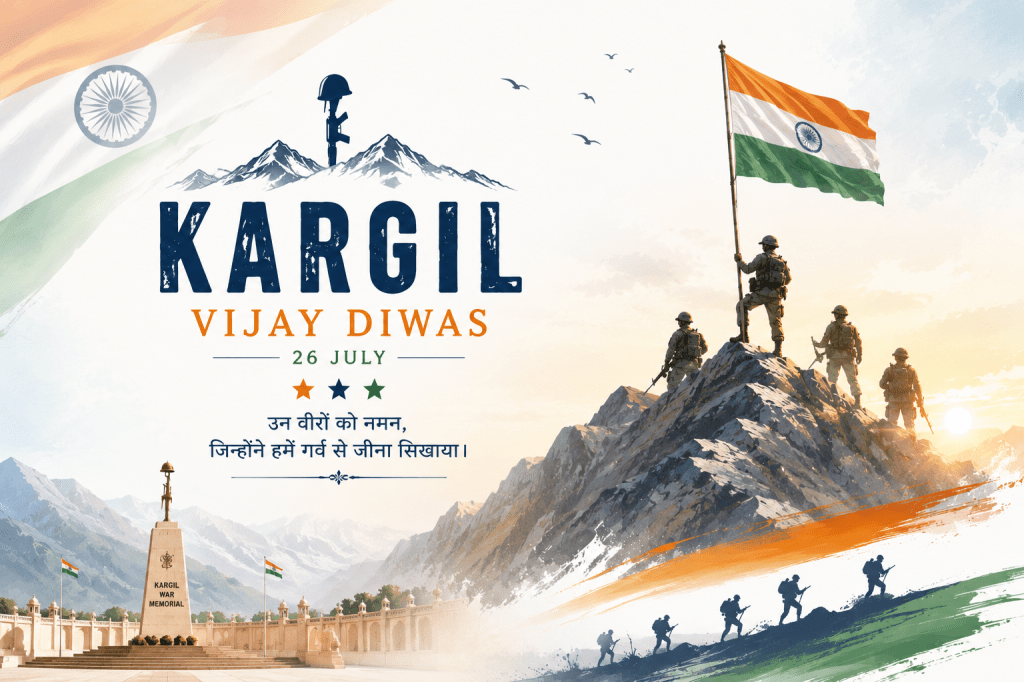
Every year on 26 July, India observes Kargil Vijay Diwas to commemorate one of the most remarkable chapters in the nation’s military history. The day marks the successful culmination of the Kargil War of 1999, when the Indian Armed Forces reclaimed strategic mountain peaks that had been occupied by Pakistani intruders along the Line of Control (LoC) in the Kargil sector of Jammu and Kashmir. More than a celebration of military success, Kargil Vijay Diwas is a solemn tribute to the extraordinary courage, determination and selfless sacrifice of the soldiers who fought under some of the harshest conditions imaginable. Their unwavering commitment ensured not only the restoration of India’s territorial integrity but also reinforced the nation’s faith in the valour and professionalism of its Armed Forces. Every fluttering Tricolour on this day reminds the nation that peace and security are safeguarded by brave men and women in uniform who willingly place duty before self.
The origins of the conflict can be traced to the winter of 1998–99, when Pakistani regular soldiers and armed intrudes the Line of Control and breached occupied several unguarded heights on the Indian side of the Kargil sector. These positions overlooked the strategic National Highway 1A, the vital road connecting Srinagar with Leh, giving the infiltrators the ability to threaten India’s supply lines to Ladakh. The rugged mountains, extreme weather and prolonged winter had traditionally resulted in temporary vacation of certain forward posts by both sides, a practice that Pakistan sought to exploit. However, local shepherds first reported unusual movements in the area, leading to reconnaissance patrols that confirmed the scale of the intrusion. What initially appeared to be isolated infiltration soon emerged as a carefully planned military operation designed to alter the status quo along the LoC. The discovery transformed the situation into one of the most significant military confrontations in South Asia since the 1971 war.
India responded with remarkable speed and determination by launching Operation Vijay, one of the largest high-altitude military campaigns ever undertaken. Thousands of troops were rapidly mobilized and deployed across the difficult terrain of the Kargil, Drass, Batalik and Mushkoh sectors. Simultaneously, the Indian Air Force initiated Operation Safed Sagar, providing crucial aerial reconnaissance, logistical support and precision strikes against enemy positions while operating within the constraints of not crossing the Line of Control. Fighting at altitudes ranging from 16,000 to nearly 18,000 feet posed immense challenges. Soldiers had to climb steep, icy slopes carrying heavy weapons and equipment while enduring freezing temperatures, thin air and relentless enemy fire from commanding heights. Despite these formidable obstacles, the seamless coordination between the Army and the Air Force demonstrated India’s military professionalism, resilience and strategic resolve. The campaign became a remarkable example of joint operations under some of the world’s most demanding combat conditions.
Several fierce battles during the conflict became defining moments in India’s path to victory. The capture of Tololing marked a crucial turning point, breaking the enemy’s defensive grip and restoring confidence among Indian forces. The subsequent battle for Tiger Hill, one of the most iconic engagements of the war, showcased extraordinary courage as Indian soldiers undertook perilous night climbs across near-vertical cliffs to surprise and overpower entrenched enemy positions. Equally significant were the operations in Point 4875, Batalik and the Drass sector, where troops fought relentlessly despite severe casualties and difficult terrain. Every ridge and peak demanded meticulous planning, immense physical endurance and unwavering determination. Victory was often measured not in kilometres but in the successful capture of individual mountain features that held immense tactical value. These hard-fought battles demonstrated that determination, superior leadership and the indomitable spirit of Indian soldiers could overcome even the most daunting geographical and military challenges.
Among the countless heroes of the Kargil War, several names have become enduring symbols of courage and patriotism. Captain Vikram Batra, awarded the Param Vir Chakra posthumously, became a national icon for his fearless leadership during the capture of Point 4875 and his unforgettable words, “Yeh Dil Maange More!” His determination to continue fighting despite grave danger inspired his fellow soldiers and the entire nation. Lieutenant Manoj Kumar Pandey, also awarded the Param Vir Chakra posthumously, led repeated assaults on heavily fortified enemy positions, displaying exceptional bravery until his final moments. Grenadier Yogendra Singh Yadav, despite sustaining multiple gunshot wounds, continued climbing steep cliffs and clearing enemy bunkers, an act of extraordinary courage that earned him the Param Vir Chakra. Rifleman Sanjay Kumar displayed remarkable gallantry by charging enemy positions and capturing their weapons while seriously injured. Numerous other officers and soldiers, including Captain Anuj Nayyar, Major Rajesh Adhikari and many decorated personnel, displayed exceptional valour and leadership, ensuring that the Tricolour continued to fly proudly over every reclaimed peak. Their stories remain timeless reminders that extraordinary courage often emerges in the face of overwhelming adversity.
The victory in Kargil came at a tremendous human cost. The conflict claimed the lives of 527 Indian soldiers, while many more sustained serious injuries that would affect them for the rest of their lives. Behind every uniform stood families who endured unimaginable loss with dignity and pride, knowing that their loved ones had made the supreme sacrifice in service of the nation. Across India, stories of courage from the battlefield inspired millions, strengthening the bond between citizens and the Armed Forces. The war highlighted that the price of national security is often paid by individuals whose names may never appear in history books but whose sacrifices form the foundation of the nation’s peace and sovereignty. Their legacy continues to inspire future generations to value patriotism, responsibility and selfless service above personal gain.
The Kargil conflict also prompted significant reforms in India’s defence preparedness. Detailed reviews led to improvements in intelligence coordination, surveillance capabilities, border management and high-altitude operational readiness. Investments in modern equipment, advanced communication systems, precision weapons and better logistical infrastructure significantly enhanced the Armed Forces’ ability to respond to future challenges. The war underscored the importance of jointness among the Army, Air Force and other security agencies, while also reinforcing the need for constant vigilance along sensitive borders. The lessons learned from Kargil continue to shape India’s military doctrine and strategic planning, ensuring that the nation remains better prepared to confront emerging security threats in an increasingly complex geopolitical environment.
Today, Kargil Vijay Diwas is observed across the country with deep respect and gratitude. At the Kargil War Memorial in Drass, one of the highest battlefields in the world, the names of the fallen heroes stand engraved as a permanent testament to their sacrifice. Veterans, serving soldiers, families of martyrs and citizens gather each year to pay homage through wreath-laying ceremonies, remembrance events and patriotic tributes. Educational institutions, government organizations and communities across India also commemorate the occasion by sharing the inspiring stories of Kargil’s heroes, ensuring that the values of courage, unity and national service continue to resonate with younger generations. The memorial serves not merely as a monument of stone but as a living reminder that freedom is protected by unwavering commitment and extraordinary sacrifice.
Kargil Vijay Diwas is, therefore, much more than the anniversary of a military victory. It is a day of national reflection, gratitude and renewed commitment to the ideals for which the nation’s soldiers fought. The peaks of Kargil stand today not only as geographical landmarks but as enduring symbols of courage, resilience and the unbreakable spirit of India. As the nation remembers the heroes of 1999, it also reaffirms its collective responsibility to honour their legacy by preserving the unity, sovereignty and peace for which they gave everything. Their sacrifice continues to inspire every generation, reminding us that while wars may be fought on distant mountains, the values they defend belong to every citizen of the nation.


