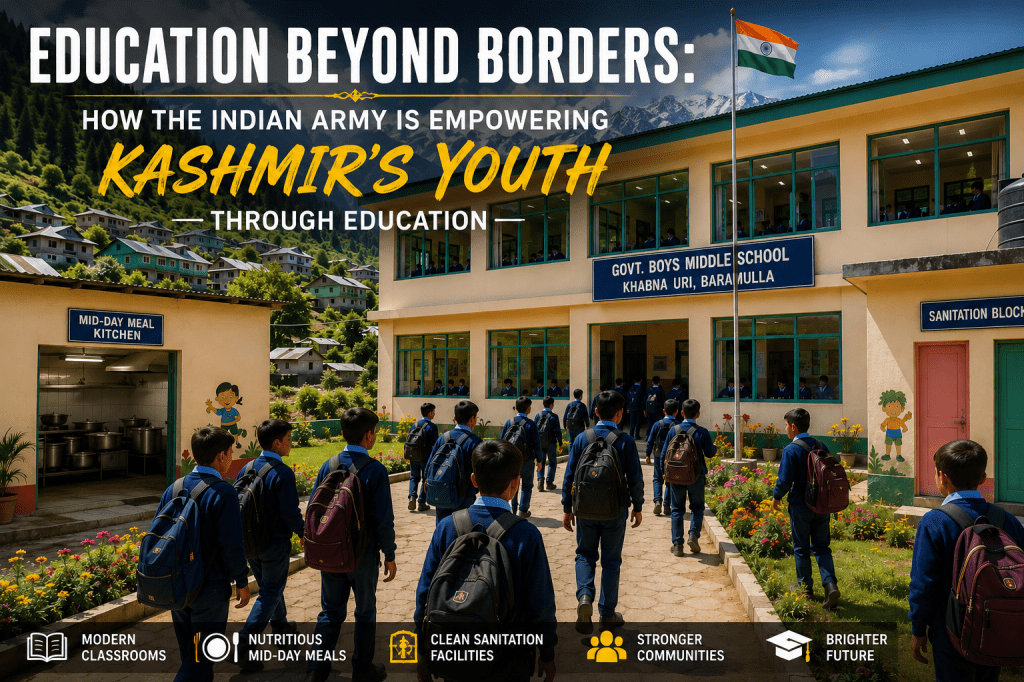
Indian Army Upgrades Government School in Uri to Empower Kashmir’s Youth
Education is one of the strongest foundations of peace, progress and prosperity. In a region like Jammu and Kashmir, where geographical challenges and decades of conflict have affected development, ensuring quality education for children has become a national priority. Alongside its primary responsibility of safeguarding the country’s borders, the Indian Army has consistently played a significant humanitarian role in supporting education, healthcare and infrastructure across remote and border areas. Through its civic action initiatives, the Army has demonstrated that national security is not only about protecting territory but also about investing in the future of the nation’s youth.
A recent example of this commitment is the inauguration of the upgraded Government Boys Middle School at Khabna in Baramulla’s Uri sector by the Indian Army’s Dagger Division under Chinar Corps. Executed in partnership with the Bank of New York (BNY) and the International Association for Human Values (IAHV), the project reflects the Army’s determination to improve educational infrastructure in underserved regions. The upgraded campus now includes a modern six-classroom academic block, a Mid-Day Meal kitchen and separate sanitation facilities, creating a healthier and more conducive learning environment for students from economically disadvantaged families living along the border.
Such initiatives are far more than construction projects. They represent an investment in human potential. A well-equipped classroom gives children the confidence to dream bigger, while clean sanitation facilities encourage regular attendance, especially among girls. A modern kitchen ensures that students receive nutritious meals under the Mid-Day Meal Scheme, helping improve both health and academic performance. These improvements collectively create an atmosphere where learning can flourish.
The Indian Army has long recognised that the youth of Kashmir are the region’s greatest strength. By supporting education, the Army aims to provide young people with opportunities that enable them to build successful careers and contribute positively to society. Access to quality education helps students develop critical thinking, technical skills and confidence, reducing barriers created by remoteness and limited resources. Every school upgraded and every classroom built becomes a stepping stone toward a brighter future.
Across Jammu and Kashmir, particularly in remote border districts, educational infrastructure often faces challenges due to difficult terrain, harsh weather and limited connectivity. In many villages, schools require better classrooms, improved sanitation, libraries, playgrounds and digital learning facilities. Recognising these needs, the Indian Army has worked alongside civil administration, educational institutions and community organisations to bridge these gaps wherever possible. Such collaborative efforts demonstrate how government agencies, private organisations and the armed forces can work together for the common good.
The Army’s contribution to education extends beyond physical infrastructure. Through initiatives such as Army Goodwill Schools, educational awareness programmes, career counselling sessions, scholarship guidance, computer literacy drives and motivational interactions, thousands of students have benefited over the years. Many young boys and girls from remote areas have gone on to pursue higher education, join professional institutions and build successful careers in medicine, engineering, civil services, sports and the armed forces themselves. These achievements highlight the transformative power of educational support.
Community participation is another important aspect of these initiatives. The inauguration ceremony at Khabna was attended by senior Army officers, civil administration representatives, education department officials and village elders. Such participation reflects the shared responsibility of building stronger educational institutions. When local communities actively engage with schools, they help create an environment where children feel encouraged to learn and parents become active partners in their education.
Education also plays a vital role in strengthening social harmony and long-term development. Young people equipped with knowledge and skills are better prepared to participate in the region’s economic growth. They are more likely to pursue entrepreneurship, higher education and meaningful employment, contributing to the prosperity of their communities. By improving access to education in border areas, the Indian Army supports a broader vision of inclusive development that benefits society as a whole.
The significance of educational initiatives becomes even greater in border villages, where opportunities can sometimes be limited due to geographical isolation. Upgraded schools reduce disparities between urban and rural education, giving children equal opportunities to compete academically. Modern classrooms, better facilities and improved learning environments inspire students to attend school regularly and remain focused on their studies. For many families, these improvements represent hope for a better future.
The Indian Army’s approach reflects the belief that security and development go hand in hand. A peaceful and prosperous society is built not only through safeguarding borders but also by empowering its citizens through education and opportunity. By helping strengthen educational infrastructure, encouraging youth development and supporting community welfare, the Army contributes to nation-building in meaningful ways that extend beyond its traditional military role.
The story of the upgraded Government Boys Middle School at Khabna is therefore more than a local development project. It symbolises the power of partnership, compassion and commitment to the future generation. Every classroom constructed, every child encouraged to stay in school and every educational opportunity created strengthens the foundation of a more confident and educated Kashmir.
As Jammu and Kashmir continues its journey of development, investments in education will remain among the most valuable contributions to society. The Indian Army’s continued efforts in supporting schools and youth development demonstrate that empowering young minds is one of the strongest ways to build lasting peace, resilience and progress. By nurturing education today, the Army is helping shape tomorrow’s leaders, innovators and responsible citizens who will carry forward the vision of a stronger, more prosperous and united India.


