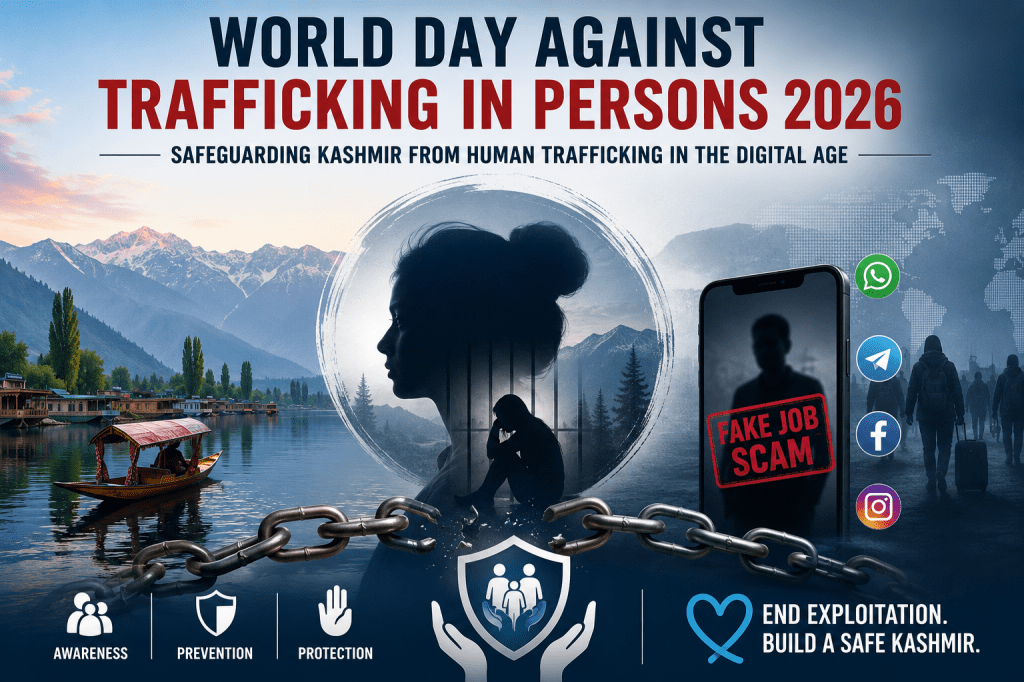
Every year on 30 July, the world observes World Day Against Trafficking in Persons, a United Nations-led observance that reminds us of one of the gravest violations of human rights is human trafficking. While often associated with organised crime networks operating across international borders, trafficking can also begin with something as simple as a deceptive phone call, a fake job advertisement or a misleading social media message. In today’s digitally connected world, no region is entirely immune and Jammu & Kashmir is no exception.
For the people of Kashmir, where aspirations for education, employment and entrepreneurship continue to grow, awareness is the first line of defence. Protecting vulnerable individuals from exploitation requires informed citizens, responsible institutions and a vigilant society.
A Global Call to End Human Trafficking
The United Nations General Assembly designated 30 July as the World Day Against Trafficking in Persons in 2013 to strengthen global efforts against trafficking and to support survivors. The observance aims to raise awareness, encourage governments to strengthen anti-trafficking measures, protect victims and promote international cooperation against organised criminal networks.
Human trafficking involves the recruitment, transportation, transfer or harbouring of individuals through deception, coercion, abuse of vulnerability or force for the purpose of exploitation. Victims may be subjected to forced labour, sexual exploitation, domestic servitude, forced marriage, child labour, criminal activities or even organ trafficking. Men, women and children can all become victims, irrespective of age, background or nationality.
2026 Theme: “Trapped Behind the Scam”
The 2026 campaign, titled “Trapped Behind the Scam,” highlights an emerging global concern, human trafficking linked to online scam operations. Criminal syndicates increasingly exploit digital platforms to advertise fake employment opportunities, overseas placements and lucrative work from home offers. Unsuspecting individuals are lured through social media, messaging applications or fraudulent recruitment agencies. Once recruited, many victims find themselves trapped in scam compounds where passports are confiscated, communication is restricted and they are forced to participate in cyber fraud under threats and violence. This theme carries an important message for Kashmir’s digitally connected youth. As more young people explore employment opportunities outside the Union Territory and abroad, verifying recruitment agencies, job offers and travel arrangements has become more important than ever.
Understanding the Risks in Jammu & Kashmir
Jammu & Kashmir has witnessed remarkable progress in education, digital connectivity and economic opportunities in recent years. However, these positive developments also require greater public awareness about emerging cyber-enabled crimes. Many students and skilled workers seek employment in metropolitan cities and overseas destinations. While the overwhelming majority pursue legitimate opportunities, fraudulent agents occasionally exploit job seekers by making false promises regarding salaries, accommodation or visa arrangements.
Women and children remain among the most vulnerable groups. Cases involving deceptive marriage proposals, domestic servitude, forced labour and child exploitation reported in different parts of the country serve as reminders that awareness and timely intervention are essential. Authorities in Jammu & Kashmir continue to encourage citizens to report suspicious recruitment practices and missing persons without delay. Digital platforms have also transformed the way traffickers operate. Fake employment websites, anonymous messaging groups, forged consultancy advertisements and social media profiles can all be misused to identify and target vulnerable individuals. Digital literacy is therefore becoming an important component of trafficking prevention.
Learning from Reality
Although Jammu & Kashmir does not record trafficking cases on the scale seen in some other regions, isolated incidents involving deceptive recruitment, labour exploitation and missing persons demonstrate that the threat cannot be ignored. Law enforcement agencies have, on several occasions, rescued vulnerable individuals through coordinated operations and inter-state cooperation.
These cases reinforce an important lesson: trafficking often begins long before physical exploitation occurs. It frequently starts with manipulation, false promises and financial desperation. Recognising these warning signs at an early stage can prevent exploitation before it happens.
Building a Safer Kashmir
Preventing human trafficking requires collective responsibility. Government agencies, the Jammu & Kashmir Police, Anti Human Trafficking Units, educational institutions and civil society organisations continue to conduct awareness programmes encouraging safe migration, cyber awareness and prompt reporting of suspicious activities. Families also have an important role to play by discussing online safety with young people, verifying overseas employment offers and remaining alert to sudden requests involving travel, documentation or financial payments to unknown recruiters.
Citizens can contribute by verifying every employment offer through official channels, avoiding unregistered recruitment agents, never surrendering original identity documents unnecessarily, reporting suspicious online advertisements or missing persons immediately, encouraging digital literacy among children and young adults.
A Shared Responsibility
Human trafficking is not merely a law enforcement issue. It is a challenge that affects human dignity, security and social wellbeing. As trafficking networks increasingly exploit technology, communities must respond with greater awareness, stronger partnerships and informed decision-making.
On this World Day Against Trafficking in Persons, the people of Jammu & Kashmir join the global commitment to protect every individual from exploitation. By promoting safe migration, strengthening digital awareness and encouraging timely reporting of suspicious activities, society can ensure that opportunities for education and employment remain pathways to progress—not traps laid by organised criminals. A safer future begins with awareness and awareness begins with each one of us.


