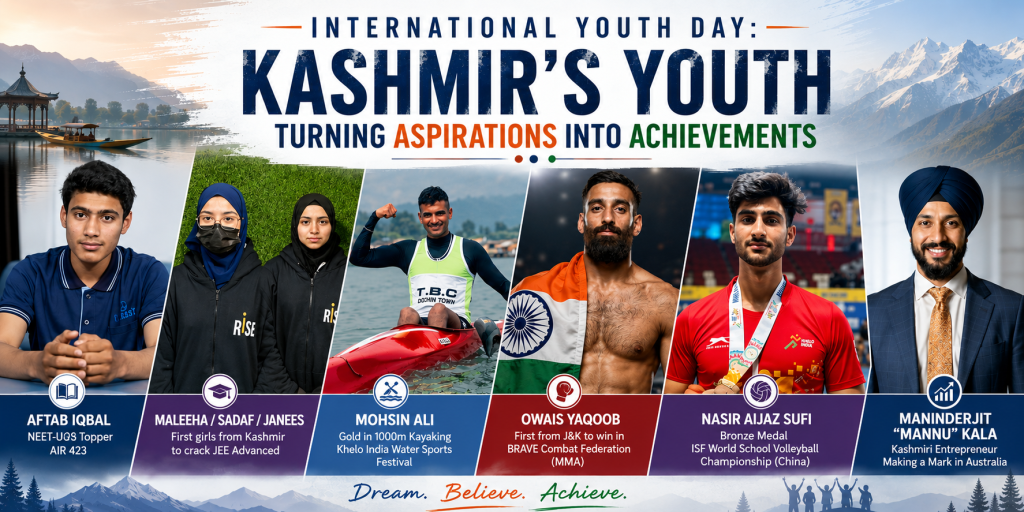
Kashmir’s story today is increasingly being written by its young people. Across classrooms, sports fields, laboratories, start-ups and creative spaces, a new generation is turning ambition into achievement. The aspirations of young Kashmiris are no longer confined to conventional career paths; they are increasingly reaching national and international platforms. On International Youth Day, the Valley’s youth deserve to be recognised not merely for the dreams they carry but for the growing number of dreams they are already turning into reality.
Education remains one of the strongest foundations of this transformation. Recent achievements show that students from Kashmir and other parts of J&K are competing at the highest levels. In 2025, Aftab Iqbal from Ramban emerged as J&K’s NEET-UG topper with an All-India Rank of 423 and a 99.98 percentile. Even more significant was the achievement of Maleeha, Sadaf and Janees, three Kashmiri girls who cracked JEE Advanced in 2025, marking a historic milestone as the first girls from Kashmir to enter the IIT system. These achievements demonstrate how education is expanding the horizons of young Kashmiris and encouraging students, particularly girls, to aim for institutions and professions once considered beyond their reach.
The transformation is equally visible in sports, where young Kashmiris are taking their talent from local grounds to national and international arenas. Mohsin Ali, an 18-year-old from Srinagar, captured national attention after winning gold in the 1,000-metre kayaking event at the inaugural Khelo India Water Sports Festival on Dal Lake in 2025. In combat sports, Owais Yaqoob made history with a BRAVE Combat Federation victory, becoming the first fighter from J&K to win in the promotion. Youngsters such as Nasir Aijaz Sufi, who won bronze at the ISF World School Volleyball Championship in China, further demonstrate the breadth of sporting talent emerging from the region. The growing sporting culture is also reflected in the wider participation of J&K youth, with government data reporting more than 58 lakh young people engaged in sports and 2,556 national medals won since 2021–22.
Another important change is taking place in the way young Kashmiris view employment. The traditional aspiration for a secure government job is increasingly being complemented by entrepreneurship, innovation and self-employment. Young entrepreneurs are using technology, social media and local resources to build businesses in tourism, food, handicrafts, agriculture and digital services. Maninderjit “Mannu” Kala, who grew up in Baramulla and went on to become a successful entrepreneur in Australia, represents one example of how Kashmiri ambition can travel far beyond geographical boundaries. At the grassroots level, young women such as Harmain, a 20-year-old student who turned her interest in baking into a home-based venture, reflect a quieter but equally important entrepreneurial movement within the Valley.
Technology is opening another frontier. Kashmir’s young people are increasingly engaging with artificial intelligence, robotics, digital design and other emerging fields. At TechKnow 2025, a student-led technology initiative in Srinagar, young participants showcased AI and robotics projects, demonstrating that the Valley’s students are capable of engaging with technologies shaping the future. The emergence of platforms such as the University of Kashmir’s innovation and incubation initiatives and SKUAST-K’s rural business incubation programmes is further connecting students with entrepreneurship and commercialisation.
Young Kashmiris are also finding new confidence in creative expression. Bazlah, a Class 10 student, founded the Fervent Flair Collective and led an exhibition that brought together teenage artists in Srinagar. Such initiatives show that youth achievement is not restricted to examination results or medals. Art, music, filmmaking, design and other creative pursuits are becoming important avenues through which young Kashmiris express their identity and connect with wider audiences.
This changing youth landscape is being supported by an expanding ecosystem of opportunity. Initiatives such as Mission YUVA are designed to encourage entrepreneurship, provide credit and develop employment opportunities. By early 2026, the programme had recorded more than 1.59 lakh registrations, with banks disbursing ₹594 crore to over 10,000 entrepreneurs. Its focus on first-generation entrepreneurs, women and youth from remote areas is particularly significant for a region where access to opportunity has often depended on geography.
Yet, the real strength of Kashmir’s youth lies not simply in individual success stories. It lies in the changing mindset behind them—the willingness to compete, innovate, experiment and create something new. From a student preparing for NEET in a small town to an athlete competing overseas, from a young woman running a home enterprise to teenagers experimenting with AI and art, the message is increasingly clear. Kashmir’s youth are not merely preparing for tomorrow. Across classrooms, playing fields, businesses and creative spaces, they are already building it.


