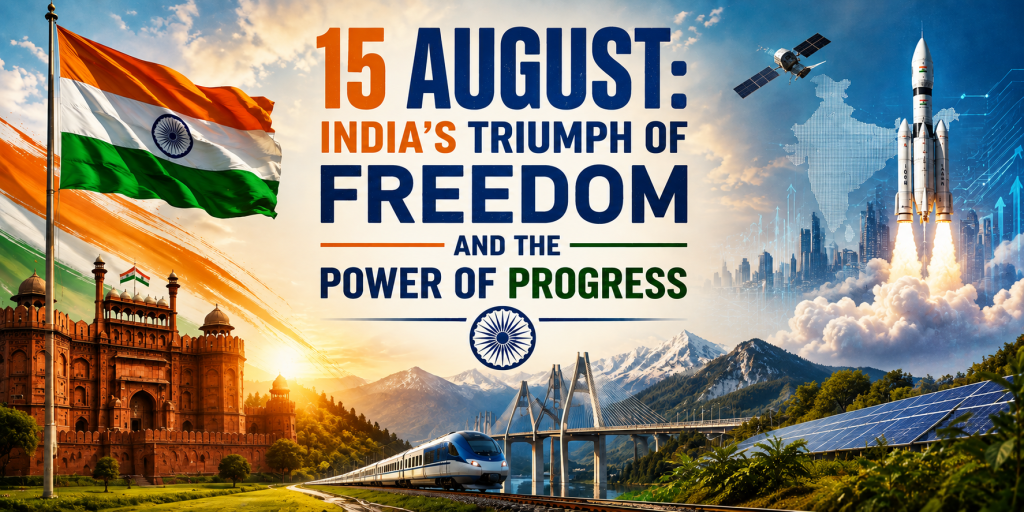
Every year on 15 August, the Indian national flag rises proudly over the Red Fort, carrying with it the memories of countless sacrifices, struggles and dreams that shaped the nation’s journey towards independence. For India, Independence Day is not just a celebration of the end of British colonial rule; it is a reminder of the courage of freedom fighters, the strength of democratic values and the determination of more than a billion people to build a better future.
However, across the border, the As India celebrates 15 August as a symbol of freedom, sacrifice and national progress, some voices across the border observe the day as a ‘Black Day’. In Pakistan, political groups use the occasion to express opposition towards India, particularly over the Kashmir dispute. While this remains a part of a political narrative, it highlights the contrasting ways in which the two countries interpret the legacy of 1947.
The contrast between these two narratives reflects a larger difference in how nations choose to remember history. India’s Independence Day represents the achievement of freedom after a long anti-colonial struggle. It represents the sacrifices of leaders, revolutionaries and ordinary citizens who fought against foreign rule. The tricolour is not merely a symbol of independence; it represents the constitutional values, democratic institutions and aspirations of a diverse nation.
For political voices in Pakistan, however, India’s Independence Day has often become an occasion to express opposition rather than reflection. The use of the “Black Day” narrative by certain organisations is largely connected to their political positions on regional disputes, especially Kashmir. Such narratives attempt to shift attention from the broader story of independence and development towards a continuing cycle of historical and political confrontation.
The Kashmir issue has remained one of the most sensitive and debated aspects of India-Pakistan relations since independence. Over the decades, the region has been at the centre of political disagreements, security challenges and competing narratives from both sides. While Pakistan has frequently highlighted Kashmir as a key issue in its political discourse, India has maintained that Jammu and Kashmir is an integral part of the country. For India, the focus in recent years has increasingly shifted towards development, connectivity, tourism, infrastructure and creating better opportunities for the people of the region. Beyond political debates, the real priority remains ensuring peace, stability and a better future for the people of Kashmir.
But the strength of a nation is not measured by how strongly it opposes another country. It is measured by how effectively it improves the lives of its own citizens. After independence, India faced enormous challenges like poverty, illiteracy, social divisions and economic difficulties. Yet, through decades of democratic participation and institutional development, India has built one of the world’s largest democracies and emerged as a major global power.
From becoming a leader in space exploration to expanding its technology sector, from strengthening its economy to increasing its global influence, India’s journey after independence demonstrates the power of long-term nation-building. The achievements of Indian scientists, entrepreneurs, soldiers, athletes and citizens represent the real meaning of freedom.
The most important question for any independent nation is not how it criticises another country but how it creates opportunities for its own people. True independence means economic progress, scientific advancement, social development and the ability of citizens to shape their own future.
History between India and Pakistan is complex and both nations carry memories of partition, conflict and political disagreements. However, using national days primarily as platforms for hostility cannot change historical realities or improve the lives of ordinary people. The future of any country depends more on innovation, stability and development than on narratives of opposition.
On 15 August, India celebrates not only the freedom achieved in 1947 but also the continuous effort to strengthen its democracy and build a modern nation. The message of Independence Day is not about hatred towards any country; it is about confidence in one’s own journey.
A nation that believes in its progress does not need to define itself through the criticism of others. India’s Independence Day stands as a reminder that the greatest response to negativity is achievement and the strongest statement of freedom is a nation’s ability to rise, grow and create a better future for its people.


