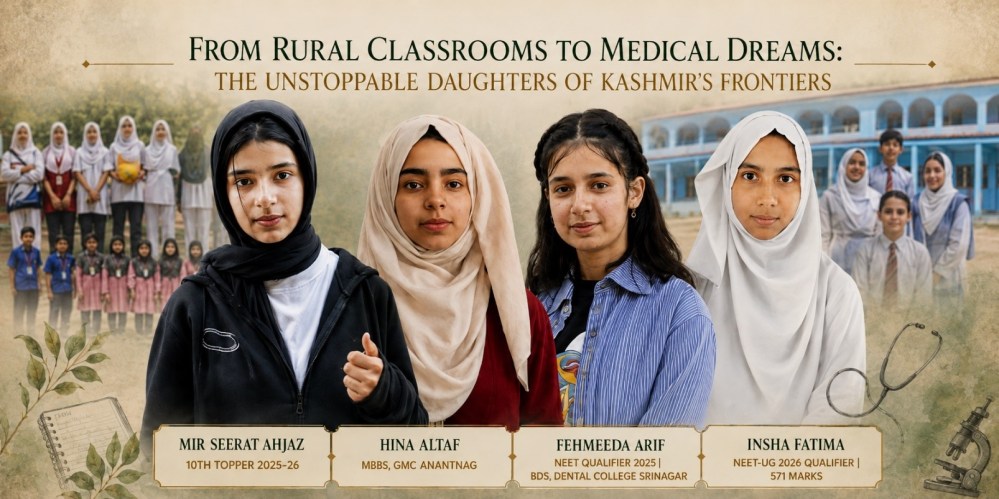
For a girl growing up in a remote part of Kashmir, the road to a medical college can appear to begin very far away. The distance is not measured only in kilometres. It can also be measured in access to specialised coaching, exposure to competitive examinations and the availability of academic guidance. Yet some of the strongest evidence that geography does not have to dictate ambition is emerging from classrooms located in the very areas where educational access has historically been more difficult. In the Karnah–Tangdar region of Kupwara, Army Goodwill School Hajinar has been providing education since 1999. Today, its students include young women who have crossed one of India’s most competitive academic hurdles and moved towards careers in medicine.
Among them is Hina Altaf, an AGS Hajinar student who qualified NEET 2025 and secured admission to MBBS at Government Medical College, Anantnag, according to the school’s official achiever’s record. Another is Fehmeeda Arif, also from AGS Hajinar, who qualified NEET 2025 and secured a place in BDS at Government Dental College, Srinagar. Their achievements are significant not simply because NEET is a demanding examination, but because they emerged from a school serving the Karnah–Tangdar region, a remote part of Kupwara where the educational journey can involve challenges that students in major urban centres may never encounter. The official Jammu and Kashmir Board of Professional Entrance Examinations selection list also records Fehmeeda Arif in the 2025 BDS selection for Government Dental College, Srinagar, providing independent confirmation of the admission.
Their stories also challenge a familiar way of discussing girls from remote areas. Too often, such achievements are presented primarily as stories of hardship, as though the most important thing about a successful rural girl is the difficulty she has overcome. That framing misses the more important point. These students are not defined by their location. They are students who have studied, prepared, competed and earned their place in a demanding professional pathway. Their success should therefore be understood not as an extraordinary escape from their surroundings, but as evidence of what becomes possible when ability is supported by sustained educational opportunity. The question is not whether talent exists in remote Kashmir. It clearly does. The more important question is whether that talent receives enough opportunity to develop.
Army Goodwill School Hajinar’s recent record suggests that the answer can increasingly be yes. Its official achievers list records not only Hina Altaf and Fehmeeda Arif from NEET 2025, but also Faisal Mughal and Zubair Altaf, who qualified NEET 2026. The school also records students gaining exposure to national programmes in science and technology, including Faizan Fayaz, selected for ISRO’s YUVIKA 2026, and Mohina Shabir, selected for the Viksit Bharat Buildathon 2025. These achievements point towards an educational environment in which competitive examinations, innovation and wider exposure are becoming part of the aspirations available to students in a remote region.
For girls in particular, that expansion of opportunity has a significance that extends beyond individual careers. A girl entering medicine or dentistry changes the horizon of what younger students around her can imagine. Her achievement can influence siblings, classmates and families who may begin to see professional education as a realistic pathway for daughters as well as sons. This does not mean that every girl must become a doctor to demonstrate empowerment. The real achievement lies in creating the freedom to choose: medicine, engineering, science, teaching, entrepreneurship, sport or any other field in which her ability can find expression. Education becomes meaningful when a girl’s future is defined by her capabilities and choices rather than by assumptions about where she comes from.
The story is not confined to Hajinar. Army Goodwill School Wayne in Kupwara, for example, lists Insha Fatima among its NEET-UG 2026 achievers, while the school’s activities also include dedicated NEET/JEE coaching sessions. Wayne is another example of how competitive academic preparation is increasingly being brought into the educational environment of students in Kupwara. The significance of such initiatives lies in making competitive examinations feel less distant. A national-level examination should not become an ambition only after a student leaves a remote school for a major city. The preparation and the confidence to attempt it can begin much closer to home.
There is, however, a larger lesson in these stories. We should be careful about describing every successful girl from a rural or frontier school as an “exception”. Doing so can unintentionally suggest that professional achievement is unusual for girls from such communities. The better interpretation is that these students are helping normalise a possibility that should never have been considered extraordinary. A medical college seat does not erase geography, nor does it solve every educational challenge faced by remote communities. But it proves something important: when a capable student receives access to structured education, guidance and opportunity, the distance between a frontier classroom and a professional career can become much smaller.
The daughters of Kashmir’s frontiers do not need their dreams to be romanticised. They need them to be taken seriously. Hina Altaf’s MBBS journey, Fehmeeda Arif’s path to dentistry and Insha Fatima’s NEET-UG 2026 achievement are valuable not because they fit a story of hardship, but because they belong to a larger story of expanding opportunity. A doctor does not begin in a hospital or a medical college. The journey can begin much earlier, with a schoolbag, a teacher, a science textbook and the belief that a girl from a remote classroom has every right to aim for the same future as anyone else. The frontier may shape where she begins, but it does not have to decide where she ends.


