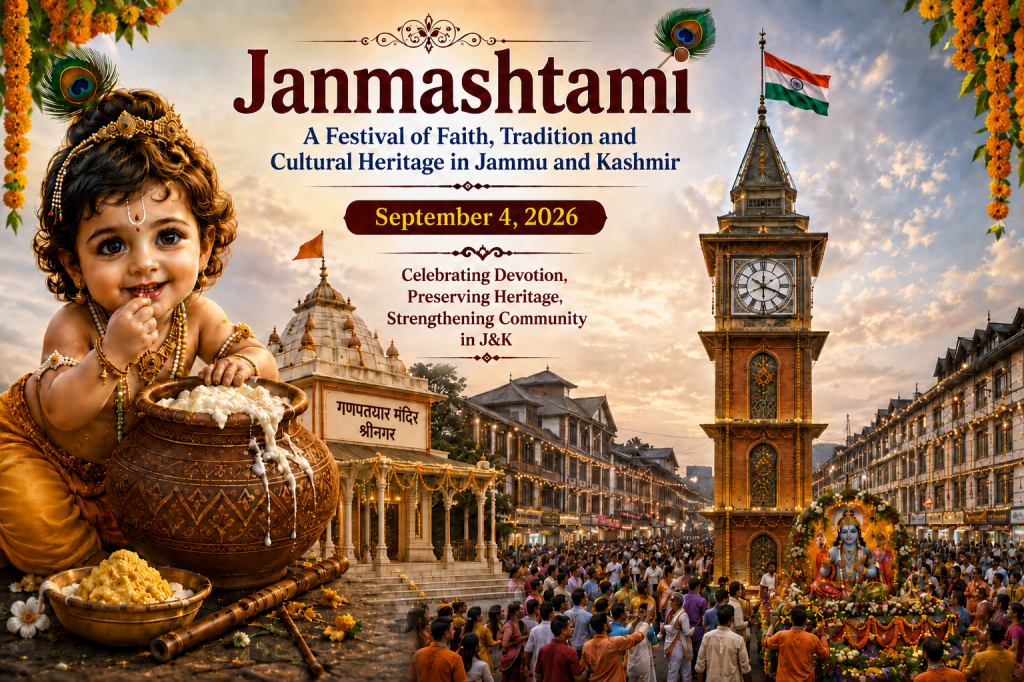
Shri Krishna Janmashtami is one of the major festivals of Hinduism. The festival is celebrated as the birth anniversary of Lord Shri Krishna. According to the Hindu calendar, Janmashtami falls on the Ashtami Tithi of the Krishna Paksha of the month of Bhadrapada. On the occasion of Janmashtami, temples in different areas of Jammu and Srinagar are decorated, and religious and cultural programmes are organised.
Lord Shri Krishna was born in Mathura to Devaki and Vasudeva. At that time, Mathura was ruled by King Kansa. According to religious belief, Kansa was told through a divine prophecy that Devaki’s eighth child would bring an end to his tyranny. Following this, Kansa imprisoned Devaki and Vasudeva.
Shri Krishna was born in the prison at midnight. After his birth, Vasudeva carried the infant Krishna across the Yamuna and reached Gokul, where Nanda and Yashoda raised him. This is why Janmashtami also holds special significance for remembering Krishna’s childhood form and his childhood leelas.
On Janmashtami, devotees observe a fast and offer prayers to Lord Krishna. The child form of Krishna, known as Laddu Gopal, is beautifully decorated in homes and temples. Temples are decorated with flowers, colourful lights and tableaux. At several places, bhajan-kirtan, religious discourses and cultural programmes are also organised.
After a day of prayers and fasting, a special celebration of Krishna’s birth is held at night. Midnight marks the symbolic celebration of the birth of Lord Krishna. During this time, devotees perform aarti, blow conch shells, sing devotional songs and offer prayers. At many places, tableaux based on Krishna’s childhood leelas and various episodes from his life are also prepared. In several traditions, Nandotsav is celebrated on the day following Janmashtami, commemorating the celebrations associated with Krishna’s birth.
In the Jammu region, Janmashtami is also locally known as “Thakuran Da Vrat.” Fasting, temple visits and community religious programmes have traditionally held special significance in Jammu’s religious and cultural traditions on this day.
In Jammu, temple decorations, religious processions and tableaux are among the major attractions associated with Janmashtami celebrations. The religious traditions associated with the historic Raghunath Temple in the city are also an important part of Jammu’s cultural heritage. Local folk traditions also mention the practice of flying kites during the festival.
In Kashmir, Janmashtami has been particularly associated with the religious and cultural traditions of the Kashmiri Pandit community. In recent years, religious events and processions held in Srinagar on the occasion of Janmashtami have brought this tradition into the public sphere once again.
In 2025, a Janmashtami procession was taken out from the Ganpatyar Temple in Srinagar. The procession passed through Habba Kadal and reached Lal Chowk. Devotees participated in bhajan-kirtan and religious programmes. A significant participation of devotees was also witnessed at Lal Chowk in Srinagar on the occasion of Janmashtami.
These events featured tableaux of Lord Krishna, devotional songs, religious chants and cultural participation by children. They also reflect the connection between religious traditions and cultural heritage in Jammu and Kashmir.
Janmashtami in Jammu and Kashmir is not limited to religious rituals alone. Temple decorations, processions, tableaux, bhajan-kirtan and community participation give the festival a broader cultural character.
From the temples of Jammu to Lal Chowk in Srinagar, Janmashtami brings people together in a celebration of faith, cultural heritage and cherished traditions. This year’s festivities once again carry a message of devotion, cultural pride and community participation across Jammu and Kashmir.


