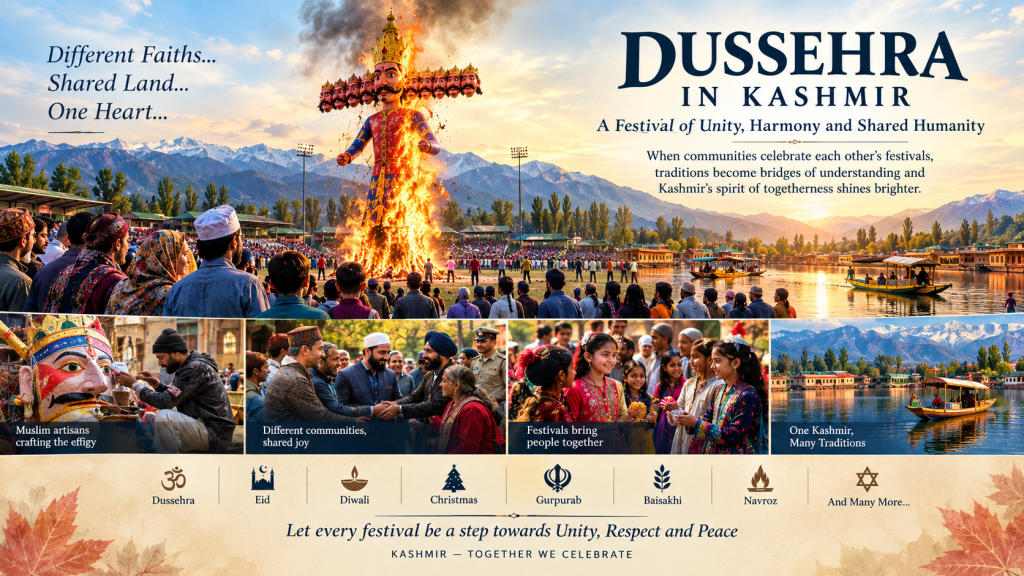
When communities celebrate each other’s festivals, traditions become bridges of understanding and Kashmir’s spirit of togetherness shines brighter.
Kashmir has long been known for its breathtaking landscapes, rich cultural heritage and traditions of communal harmony. Beyond its mountains, gardens and rivers, the Valley’s greatest strength lies in the bonds shared by its people. The celebration of Dussehra in Srinagar, including the burning of the effigies of Ravana at the Sher-e-Kashmir Cricket Stadium on October 20, 2026, offered a meaningful reminder that festivals can bring people together across religious and cultural boundaries.
The event was organised by peoples of Kashmir witnessed the participation of families, members of different communities and security personnel. The preparations also involved local Kashmiri artisans, including Muslim craftsmen, whose skills and contributions helped bring the celebration to life. Their participation reflected an important truth, a festival may belong to a particular religious tradition, but the happiness, goodwill and sense of belonging it creates can be shared by everyone.
Dussehra, also known as Vijayadashami, celebrates the victory of good over evil. The story of Lord Rama’s triumph over Ravana carries a timeless message about truth, righteousness, humility and the responsible use of power. These values are not limited to any one religion or community. They speak to the conscience of every human being and remind us that society becomes stronger when people stand against injustice, hatred and wrongdoing.
In Kashmir, where communities have experienced periods of uncertainty and social division, such celebrations hold particular significance. When people from different backgrounds come together, extend greetings, assist in preparations or simply share the happiness of a festival, they create opportunities for trust and mutual understanding. Small gestures of friendship can help overcome misunderstandings that often grow when communities remain distant from one another.
The involvement of Muslim artisans in preparing Dussehra effigies is a powerful example of Kashmir’s shared cultural life. Their contribution demonstrates that cooperation does not require people to abandon their own religious beliefs or traditions. Instead, it allows them to respect the beliefs of their neighbours while working together for a common purpose. Such participation should be understood not as an exception, but as an expression of the everyday humanity that connects people across Kashmir.
The message of unity becomes even more meaningful when it extends beyond a single occasion. Eid, Diwali, Dussehra, Christmas, Baisakhi, Navroz, Gurpurab and other festivals carry distinct histories and spiritual meanings. Yet they all offer opportunities for reflection, generosity, family togetherness and goodwill. People do not need to follow the same faith to appreciate these values or to share in one another’s happiness.
Kashmir’s younger generation has a particularly important role to play in preserving this spirit. Schools, colleges, neighbourhoods and community organisations can encourage interfaith interactions, cultural programmes and respectful conversations about different traditions. Children who grow up celebrating their neighbours’ happiness are more likely to develop empathy, reject prejudice and build friendships that rise above religious divisions.
At the same time, genuine harmony requires more than attending celebrations. It calls for respect for every community’s religious sentiments, equal dignity for all citizens and the freedom to practise one’s faith peacefully. Unity should never mean uniformity. Kashmir’s cultural richness lies precisely in its diversity, where different traditions can flourish while people remain connected through shared values and responsibilities.
Dussehra in Srinagar therefore offers a message that extends far beyond the festival grounds: celebrate every community’s happiness, respect every religion and stand together as fellow human beings. No festival becomes smaller when another community joins its celebration; its spirit becomes larger through friendship and goodwill.
The future of Kashmir depends not only on preserving its natural beauty but also on nurturing the relationships that make the Valley a home for its diverse communities. Let every festival become an opportunity to open doors, extend hands and strengthen bonds.
The true victory of good over evil is achieved when hatred gives way to love, suspicion gives way to trust, and division gives way to unity. This is the message Kashmir can share with the entire nation: our faiths may differ, but our humanity unites us.


