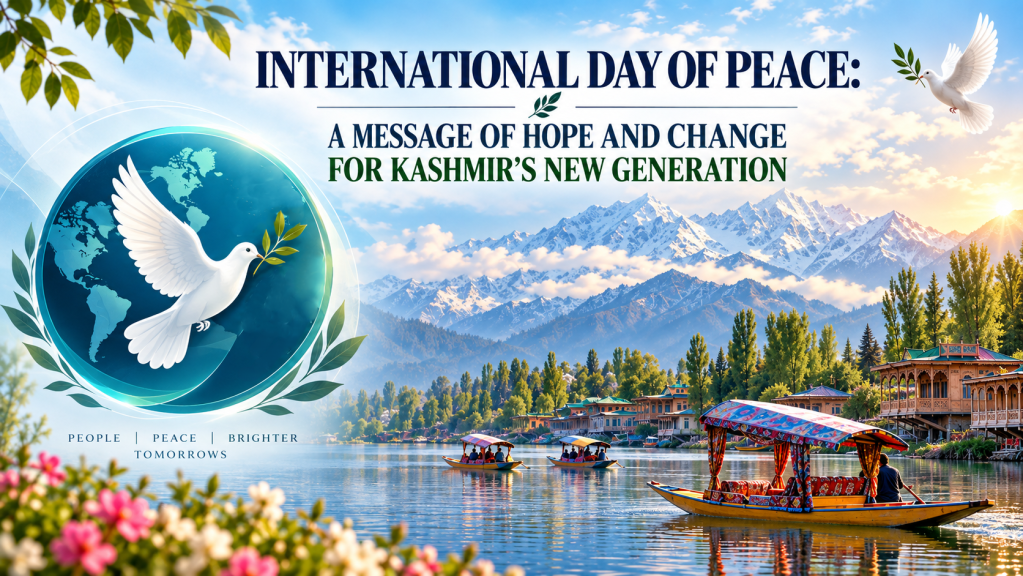
Every year on September 21, the world observes the International Day of Peace. For 2026, the United Nations has chosen the theme “Invest in Peace – For Everyone, Everywhere, Every Day”, conveying the message that peace is created not only through major international agreements but also through small, positive efforts in everyday life. According to the United Nations, peace is not merely the absence of war, but a life connected with security, dignity, opportunity and cooperation.
The International Day of Peace was initiated by the United Nations General Assembly in 1981. In 2001, September 21 was permanently designated as the International Day of Peace and recognised as an occasion for global ceasefire and non-violence. The UN’s message remains as relevant today as ever: peace is not the responsibility of governments and institutions alone. Students, teachers, sportspersons, artists, social workers and ordinary citizens can also contribute to building a peaceful society through their behaviour and actions.
In the context of Kashmir, this message can be viewed in a different light. The Valley’s younger generation is today making its mark in fields such as education, sports, entrepreneurship, tourism, art and technology. These changes are not merely stories of individual success; they also demonstrate that when young people receive opportunities and positive direction, their energy can be transformed into progress for society. Players reaching national-level competitions, students succeeding in competitive examinations, women starting their own businesses and young people exploring new possibilities in remote areas are all part of this change.
The role of tourism in Kashmir’s economy is also an important example of this positive change. According to the Jammu & Kashmir Government’s Economic Survey 2025–26, the Union Territory recorded around 1.78 crore tourist visits in 2025. The survey highlights that tourism contributes nearly 7% to Jammu & Kashmir’s GSDP and provides livelihoods to around 5 lakh people, both directly and indirectly, through sectors such as hospitality, transport, handicrafts and adventure services.
The significance of these figures is not limited to tourism alone. When people in a region move forward in activities such as education, business, tourism and sports, opportunities within society expand. This is why providing young people with positive opportunities is an important part of the broader process of peace and development. A cricket bat, a book, a computer, a camera or a young person’s own small business—each can become a tool for building the future.
Today, social media is also an important part of young people’s lives. In this context, peace is also connected with responsible digital behaviour. Verifying facts before sharing misinformation, avoiding hateful language and communicating respectfully with people who hold different views are steps through which every individual can create a positive environment at their own level. The United Nations also calls upon young people and ordinary citizens to speak out against violence, hatred and discrimination and to verify facts before sharing them.
For the youth of Kashmir, the message of the International Day of Peace is particularly important—because the future is shaped not only by circumstances, but also by the direction chosen by the new generation. Turning education into opportunity, sports into discipline, skills into employment and differences into dialogue are pathways that can take society forward.
Peace should not be a feeling limited to a single day. It should begin in the classroom, on the playing field, at home, at the workplace and through our behaviour within society. Kashmir’s new generation has talent, energy and dreams. If these dreams receive opportunities and positive direction, these young people can become the Valley’s strongest identity in the years to come.
The message of the International Day of Peace is simple—investing in peace is not only about securing today, but also about creating a better tomorrow for future generations. And this change can begin when every individual in the country makes a positive contribution at their own level and becomes a partner in building a prosperous nation.


