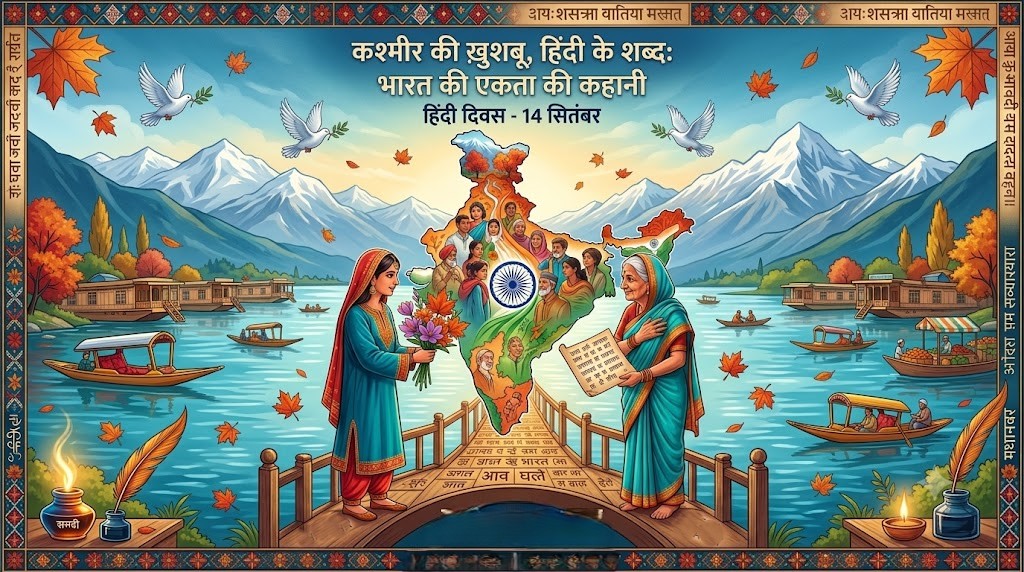
Language is not merely a means of communication; it carries within itself the identity, culture, emotions and history of a society. In a multilingual country like India, every language brings with it its own melody and its own colour. Hindi Diwas, celebrated every year on 14 September, is an occasion to understand and honour this linguistic heritage. On 14 September 1949, the Constituent Assembly adopted Hindi in the Devanagari script as the Official Language of the Union. Today, Hindi is an important link of communication among people from different parts of the country, but its significance becomes even greater when we respect the diversity of all the languages and dialects of India.
Kashmir is a beautiful example of this linguistic diversity. Its identity is shaped not only by Dal Lake, snow-covered mountains, green meadows and chinar trees, but also by its rich linguistic and cultural traditions. The Kashmiri language is an important language that expresses the emotions, folk traditions and social life of the people of the Valley. It is one of the 22 languages included in the Eighth Schedule of the Constitution of India. The fragrance of the soil of Kashmir can be felt in Kashmiri folk songs, sayings, poetry and everyday conversations.
The linguistic world of Kashmir is not limited to Kashmiri alone. Urdu has had an important place in its literature and social life, while Dogri, Hindi and English are also used as mediums of communication and education in different areas. The Jammu and Kashmir Official Languages Act, 2020, designated Hindi, Kashmiri, Dogri, Urdu and English as the official languages of the Union Territory. This arrangement reflects the multilingual and multicultural identity of Jammu and Kashmir.
In such an environment, the role of Hindi can be seen as a connecting language. Tourists, students, employees and other people coming from different states of the country often find Hindi to be a convenient medium of communication when they connect with Kashmir. From markets to tourist destinations and from education to digital platforms, the use of Hindi helps bring people closer to one another. The youth of Kashmir are also acquiring knowledge of Hindi and other languages while remaining connected to their local language and culture, opening new opportunities for education, employment and communication at the national level.
This relationship between Hindi and Kashmiri is not one of competition, but of coexistence and cultural exchange. When a Kashmiri expresses his or her emotions in the mother tongue and conveys them to other parts of the country through Hindi, both local identity and national connection can be seen together. This is the beauty of India—loving one’s own language does not mean creating distance from another language.
In the culture of Kashmir, along with words, music, poetry, folk tales and traditions have also been passed down from generation to generation. The folk expressions found in the Kashmiri language present a picture of the social life of the Valley, while Hindi enables the stories of Kashmir to reach a wider readership across the country. In this way, languages do not merely exchange words; they also provide an opportunity to understand one another’s cultures.
In today’s digital age, this connection has become even stronger. Social media, blogs, online news and digital education have given young people an opportunity to present their language and culture on a wider platform. The youth of Kashmir are taking their achievements, art, tourism, literature and local traditions to the country and the world in Hindi as well as in other languages. This is helping the voice of Kashmir reach an even larger audience.
The message of Hindi Diwas, therefore, should not remain limited to the promotion of Hindi alone. It reminds us that the true strength of India lies in its linguistic diversity. The sweetness of Kashmiri, the widespread reach of Hindi, the literary beauty of Urdu and the rich traditions of Dogri and numerous other Indian languages together complete the cultural picture of India. Article 351 of the Constitution also views the development of Hindi as a means of expressing the elements of India’s composite culture.
From the valleys of Kashmir to every corner of the country, every language writes its own chapter in the story of India. Therefore, the message on Hindi Diwas is simple—take pride in your own language, respect other languages, and let words become bridges between hearts. This is the identity of an India adorned with the fragrance of Kashmir and the words of Hindi, where there are many languages, but the spirit remains one.

 Kashmir RootStock