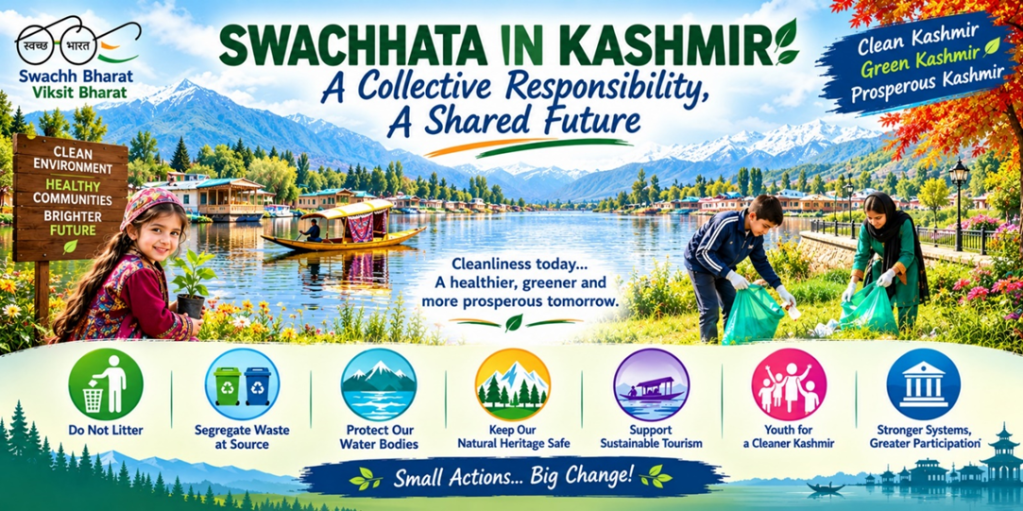
The vision of a clean and developed India begins with the participation of every citizen. The spirit of “Swachhata Mein Sahbhag, Swachh Bharat, Viksit Bharat” goes beyond cleanliness drives and awareness campaigns. It calls for a sustained culture of responsibility, participation and collective action in which every individual recognises their role in creating a cleaner, healthier and more sustainable society. In Kashmir, where the environment, tourism, livelihoods and community life are closely interconnected, this message carries a special significance. Swachhata is not merely about keeping our surroundings clean, it is about protecting the natural wealth of the region and creating an environment in which communities can prosper.
Kashmir is renowned for its lakes, rivers, mountains, forests, meadows and wetlands, which form an integral part of its identity and economy. From Dal Lake and the Jhelum to the picturesque landscapes that attract visitors throughout the year, this natural heritage is both a privilege and a responsibility. Its preservation cannot be left to government agencies alone. Every citizen, visitor, business, institution and community have a role to play in ensuring that Kashmir remains clean, healthy and environmentally sustainable. The beauty of Kashmir can be preserved only when appreciation is accompanied by responsible action.
The true spirit of Swachhata lies in making cleanliness a habit rather than treating it as an occasional activity. A cleanliness drive may remove waste from a particular place on a particular day, but lasting change begins when people stop littering, segregate waste, dispose of it responsibly and encourage others to do the same. For Kashmir, such behavioural change is emergency because of the sensitivity of its ecological environment. Plastic waste and indiscriminate dumping can affect public spaces, landscapes and fragile ecosystems. Preventing waste from entering the environment is therefore, as important as removing it.
Kashmir’s lakes, rivers, streams and wetlands deserve special attention in this collective effort. These water bodies are not only ecological assets but are also closely linked with tourism, livelihoods and the overall well-being of the region. Keeping them clean requires responsible action at every level. Waste should never be allowed to enter water bodies or accumulate along their banks. Communities living around these natural resources can become active partners in their protection, while visitors can contribute by respecting the environmental sensitivity of the destinations they visit. Protecting Kashmir’s water bodies today is an investment in its ecological and economic future.
Cleanliness is also closely connected with tourism. Visitors come to Kashmir to experience its natural beauty, culture and hospitality. Clean streets, well-maintained public spaces and litter-free tourist destinations enhance that experience, while unmanaged waste can undermine it. Tourists can contribute by avoiding littering, using designated waste facilities and reducing unnecessary plastic use. Hotels, restaurants, shopkeepers, transport operators and other tourism stakeholders can strengthen the effort through responsible waste-management practices. In this way, cleanliness becomes an essential part of sustainable tourism and responsible travel.
The participation of young people can give this movement lasting momentum. Kashmir’s youth can become ambassadors of cleanliness and environmental responsibility in schools, colleges, neighbourhoods and villages. Awareness programmes, cleanliness clubs, community volunteering and responsible use of social media can help transform young people into active participants in building a cleaner future. At the same time, government institutions, municipalities, panchayats and local organisations have an important role in providing effective sanitation infrastructure, waste collection and awareness mechanisms. However, infrastructure can deliver lasting results only when supported by public participation and a genuine sense of ownership.
The deeper meaning of “Swachhata Mein Sahbhag” is therefore collective responsibility. A clean street, a litter-free tourist destination, a protected water body and a well-managed neighbourhood are all the result of countless individual choices. When responsible choices become part of everyday life, cleanliness becomes a culture rather than a campaign. Clean surroundings contribute to healthier communities, protected natural resources and sustainable tourism, while sustainable development creates opportunities for future generations.
For Kashmir, the journey towards development must go hand in hand with the protection of its natural and cultural heritage. Every household can practise waste segregation, every citizen can avoid littering, every visitor can respect the destination they visit, and every institution and business can contribute to responsible waste management. These may appear to be small actions, but collectively they can create meaningful change.
A cleaner Kashmir is therefore not merely about cleaner roads or public spaces. It is about protecting its lakes and rivers, preserving its landscapes, strengthening communities and ensuring that future generations inherit the natural wealth that makes the region unique. When cleanliness becomes a shared responsibility and participation becomes a daily habit, Kashmir can move towards a cleaner, healthier and more sustainable future while contributing meaningfully to the larger vision of a Swachh and Viksit Bharat.


