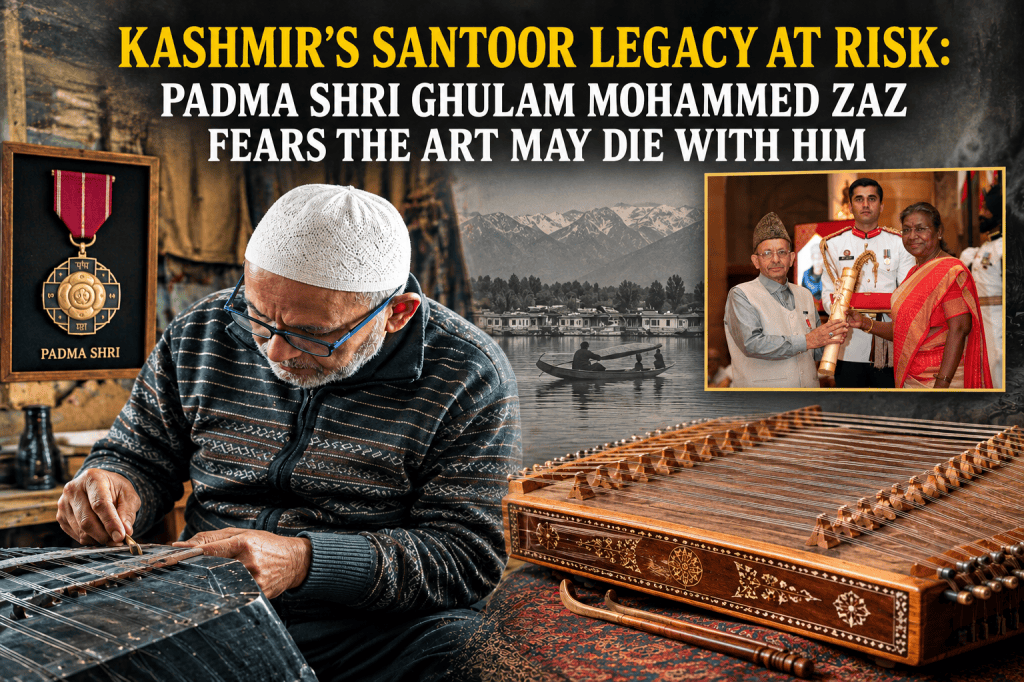
In the narrow lanes of Zaina Kadal in Srinagar, where the rich cultural heritage of Kashmir continues to live through its traditional crafts, Padma Shri awardee Ghulam Mohammed Zaz is keeping an extraordinary musical tradition alive. A master craftsman from a family of traditional instrument makers, Zaz has dedicated decades of his life to making the santoor by hand, preserving a centuries-old art that reflects the soul of Kashmiri music and craftsmanship. However, as modern lifestyles change and demand for traditional instruments declines, he faces a growing challenge: finding someone who can carry his legacy forward.
The santoor, a trapezoid-shaped string instrument played with delicate wooden mallets, holds a special place in Kashmir’s cultural identity. Its melodious notes have long accompanied the region’s classical and traditional musical traditions, creating sounds that evoke the beauty of its mountains, rivers and valleys. Behind every instrument lies the skill, patience and dedication of artisans who transform carefully selected wood into an instrument capable of producing a remarkable range of musical expressions. For Ghulam Mohammed Zaz, this process is not merely a profession but a lifelong commitment to preserving Kashmir’s artistic heritage.
Coming from a family of traditional instrument makers, Zaz inherited knowledge that cannot be acquired simply by reading books or watching demonstrations. The craft demands years of practical experience, an understanding of wood, precise measurements and an exceptionally keen ear for sound. Every stage, from shaping the wooden body to fitting the strings and ensuring the instrument produces the desired tonal quality, requires meticulous attention. Even a minor imperfection can affect the sound, making experience and craftsmanship essential to producing a quality santoor.
Despite his dedication and expertise, Zaz is concerned about the future of his craft. The declining demand for handmade instruments, combined with the absence of an apprentice willing to learn the trade, threatens the continuity of a tradition passed down through generations. As younger people increasingly pursue alternative career opportunities, traditional crafts often struggle to compete with professions that promise more stable incomes and greater financial security. Consequently, the knowledge accumulated over decades risks disappearing with the very artisans who possess it.
The situation highlights a wider challenge facing Kashmir’s traditional handicrafts and cultural practices. While the region is widely recognised for its papier-mâché, carpet weaving, wood carving and other celebrated crafts, the survival of these traditions depends on more than appreciation and recognition. Artisans need sustainable livelihoods, access to markets and opportunities to attract younger generations. Without these essential forms of support, even the most valuable cultural practices can gradually fade away.
Ghulam Mohammed Zaz’s story therefore deserves attention beyond the boundaries of his workshop. His dedication represents the determination of countless traditional artisans who continue working despite economic uncertainty and changing consumer preferences. Recognising his contribution through the Padma Shri honours his exceptional craftsmanship, but such recognition should also translate into meaningful efforts to preserve the knowledge and skills he represents. Awards can bring visibility to an artisan, while sustained institutional support can help ensure that the craft survives.
One possible avenue for promoting the santoor-making tradition is to incorporate it into initiatives such as ‘Gems of Kashmir’, using the platform to highlight the instrument’s cultural significance and the expertise required to manufacture it. Documenting traditional techniques, producing educational videos, organising demonstrations and connecting artisans with music institutions could introduce this craft to wider audiences. Workshops and apprenticeship programmes could encourage young people to learn directly from experienced craftsmen, while financial assistance and improved marketing opportunities could make the profession more attractive.
Schools, cultural organisations and government institutions can also play an important role by organising exhibitions, supporting traditional instrument makers and encouraging musicians to use locally crafted instruments. Digital platforms can further help artisans reach customers beyond Kashmir, creating new opportunities for sales and recognition. Most importantly, young apprentices should be given both practical training and a realistic opportunity to earn a livelihood from their skills.
The future of Kashmir’s santoor-making tradition ultimately depends on whether the knowledge of master craftsmen can be transferred to another generation. Ghulam Mohammed Zaz has spent decades keeping this legacy alive through patience, dedication and extraordinary skill. His greatest achievement would be to see the craft continue long after he has put down his tools. Preserving his art is not simply about saving an old profession; it is about protecting Kashmir’s cultural identity, honouring its living heritage and ensuring that the timeless melody of the santoor continues to resonate for generations to come.


