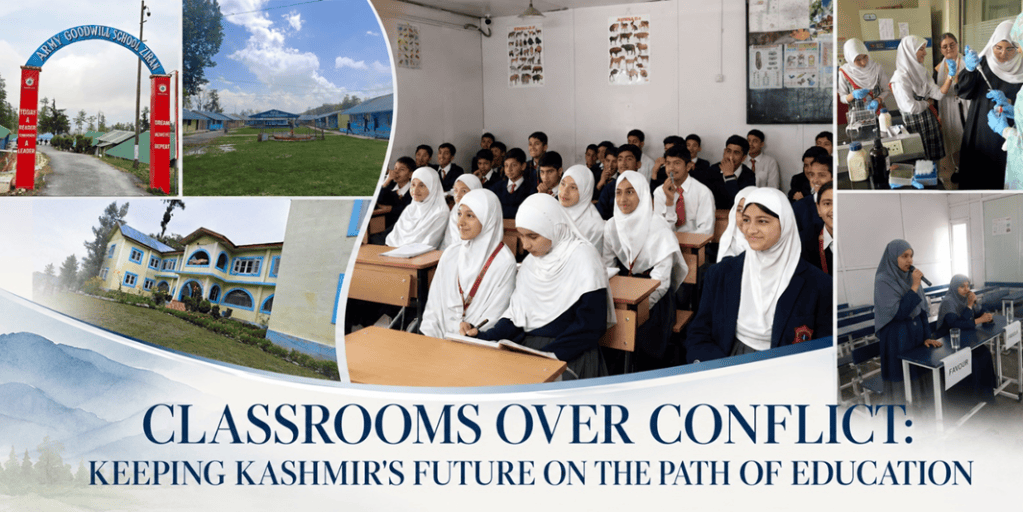
In a remote corner of Kashmir, the beginning of a school day can look remarkably ordinary. A bell rings, students take their seats, notebooks open and a teacher begins the day’s lesson. Yet for children growing up in areas where geography and circumstances can periodically disrupt everyday life, the continuity of that routine carries a significance that goes beyond academics. A classroom represents something that uncertainty cannot easily take away: the opportunity to keep learning and preparing for what comes next. This is particularly relevant in border areas, where access to education has historically been shaped not only by distance but also by difficult terrain and occasional disruption. Army Goodwill Schools have sought to keep that educational pathway open for more than 25 years with a particular focus on remote and border communities.
The importance of educational continuity is easy to underestimate when viewed only through examination results. A school provides a timetable, teachers, peer interaction and a structured environment in which students can continue developing even when circumstances outside the campus are unpredictable. The Army Goodwill Schools network currently comprises 43 schools across Jammu and Kashmir and Ladakh, serving approximately 17,000 students, including around 43 per cent girls. The network’s stated focus has expanded beyond basic access to include technology-enabled and NEP-aligned education, smart classrooms, specialised coaching, career counselling and newer skills such as artificial intelligence and robotics. The larger objective is to ensure that students in remote areas are not left behind simply because of where their schools are located.
AGS Hajinar offers a particularly revealing example of what educational continuity can mean in a difficult setting. The school’s official profile describes its location in the Karnah-Tangdar region as remote, with periods when the area remains cut off from the rest of the Valley and the wider world for months, alongside limited amenities and services and proximity to the international border. Yet the school has continued to build an academic environment in which students participate in competitions, innovation activities and wider educational initiatives. Its official impact profile describes students moving from “learning to doing” and towards transforming their own remote village. The significance lies in that progression: circumstances may restrict movement, but they do not necessarily have to restrict intellectual curiosity or the desire to improve one’s surroundings.
The continuation of learning is also increasingly connected with exposure beyond the school itself. In April 2026, more than 200 students and 40 teachers from 19 Army Goodwill Schools participated in an educational exposure visit to the CSIR-Indian Institute of Integrative Medicine in Srinagar. Students visited laboratories, interacted with scientists, observed ongoing research and learned about emerging careers in science and related fields. They also took part in a hands-on workshop and explored the scientific and commercial significance of medicinal plants. Earlier, 67 students and 17 principals and teachers from 20 AGSs participated in a two-day residential programme at IIT Jammu. Such initiatives matter because they prevent the physical remoteness of a school from becoming an intellectual isolation. A student can live far from a major research centre and still be introduced to the possibilities that exist there.
Resilience in education, however, should not be confused with pretending that disruption does not exist. It is about the ability to return to learning, adapt to changing circumstances and continue working towards long-term goals. That process requires teachers who can maintain academic momentum, identify students who need additional support and help young people remain connected to opportunities beyond their immediate environment. It also requires institutions to keep improving the quality of learning rather than treating difficult geography as a reason for lower expectations. The current AGS model places emphasis on teacher training, digital learning, career counselling and specialised academic support, reflecting an understanding that students in remote areas should be prepared for the same competitive and rapidly changing world as students elsewhere.
The role of the teacher becomes especially important in such an environment. A lesson may last forty minutes, but the message behind it can last much longer. When a teacher encourages a student to prepare for a competition, explore science, participate in a debate or consider a career previously unfamiliar to them, the classroom becomes a bridge between the present and the future. Recent activities at AGS Hajinar illustrate this wider approach: in August 2026, students participated in an inter-AGS online debate competition, with the school securing first place in both junior and senior categories and students receiving Best Speaker awards. Even a virtual competition can therefore connect students in a remote border school with peers beyond their immediate surroundings.
Ultimately, education cannot prevent every disruption that may affect a community. Nor should a school be expected to carry responsibilities beyond its purpose. Its strength lies somewhere more fundamental: it keeps the process of preparing for tomorrow alive. A difficult journey may delay a student; uncertainty may interrupt a routine; geography may make access harder. But every lesson that continues, every examination attempted, every new skill learned and every aspiration that survives difficult circumstances represents a refusal to allow disruption to become a permanent definition of the future. The most powerful answer to a disrupted future is therefore not a slogan, but continuity: keep the classroom open, keep the questions coming and keep preparing the next generation for the world beyond the conflict.


