A region’s progress is not measured merely by the roads it builds, the buildings it raises or the investments it attracts; it is equally reflected in the cleanliness of its streets, the health of its communities and the responsibility its people demonstrate towards their surroundings. In this regard, Kashmir has another reason to take pride. The national recognition earned by Shopian and Budgam at the Swachh Survekshan Awards 2025–26 marks an encouraging step towards cleaner towns, better sanitation and a more sustainable future.
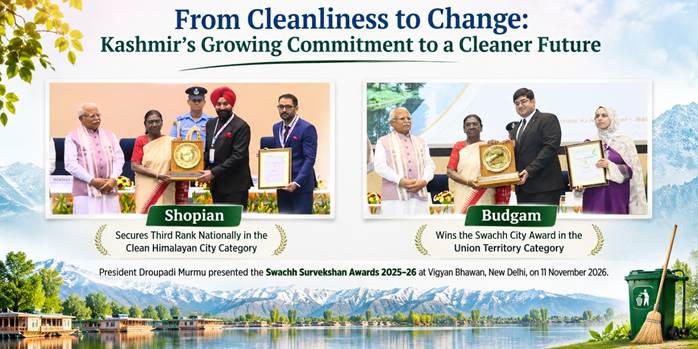
In a significant achievement, Shopian secured the third position nationally in the Clean Himalayan City category, placing the south Kashmir district among the country’s leading performers in this category. The recognition acknowledges its efforts towards maintaining cleanliness and improving sanitation standards. For a Himalayan district, where environmental preservation and responsible management of public spaces are particularly important, this achievement carries significance beyond a national ranking. It demonstrates the potential of local administration and communities to contribute meaningfully to India’s broader cleanliness mission.
Adding to this achievement, Budgam received the Swachh City Award in the Union Territory category, recognising its initiatives in sanitation, solid waste management and public participation. The award was presented by President Droupadi Murmu at a ceremony held at Vigyan Bhawan, New Delhi, on 11 November 2026. Deputy Commissioner Budgam, Jatin Kishore, and Chief Executive Officer, Municipal Council Budgam, Oruja Mohi-ud-Din, received the award on behalf of the district. The recognition reflects the coordinated efforts of the Municipal Council Budgam, the Housing and Urban Development Department, the Directorate of Urban Local Bodies Kashmir and the District Administration.
Behind these achievements lies the importance of consistent civic initiatives. Improved door-to-door waste collection, segregation of waste at source and strengthened solid waste management are essential steps towards maintaining cleaner neighbourhoods. Equally important is the growing emphasis on public participation, encouraging residents to recognise that cleanliness cannot remain solely an administrative responsibility. Every household that segregates its waste, every shopkeeper who maintains a clean frontage and every citizen who avoids littering contributes to a healthier environment.
The significance of these achievements extends beyond municipal boundaries. In a region like Kashmir, where natural beauty is closely connected with its identity, environmental responsibility is particularly important. Clean streets, properly managed waste and hygienic public spaces contribute not only to better public health but also to tourism, local economic activity and the overall quality of life. Sustainable cleanliness practices can help preserve the Valley’s natural surroundings while creating more welcoming urban spaces for residents and visitors alike.
However, the real strength behind any cleanliness initiative lies in the people who make it possible. Sanitation workers, municipal employees, administrative officials and local residents all play indispensable roles. Their collective efforts deserve recognition because lasting change is achieved not through occasional campaigns but through consistent action and shared responsibility. The achievements of Shopian and Budgam can therefore serve as encouraging examples for other districts and urban local bodies across Jammu and Kashmir.
These awards should be viewed not as the culmination of the cleanliness journey but as milestones towards higher standards of civic responsibility and environmental sustainability. The challenge ahead is to maintain this momentum, strengthen municipal infrastructure and extend responsible waste management practices to more communities.
From Shopian’s national ranking to Budgam’s recognition, Kashmir’s achievements send a positive message: meaningful progress begins when governance meets public participation. A cleaner Kashmir is not simply an aspiration; it is a collective responsibility and a vision worth working towards.


