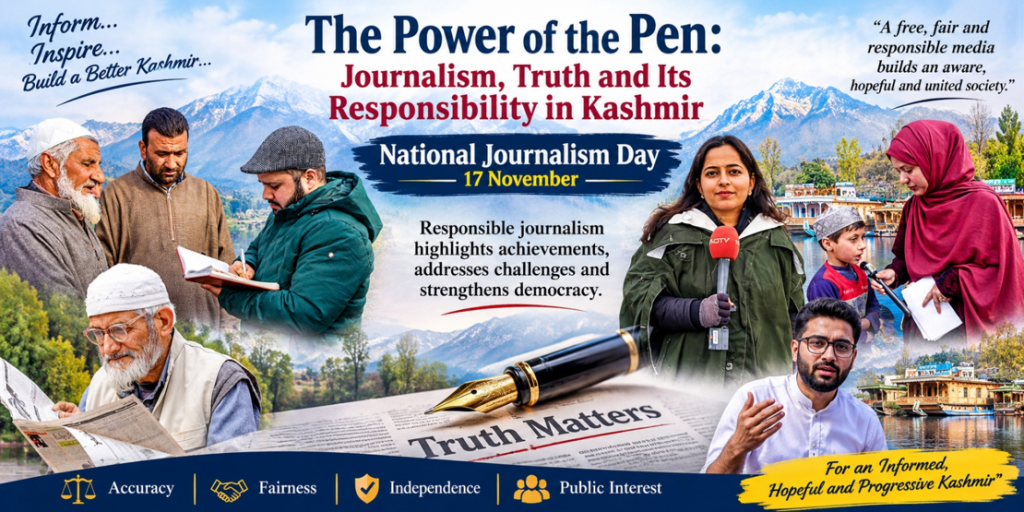
Journalism is much more than reporting events or sharing information. It is the voice of society, a bridge between people and institutions and a powerful means of bringing important issues into the public eye. In a place like Kashmir, where every day brings stories of hope, challenges, achievements and change, the role of responsible journalism becomes even more significant. Observed locally on 17 November as National Journalism Day, the occasion reminds us to recognise the contribution of journalists and reflect on the responsibilities that come with this profession.
Kashmir has a rich journalistic history. From the early days of newspapers and print journalism to today’s television channels, news portals and digital platforms, the media landscape has changed considerably. For generations, newspapers have helped people understand developments around them, raise their concerns and remain connected with the wider world. Even today, many people begin their morning by reading a newspaper, looking for news that affects their families, communities and daily lives.
Journalists in Kashmir work across diverse and often challenging environments. From busy city streets to remote mountain villages, from border areas to educational institutions, they bring stories from different corners of the region to public attention. Their work is not limited to politics or major events. Reports on education, healthcare, tourism, agriculture, sports, culture and local development are equally important. A story about a village road, a student’s achievement, a successful young entrepreneur or a community initiative can draw attention to positive change and inspire others.
However, journalism carries a responsibility that goes beyond simply being the first to publish a story. Accuracy, fairness, independence and sensitivity must remain its guiding principles. In the present digital age, information travels within seconds, but not every message circulating online is true. An unverified photograph, misleading headline or incomplete report can create confusion and harm individuals and communities. Therefore, journalists must verify facts, examine different perspectives and present information in a balanced manner. The credibility of a journalist is built not by the speed of reporting, but by the trust that people place in their work.
Social media has opened new opportunities for journalism. It has made information more accessible and allowed local voices to reach wider audiences. At the same time, it has increased the responsibility of media professionals to distinguish facts from rumours. Technology may change the way news is delivered, but the basic values of journalism must never change. Truth, honesty and public interest should always remain at the centre of every report.
Equally important is the need to highlight the positive stories of Kashmir. The achievements of students, the dedication of teachers, the creativity of artisans, the courage of sportspersons and the efforts of ordinary citizens deserve meaningful space in the media. Such stories reflect the aspirations of society and encourage the younger generation to work towards a better future. Responsible journalism does not ignore challenges; rather, it presents them with facts while also recognising efforts, solutions and progress.
On this National Journalism Day, let us acknowledge the dedication of journalists who work to keep society informed. Let us also remember those who have faced difficulties and risks while carrying out their professional duties. A free, fair and responsible media is essential for an aware and confident society. In Kashmir, where every voice and every story have its own importance, journalism must continue to serve as a force for truth, understanding and positive change. The power of the pen lies not merely in what it writes, but in the trust, awareness and hope it creates among people.


