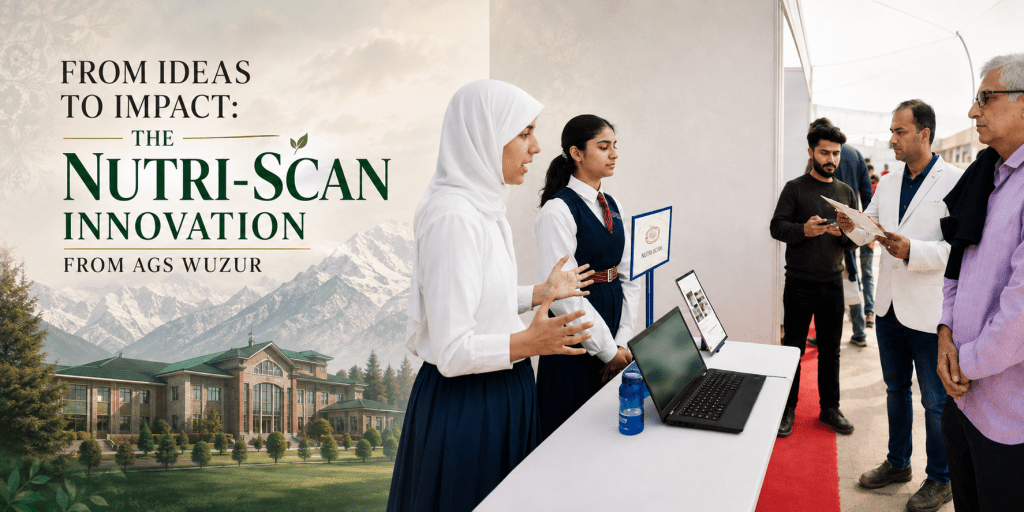
In the quiet surroundings of Wangund village near Qazigund in Anantnag, where the landscape of south Kashmir meets a growing network of educational institutions, a group of students has proven that innovation doesn’t always start in a high-tech laboratory. Sometimes it starts with a simple question about a common problem. Students from Army Goodwill School (AGS), Wuzur developed Nutri-Scan, an app that instantly scans packaged food labels and provides health alerts and multilingual voice support to make the information easier to understand. The project is emerging as a heartening example of how learning at the school level can be utilised to lead to practical solutions.
For the last 28+ years, AGS Wuzur, Qazigund, Wangund has been providing education. The school was set up under the larger Army Goodwill Schools scheme to provide quality education opportunities in Jammu and Kashmir. It combines academic learning with activities that develop creativity, confidence and practical skills. Particular note should be made of the recent emphasis on innovation, with an Innovation Club providing students a chance to work on ideas outside of the usual curriculum, to collaborate and experiment.
Nutri-Scan focuses on a problem most consumers have, but don’t pay attention to. Packaged food products are filled with information on ingredients and nutritional values, but it is not always an easy stroll in the park to understand that information. Small print, unfamiliar terminology and multiple nutritional parameters can make food labels hard to read, particularly for people who are not comfortable with technical or English-heavy information. Nutri-Scan is trying to make this process faster and more accessible, by allowing users to scan a food label and receive simplified information.
One of the project’s standout features is its combination of food-label scanning, health alerts and multilingual voice support. The application aims to present relevant information in a more accessible format, eliminating the need for users to manually read and interpret every detail on a package. The voice element is especially relevant in Kashmir’s multilingual setting, where tech that enables communication across a single language could help make electronic devices more accessible. So the project is more than simply scanning a product, it is about trying to bridge technology with a common consumer need.
The concept also highlights an important change in how students can interact with education. Students at AGS Wuzur have tried to use technology to solve a real problem, rather than just something found in textbooks or computer labs. The school’s Innovation Club has been involved in innovation, design and entrepreneurship programs previously, exposing students to design thinking and problem-solving approaches. In 2026, the Nutri-Scan prototype was also demonstrated by the school during an educational exposure visit to IIT Jammu.
This achievement becomes all the more significant when considering the larger contribution of Army Goodwill Schools across Jammu and Kashmir and Ladakh. The Indian Army has set up 43 AGSs in the region in the last over 25 years and the network has provided quality education especially in the remote and border areas. The AGS network says there are now around 17,000 students in these schools, with around 43 per cent girls studying in them. The initiative has progressively added technology enabled learning, smart classrooms, career counselling and exposure to emerging fields such as artificial intelligence and robotics.
In Kashmir, the worth of such educational opportunities goes beyond the exam results. Students who have studied at AGS Wuzur have gone on to study medicine, become entrepreneurs and pursue other professional careers, demonstrating the many different paths that education can open up. Its students have achieved good ranks in competitive examinations and young entrepreneurs in its alumni.
So Nutri-Scan is important not only because students have come up with an application, but because of the mindset behind it. It shows curiosity, experimentation and the confidence to ask if there is another way to solve an ordinary problem. The project has a bigger message from a classroom in south Kashmir, when students are given the right environment, guidance and opportunities, innovation is possible from anywhere and Kashmiri youth has an abundance of ideas waiting to be tapped.


