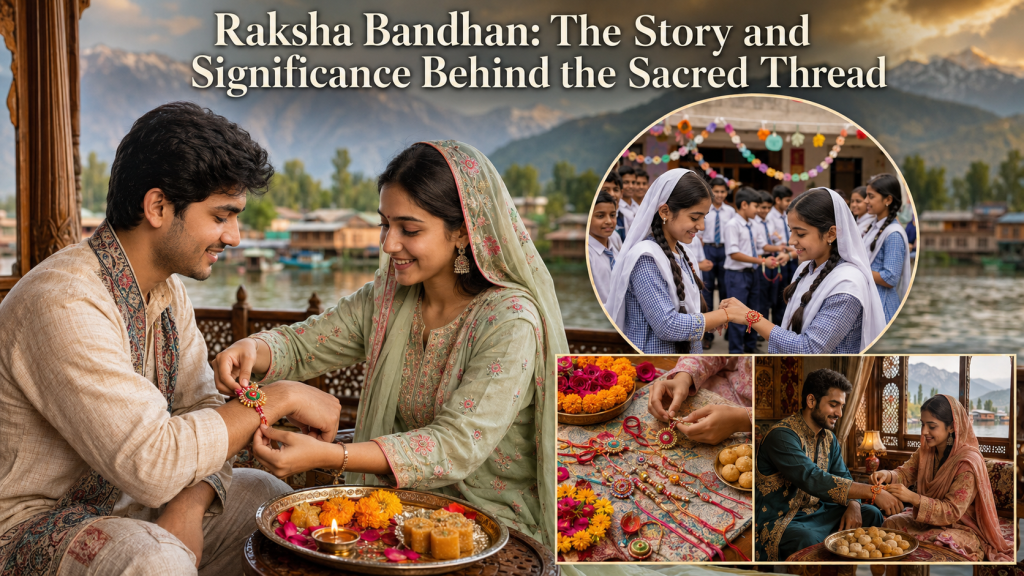
Among the major festivals of India, Raksha Bandhan holds a special place. Celebrated on the full moon day of the month of Sawan, this festival is considered a symbol of the love, trust, and responsibility that brothers and sisters have toward each other. On this day, a sister ties a Rakhi around her brother’s wrist, and the brother takes a pledge to protect her, respect her, and stand by her in every situation.
There is no definite historical year recorded for the beginning of Raksha Bandhan. However, its roots are believed to be connected with the ancient tradition of Raksha Sutra. In ancient Indian traditions, a sacred thread was tied with the wish for protection, well-being, and auspiciousness. Over time, this tradition became associated with the relationship between brothers and sisters, and Rakhi became its primary symbol. Raksha Bandhan is celebrated on the full moon day of the month of Sawan according to the Hindu calendar, which is also known as Shravan Purnima. Since it is based on the lunar calendar, its date according to the English calendar changes every year.
Among the most famous religious beliefs associated with Raksha Bandhan is the story of Lord Krishna and Draupadi. According to popular belief, when Lord Krishna injured his finger, Draupadi tore a piece of her sari and tied it around his finger. After this, Lord Krishna pledged to protect Draupadi. Although this story is not evidence of the historical beginning of Raksha Bandhan, it represents the feeling of affection, trust, and protection between brothers and sisters.
Another ancient belief is associated with Indra and Indrani. According to religious tradition, during the battle between the gods and demons, Indrani tied a sacred Raksha Sutra around Indra’s hand, wishing for his safety and victory. The story of King Bali and Goddess Lakshmi is also associated with Raksha Bandhan. According to popular belief, Goddess Lakshmi tied a Raksha Sutra to King Bali and made him her brother. This story reflects the idea that the bond of Rakhi is not limited to brothers and sisters related by birth, but can also be formed through trust, affection, and emotions.
Raksha Bandhan is celebrated with different traditions in various parts of India. In North India, it is mainly celebrated as a festival of the bond between brothers and sisters. In Maharashtra, the same full moon day is associated with the tradition of Narali Purnima, while in other parts of the country, different religious and cultural traditions connected with Shravan Purnima can be seen. These regional traditions show that in India’s diverse culture, the same festival is celebrated in different forms, but its core essence remains connected with love, protection, and strengthening relationships.
In Jammu and Kashmir, the significance of Raksha Bandhan becomes even more emotional. In a region of mountains, villages, border areas, and a strong military presence, the word ‘protection’ has a meaning that is not limited only to family relationships. In many parts of Jammu and Kashmir, people express their respect and gratitude toward Indian Army soldiers by sending them Rakhis or celebrating Raksha Bandhan with them. Especially in border and difficult-to-reach areas, soldiers often remain away from their families during festivals.
When sisters at home tie Rakhis around their brothers’ wrists, many soldiers are carrying out the responsibility of protecting the country in snow-covered mountains, difficult border areas, and challenging conditions. For them, a Rakhi sent by a schoolgirl, a local woman, or any citizen is not merely a thread, but becomes a symbol of the love, respect, trust, and gratitude of the people of the country.
This form of Raksha Bandhan in Jammu and Kashmir brings forward a larger message. A brother takes a pledge to protect his sister, while soldiers deployed along the borders carry the responsibility of protecting the families of millions of people across the country. This is why Raksha Bandhan celebrated with soldiers goes beyond a family relationship and becomes a symbol of emotional bonding between citizens and those who protect the country. On Raksha Bandhan, sisters, schoolgirls, social organizations, and various communities send Rakhis to soldiers. Special programmes are also organized at many places to honour them.
Many soldiers are unable to reach their homes on the day of the festival. In such a situation, a Rakhi tied by a girl or a citizen not only reminds them of their family but also gives them the feeling that the country remembers their sacrifice and service. In this way, the meaning of Raksha Bandhan extends beyond the family and reaches the nation. Rakhi becomes a medium of respect, trust, and emotional unity between citizens and the soldiers engaged in protecting the country.
Raksha Bandhan is not merely a thread tied around the wrist. It is a symbol of love, trust, respect, responsibility, and the pledge to stand by one another. From the ancient tradition of Raksha Sutra to the modern celebration of today, Raksha Bandhan has changed its form with time, but its core essence remains intact. When connected with soldiers, the message of ‘protection’ extends beyond the family and reaches the nation.
A Rakhi may be a small thread, but the emotions attached to it are immense. It reminds us that protection is not merely a promise, but a responsibility connected with trust, sacrifice, respect, and love. This enduring message is what makes Raksha Bandhan one of the most emotional and significant festivals of Indian culture.


