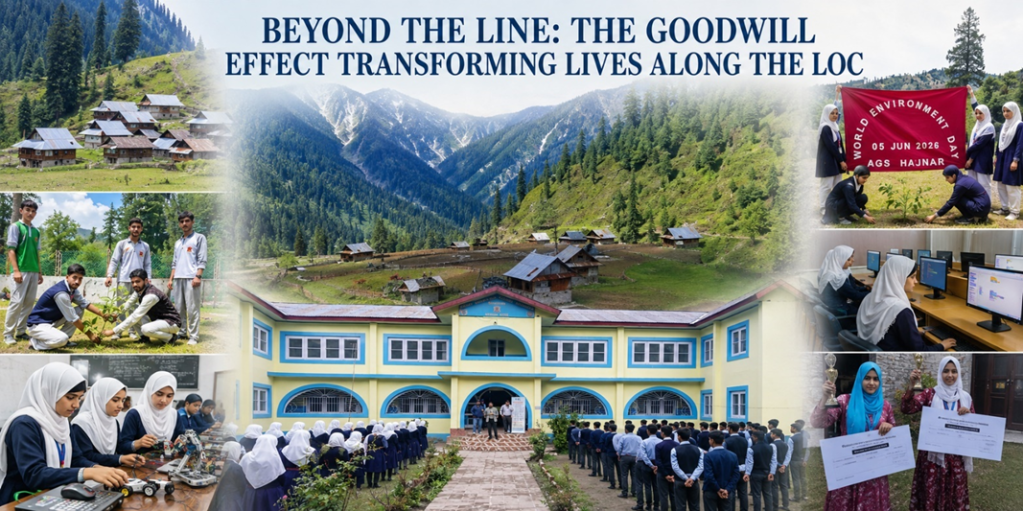
For the communities living along the Line of Control, the story of life is often told in the language of borders, security and geography. Yet beyond those familiar headlines, another story is unfolding quietly in villages where children attend school, young people look for opportunity and families strive to build more secure futures. In these areas, opportunities for education and beyond can be meaningful well beyond the classroom. One aspect of this effort has been the establishment of the Army Goodwill Schools (AGS) network as part of the broader Sadbhavana initiative of the Indian Army. The network has 43 schools in Jammu and Kashmir and Ladakh with about 17,000 students including about 43 per cent girls.
Goodwill is best demonstrated when it becomes a way of life. Not just something you do once in a while to help someone. In remote and border areas, the problem is often not lack of ambition but the gap between aspiration and access an educational Institution with structured learning, tech, career guidance and opportunities for higher education can help close that gap. The AGS network focuses on smart classes, specialised coaching, career counselling, digital learning and new age skills like artificial intelligence and robotics. Its stated mission is to develop students as future global leaders and agents of change.
The effect of such an institution can be much greater than examination results. Consider AGS Hajinar in Tangdar, a remote location that the school’s own impact profile states are cut off from the rest of the Valley for several months each year, with limited amenities and services. But its students have been involved in projects that move learning from the textbook to real-world problem solving and community engagement. The official AGS impact stories feature student-led initiatives at Hajinar as a process of moving from “learning to doing” and ultimately transforming their remote village. This progression is important because it changes the role of a school from a place where students are receiving education to a place where young people start to apply what they learn to the world around them.
The same principle is also seen in the increasing exposure available to students. In April 2026, over 200 students and 40 teachers from 19 Army Goodwill Schools visited the CSIR-Indian Institute of Integrative Medicine, Srinagar. Students visited laboratories, met scientists, saw current research and learned about new careers in science. They also learned about medicinal plants and participated in hands-on activities. Earlier, 67 students and 17 principals and teachers from 20 AGSs had participated in two-day residential program at IIT Jammu. Exposure can be particularly meaningful for students from border and remote areas because it makes institutions, professions and possibilities that may have once seemed distant more tangible.
But the “Goodwill Effect” cannot be measured only by the opportunities a school gives directly. The larger significance is what those opportunities can ignite in a community. A student might become interested in science and influence a younger sibling. When a girl gains confidence in the classroom, she can shift what girls in her community believe they are capable of achieving. “When a student discovers a career path, it can open a whole new opportunity for a family that may not have had much exposure to it before.” The change is incremental and often hard to measure but that’s exactly why access to education is important. A school can be a point from which information, confidence and aspiration radiate out into the community.
The growing focus on technology, skills and career guidance also has a wider lesson. Development in border areas cannot be concentrated only on physical connectivity or infrastructure. And human capability is also important. Technology-enabled, NEP-aligned education, career counselling and specialised coaching and pathways to higher education are now at the centre of the AGS framework. The declared focus is especially on remote areas and on ensuring equal opportunities to socio-economically disadvantaged groups, women and persons with disabilities. It acknowledges that sustainable community development requires people to have the knowledge and skills to take advantage of wider economic and educational opportunities.
Finally, one does not have to define a border community by its distance from the mainstream. It needs ways for its young people to be fully involved in it. Goodwill’s lasting value is not in creating dependence but in creating capability: the ability to learn, compete, work, innovate and make informed choices about the future. Perhaps the most significant change along the Line of Control is also the most silent: a child who starts to view education as a gateway to opportunity, a family who begins to envision new possibilities and a community whose next generation is better prepared to craft its own future. The most durable goodwill is not what is given to a community for a moment but what enables its people to build a better tomorrow for themselves.


